"When dawn spreads its paintbrush on the plain, spilling purple... ," Sons of the Pioneers theme for TV show "Wagon Train." Dawn on the mythic Santa Fe Trail, New Mexico, looking toward Raton from Cimarron. -- Clarkphoto. A curmudgeon artist's musings melding metaphors and journalism, for readers in more than 150 countries.

Saturday, December 31, 2016

Spurts, in the pages and books of 2016

Spurts. I read in spurts. Fall was not kind, immersed in teaching a new class and the depression of the election. I have to read, or my brain, my creative,  seems to die--which was the case in reading and blogging during the drought of autumn.
But it picked up in December as the year ended, bringing a total of 23 books for the year, plus five partial and unfinished.  (All nonfiction except f=fiction; e=poet essays; p=photo/essays.)
It's obvious that I prefer non-fiction, hey, I'm a journalist...concentrating on themes that have to with nature, wildlife, history  and the West. There are a lot of "self-help" books having to do with art and attitude--these seem to be increasing with my age. Some partials will be completed, and others won't.
I skip around a lot when I read, and always have more than one book going--ADD, probably.

December: Usually, I write about each of these books, and may later. You can find articles on the earlier books on the blog starting backward in July.
  • The War of Art, Pressfield
  • Tribe, Junger
  • Upstream, Oliver-e
  • American Serengeti, Flores
  • An Obvious Fact, Johnson-f
  • Unbranded, Masters-p
  • Partial--A Different Drum, Peck
  • Partial--What the Best College Teachers Do, Bain
  • Partial--The Next Species, Tennesen 
July was the last reading month:
  • Happy Potter and the Cursed Child, Rowling-f
  • The Timekeeper, Albom-f 
  • Yellow House Mauve Sky-art/fable
First half of year:
  • The Blessing Way, Hillerman (reread)
  • Art and Fear, Bayless/Orland (reread) 
  • American Ghost, Nordhaus
  • Deep South, Theroux
  • Laguna Pueblo, Marmon/Corbett-pe
  • The Highwayman, Johnson-f
  • The Great Spring, Goldberg
  • The Soul of Octopus, Montgomery
  • Coyote America, Flores
  • One Man's Wilderness, Keith/Proenneke 
  • Woe to the Land Shadowing, Shuttlesworth-poetry
  • The Beekeeper's Lament, Nordhaus
  • Childhood's End, Clarke--sf
  • Finding Abbey, Prentiss
  • Partial--Reclaiming Conversation, Turkle
  • Partial--Cimarron Crucible, Fretwell-f
  • Partial--Across the Cimarron, Wilson-f 
  • Partial--Broken Open, Lesser
  • Partial--The Western Cattle Trail, Krasingers


New Year's Eve spirits

Trying to blog about the books read this year...thankful for Grofe's Grand Canyon Suite on vinyl to provoke the spirits.

Icon of Oklahoma's years

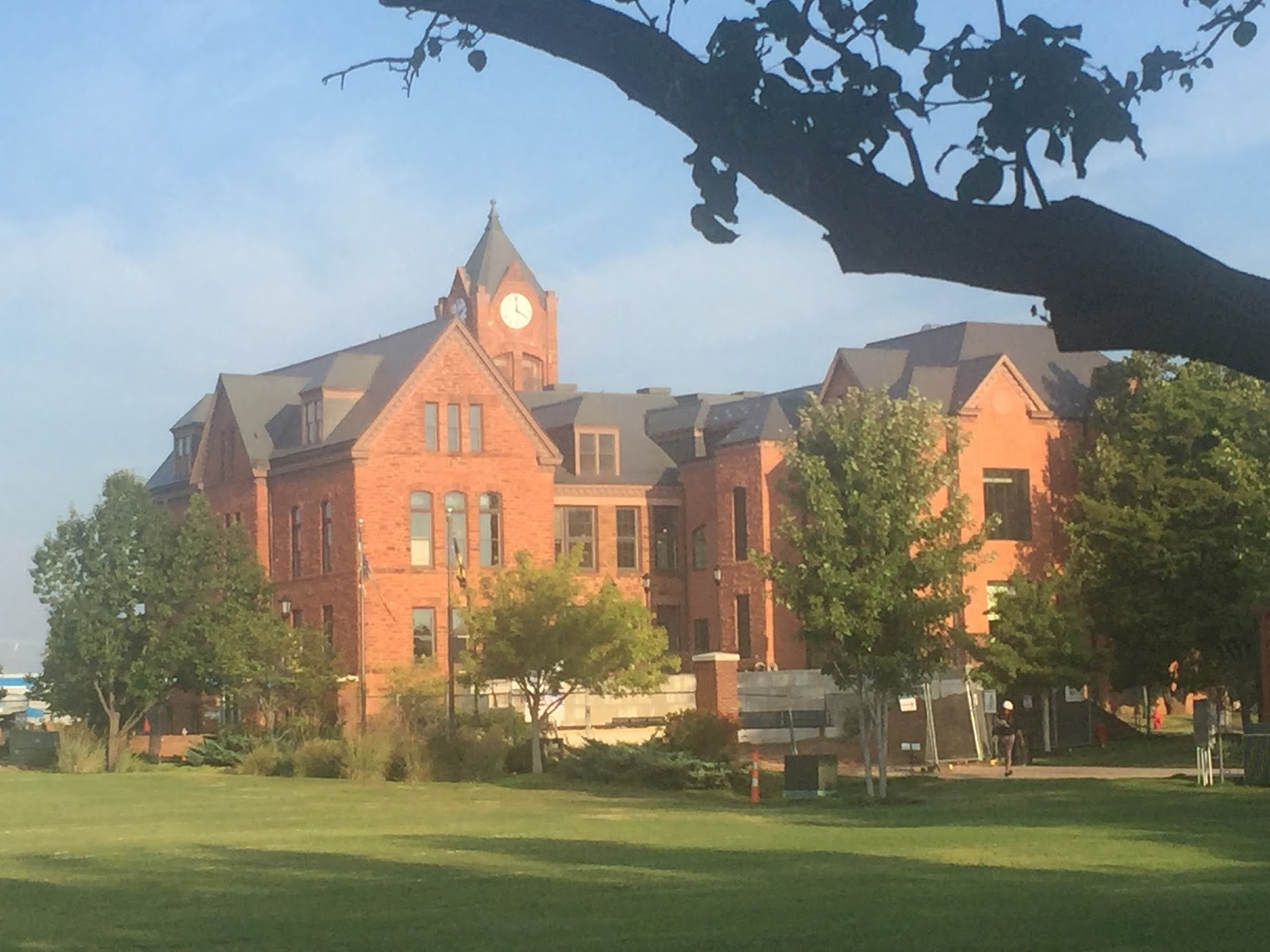
As 2016 ends, another January, and semester,  is about to begin around an Oklahoma icon, now 124 years old.
1892
Classes began in Old North at Territorial Normal School in January, 1893, in Edmond, Oklahoma Territory. Construction began in summer 1892. The school was founded in December, 1890, and first classes began in November, 1891. 
It's the oldest public institution of higher ed in Oklahoma, and Old North is the oldest building still standing from the Territorial Legislature. In 1971 it was added to  the National Register of Historic Places. Thousands of teachers and other grads are alums. If you tell someone you work there, they either attended, or know someone who did.
1913-14
The college--now University of Central Oklahoma--has had many names as it has grown and changed, and most people just call it "Central."
The building has been vacant for safety reasons for years, though opening is scheduled soon. It's taken many more years, and dollars to renovate and restore her than the actual construction did. 
I had classes inside as an undergraduate long ago, and the clock tower has been a part of my almost daily view and life for more than a quarter century now. Old North faces west, but I my building is east of her, so I've watched the seasons change with the morning sun on her east face.
My watercolor card was inspired by the winter scene from 100 years ago. Black and white photos from the UCO archives. Others are mine.

Friday, December 30, 2016

Sanctuary from time

El Santuario de Chimayó -- 9 by 12 watercolor
Time seems to stand still in certain places. For me, one of those is El Santuario de Chimayó on the high road to Taos in New Mexico.
While the church turned 200 this year, visiting it is like going back in time, to medieval faith and thought. 
The shrine, a National Historic Landmark, is famous as a pilgrimage site and its miraculous healing dirt, referred to as the "Lourdes of the Southwest." More than 300,000 visit it every year, many as just tourists, but most as Catholics professing faith and seeking healing.
About  30,000 people from all over the world make pilgrimages during Holy Week. Walking is traditional. The highway shoulders are crammed with people during those days. 

 Why? Step inside the church and you enter a different world of 16th Century faith--you are breathing time standing still. The side room contains a small room where a round pit holds the "holy dirt"--tierra bendita. People rub it on themselves or take it with them (Yes, I have some). The dirt is blessed by priests and  replenished daily.
What is impressive are the walls crowded with discarded crutches, crosses, photographs and other testimonials from those healed.
Legend says that during a holy week in the early 1800s, a friar saw a light shining from the hillside and dug the crucifix up with his bare hands. A priest took it to the Santa Cruz church, but the crucifix mysteriously returned to the spot where it was found. After the third time this happened, a chapel was built to house the crucifix, and then in 1816, the present church.
Built of adobe, it is 60 feet long and 24 feet wide with walls more than three feet thick. The present caps on the tower and metal roof were added in the 1920s. 
Inside you find hand carved doors by 19th century carpenter Pedrom Dominguez. The nave containes a six-foot tall crucifix by the santero Molleno, 1800-1850, representing Christ of Esquipulas.
Much has been written about the shrine and it is often painted and photographed, and change outside is coming rapidly. It even has a web page, and parking areas and other fancy touristy stuff are being added close by.
But for me, whether you believe in the legends or miracles or not, it is a place where time stands still. Today's watercolor hopes to catch that spirit.   

The early Santuario.
 

Thursday, December 29, 2016

Tree rings--El Alamo Viejo

El Alamo Viejo, Santa Fe, 11 by 14 watercolor
 My favorite tree, an old twisted cottonwood at the corner of Alameda and Paseo del Peralta on the banks of the Santa Fe "river" in Santa Fe, has put on another ring this year, a record of its growth and the weather.
As another year comes to an end,  the tree reminds me of the values of age, and of life, of being different.
The older it grows, the more interesting, more substantial, more important. 
Its weathered, rugged trunk and twisted limbs bespeak its character. Deep roots thrive in an arid land on the nearby  often scarce water.
Santa Fe tree, 11 by 14 watercolor
It endures, ignored by throngs of hurried travelers driving by every day, who think it's just another tree, unaware of the stories it has  lived. I don't know how old it is but I expect it is older than anyone now living.
I guess that's why it's my favorite tree, because it reminds me of aging humans.  We, with shorter life spans, also become more interesting, develop more character, have lived more stories and become more substantial as the years go by.
Tree rings. Thus it is that I've tried to paint it many times.
A previous article, photo and paintings: El Alamo Viejo