"When dawn spreads its paintbrush on the plain, spilling purple... ," Sons of the Pioneers theme for TV show "Wagon Train." Dawn on the mythic Santa Fe Trail, New Mexico, looking toward Raton from Cimarron. -- Clarkphoto. A curmudgeon artist's musings melding metaphors and journalism, for readers in more than 150 countries.
Showing posts with label Cimarron River. Show all posts

Saturday, January 6, 2018

Paddling to happiness

"The Sound of Happiness," 5 by 7 watercolor, 300# d'Arches cold-pressed paper
"When have you been the  happiest?" is not an easy question to answer on your birthday or any other time. Too many years, miles, people and places. I can't paint weddings, or births of children, or...the list goes on.
But approaching each day without a plan for this month's daily watercolor challenge, to paint "Happy," one image came to mind.
Canoes. Canoeing. I was an amateur canoeist at best, and no longer have the red, 80-pound, 15'8" Old Town Discovery   from a few years ago, but thinking about it, lifted my imagination and memories.
It's difficult to be a canoeist in this country--we have almost no canoe water--clear, fresh flowing streams. Other than family trips decades ago to the Illinois River in eastern Oklahoma, my canoe trips were few, other than out to Lake Arcadia, and down two muddy rivers, the Cimarron from near Crescent to Guthrie, and from El Reno down the North Canadian to Lake Overholser.

But my time trying to learn, to be alone on the water early in the morning at first light, or being lost in nature's time down a river alone or with friends or loved ones, those are times of happiness.
I'm envious of those who are expert at canoeing and do so regularly. I know why. There is only your own effort, and no sound except the dip of the paddle and the slight gurgle of the wake.  Time to think, to solve the problem of the next stroke, to view the wildlife, to think. 
One image that stands out is at Arcadia Lake one morning, I was upwind and quietly floated within 100 feet of an osprey sitting in a tree with a fresh catch. Another time, a flight of Canada geese came in low over the brush and landed not far from me. Happiness.
Canoes transport history and craft and philosophy and romance and literature and cultures, one of the most ancient means of transportation in the world. You must read John McPhee's The Survival of the Bark Canoe, about a 150-mile trip in the Maine woods.

  • "Everyone must believe in something.  I believe I'll go canoeing." --Thoreau
  • "Refuse to accept the belief that your professional relevance, career success or financial security turns on the next update on the latest technology. Sometimes it's good to put the paddle down and just let the canoe glide."-- Simon Mainwaring
  • "I thing it much better that, as we all go along together, that every man paddle his own canoe." --The "Indian" in Settlers of Canada, 1844, Captain Marryat.
  • "There is magic in the feel of a paddle and the movement of a canoe, a magic compounded of distance, adventure, solitude, and peace. The way of a canoe is the way of the wilderness and of a freedom almost forgotten. It is an antidote to insecurity, the open door to waterways of ages past and a way of life with profound and abiding satisfactions. When a man is part of his canoe, he is part of all that canoes have ever known." --Sigurd F. Olson
  • "Canoe Trip," on selling my canoe--Canoe Trip

My canoe
My radio column "Coffee with Clark" on KCSC-FM about the geese, from almost 20 years ago:
I could hear them before I saw them. At first I wasn’t sure, but then the sound was unmistakable.
I’d just pulled my canoe out of the lake. The sky was gray with the first cool front of autumn, the sun hidden almost on the horizon. A slight breeze. Quiet.
Then they came in low over the still-green treetops, wings motionless, gliding down in formation toward the water behind the leader.
Maintaining perfect order, they swooped in low over the water, rose, banked, wings moving in unison, voices almost quiet. They skimmed the surface of the water, never missing a beat, not slowing down, until they banked again and had scouted the skeletal old trees full of egrets, the shoreline foliage, the beaver dam, the shallow, almost still water.
After the second pass over the landing area, they curled up in the air, breaking formation. Then they spread their wings wide, putting on their air brakes--you could hear the air and wind rushing against those gray feathers--and they dropped down to smooth landings. The first feet skidded into the water with orderly furrows, settled down into the warm water. The rest of the flock followed.
In a few minutes another flock followed, finding assurance in their companions’ presence. 
In less than five minutes the water was full of them, occasionally honking, settling into the shallows for evening feeding and roosting.
I stood there spellbound at the aerial grace, precision, and promise of Canada geese. These early birds are the first harbingers of fall, when leaves turn, the light changes, the breezes rattle brittle leaves and seeds.
Once they were all down, talking to each other, I pulled my canoe up. I wished I’d been on the water in the middle of them, but if I had, they wouldn’t have landed and I would have missed it all. Our lives are richer when we stay out of the way and let the geese have their way. Theirs is the promise of fall.

Tuesday, March 20, 2012

My kind of roads

I hate lines of traffic, and stop lights, and Interstates, and straight, narrow subdivision streets and all city streets jammed with cars and trucks, and commuting. You almost can't breathe in Edmond and big cities. You forget nature and your senses and life, ruled by time and trivia.
     So my journey to the tip of the Oklahoma Panhandle this spring break was a journey to being alone, to hearing wind and meadowlarks, to hiking to the top of Black Mesa, to  open spaces and stories and imagination. It's a 350 + mile trip to Cimarron County, and the farther west you get, the better--fewer people, less traffic, wider skies, dryer landscapes and wider skies. County seat Boise City is closer to Santa Fe and Denver than OKC and Black Mesa and Kenton is another 40 miles. Some road signs out there made me realize I have some favorite kinds of roads. They match my personality, my temperament, my spirit.
     Probably the best are those with lots of curvy warning signs. They hint at adventure, something undiscovered, perhaps danger, and make you slow down to wonder what's ahead. And there's something around every bend, just like in life..something new, something interesting, something exciting, or boring or disappointing or who knows....
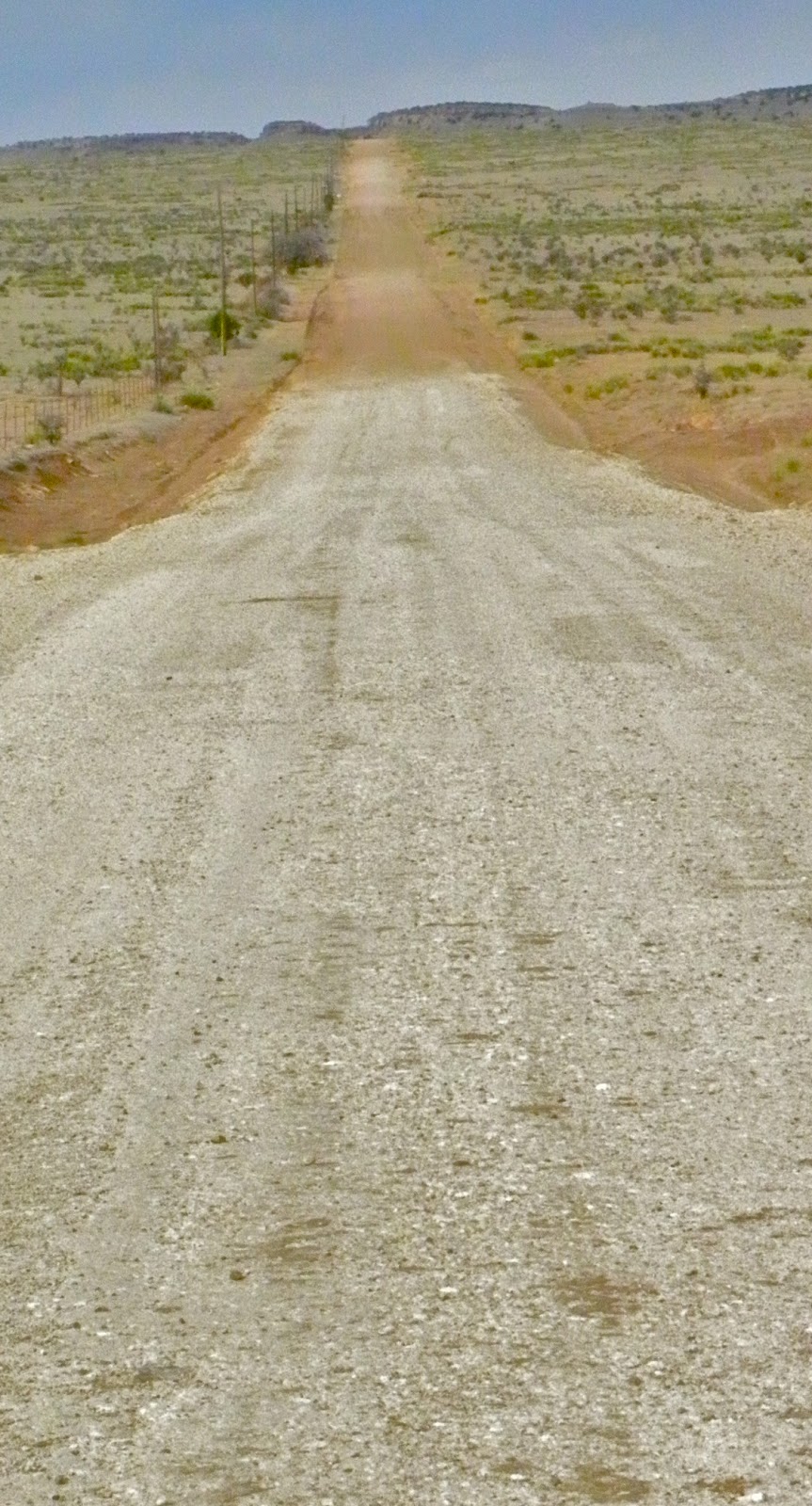
But there are straight roads I like too. Like those that remind me of the old song, "Look down, look down that lonesome road...." There are a lot of those out there, and I most like the dirt and gravel ones undulating over the hills. "What's ahead, what's ahead," I hear the whispers in my mind.
   What will I find, what will I see, who was here first, why is there a road here? Questions galore...and finally, my citified mind takes control and I think, "Turn around, you're wasting time." Such an obscenity, and affront to creativity, to discovery, to exploration, to change that breaks the rules of modern society.
   But it takes over, and I do, seeking other roads, other possibilities, rather than what is over the next hill. Wouldn't you really want to know?
   But I also like straight, paved roads--other than the one from Fort Sumpter to Vaughn, N.M., which is 70 plus mind-numbing straight miles that you dare not speed on, and which can hypnotize you. Instead, I like the ones where there is no traffic, no cops, no population--the "Blue Highways" of William Least Heat Moon. There are those out here in the Oklahoma Panhandle aptly named "No Man's Land." A car, or more likely, a pickup truck, in 40 miles is heavy traffic. The roads, like the one at the top of this blog title, or others, are where you look down in the early morning and for some reason the speedometer shows 80 or 90 or 100 mph--or slow down and stop in the middle of the road to take a photo of an old windmill, gate or abandoned house--and nobody cares or knows, as you speed along with your thoughts.
There are others, roads not taken. And you wonder where they lead.
But there's another road out here that fires my imagination also. This is where the Santa Fe Trail's (the 1800 international interstate from Missouri to Santa Fe) Cimarron Cutoff bypassed the Rocky Mountains at Raton Pass, and followed the mostly dry Cimarron River southwest, across what is now the tip end of the Oklahoma Panhandle, and entered what was then the Republic of Mexico, heading for the landmark Rabbit Ear Peak north of where Clayton N.M.is now.  It avoided the mountains but risked drought and the Comanches, from the 1830s for almost 50 years.   
A D.A. R. and historical marker marks the spot where it crossed  the current north-south pavement  showing the landscape heading southwest. I couldn't help but wonder if 150 years from now some historical marker would point out where our Interstates once were. No wonder I like the back roads.