"When dawn spreads its paintbrush on the plain, spilling purple... ," Sons of the Pioneers theme for TV show "Wagon Train." Dawn on the mythic Santa Fe Trail, New Mexico, looking toward Raton from Cimarron. -- Clarkphoto. A curmudgeon artist's musings melding metaphors and journalism, for readers in more than 150 countries.
Showing posts with label European colonialism. Show all posts

Monday, January 27, 2014

Janus--Record month "blogstone"

Screen shot of stats at 2:36 p.m. today
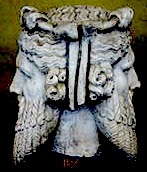
January, month of Janus, the Roman god of two faces, looking back and forward, set two  records, reaching a 'bloodstone" for Coffee with Clark. 
Roman god Janus
The blog surpassed 6,000 page views this month between 2 and 2:30 pm CST today, about 500 more than last month, and more than 6700 page views in the last 30 days. 
Boosting the traffic this past month have been the numerous articles about my twitter for journalists class at UCO, #clarkclass, which generated a lot of interest. As with the new year, I don't know where this is going, but Coffee with Clark will continue to change and grow as it approaches its sixth birthday.
And during the month, a reader from Cameroon in Africa notched the 131st country to have readers of the blog, and 19th in Africa.
Cameroon
Cameroon, located just north of the equator, was colonized by Germany in the 1880s, but divided by Britain and France after WWI. After about 10 years of fighting against those colonial powers, the country gained independence in 1960-61. 
With more than 20 million people, Cameroon is slightly larger than California. While it is relatively stable and economically strong compared to its neighboring countries, there is a lot of poverty. In the early 2000s, unemployment was about 30 percent. French and English are official languages.
It has the same authoritarian president since 1984, and corruption is rampant, ranking it 144 out of 179 countries, according to one report. Still, it is a haven for many refugees from neighboring countries. Its flag was adopted in 1975. 
With more than 200 linguistic groups among the population, and a widely varied geography, Cameroon is often referred to as "Africa in miniature."I have no idea who the reader from Cameroon was this month, but these visitors help me travel the world in my imagination.

Wednesday, March 13, 2013

New readers and their flags, the blog at 95

Readers from two countries not previously showing up on my blog stats clicked in today, bringing the number of countries the blog has reached to 95, I'm stunned, and would love to know what postings attracted them, or how they found it, and if they used the translation device in the left sidebar, or read it in English. Ah, so many questions
The first is especially meaningful to me, Greece, the birthplace of western civilization about 3,200 BC. There's too much history to even attempt to summarize here.
But the flag has a rich heritage. The white cross symbolizes Eastern Orthodox Christianity, the religion of Greece and Cyprus...and I have readers there too.he nine stripes have two different possibilities, representing the nine syllables of the Greek words for "Freedom (the blue) or Death (the white)." I'm reminded of New Hampshire's motto: "Live Free or Die." The stripes may also go way back to symbolize the nine muses, the goddess of art and civilization. the flag was official adopted in 1822,
The nine stripes have two different possibilities, representing the nine syllables of the Greek words for "Freedom (the blue) or Death (the white)." I'm reminded of New Hampshire's motto: "Live Free or Die." The stripes may also go way back to symbolize the nine muses, the goddess of art and civilization. the flag was official adopted in 1822,


The other country new today is Ghana, a remnant of the Ghanan empire before European explorers began sacking the country in the 1600s. The first were the Portuguese, followed by the Dutch, and then the British, taking over in 1898.
What attracted them? Natural resources, especially gold and ivory. The English named the entire area "the Gold Coast" and the French, impressed with the peoples' jewelry,  named it "Cote d'Ivoire," both names that have stuck.
 The current flag was adopted when Ghana gained independence from Britain in 1957. The back star in the center is the star of African freedom , and the three bands in traditional African colors are red for the bloodshed of those who fought for independence, yellow for the country's mineral wealth, and green for the forests. Ghana comes from the word "Warrior King." This is the 11th country in Africa to have blog readers here.