"When dawn spreads its paintbrush on the plain, spilling purple... ," Sons of the Pioneers theme for TV show "Wagon Train." Dawn on the mythic Santa Fe Trail, New Mexico, looking toward Raton from Cimarron. -- Clarkphoto. A curmudgeon artist's musings melding metaphors and journalism, for readers in more than 150 countries.
Showing posts with label beaches. Show all posts

Sunday, July 15, 2018

Watercolor stories

"Moonlight"
Paintings should hint at stories, I've heard, and I'm finding that most paintings have stories.
July's #WorldWatercolorMonth daily challenges are provoking stories of my own as I try to match emotion and craft with the subjects.
"Yum"
The most recent prompts were Forest Animals, Fast & loose, Sweet Treats, and On the Beach. All are 5 by 7, 140 lb. Fabriano Artistico cold press paper.
Here they are, with a second, more impressionistic one of the roadrunner done today, just for fun. I'm perhaps most pleased with this one so far. It makes up for the failure I had on mountains, so there is still one a day.
That is the key, having fun, trying new things. 
I still have a long way to go on figures, but how better to practice than on a long-legged brunette in a bikini? 
"Red Hat"
Stories, I told you--unicorns, roadrunners, snow cones, and beauties. 
Tomorrow may be a little different, more abstract or impressionistic--wonder what the story will be on "Casting Shadows"?
"Beep, beep"

"Speed"


Sunday, January 21, 2018

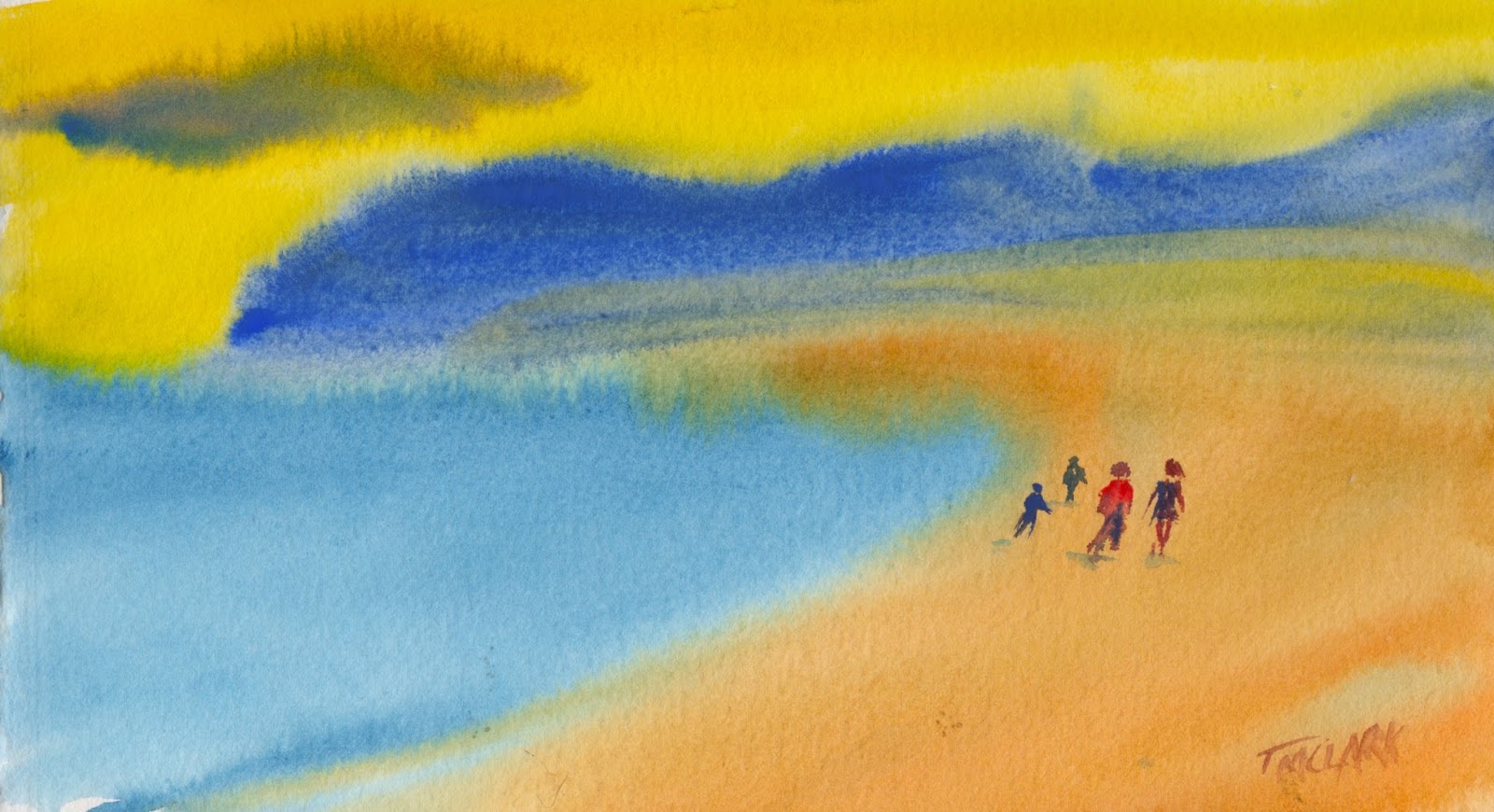
Play time, beach time

Beach time, 5 1/2 by 10 watercolor, 300 lb. d'Arches cold press paper
Time to play. After two days of trying to paint a structure at Chaco Canyon in New Mexico, and six attempts of frustration, I read something this morning about play and how important it is.
No sermon or lecture here, just tuning into happiness. The phrase that caught me is that "play is like a day at the beach."
Growing up in the Southwest, I'm not a big fan of large bodies of water. It seems to me that bad things can happen when you're in water over your head. Like drowning, sharks, jellyfish, the Titanic, the Lusitania, hurricanes.  Some of that probably has to do with being pushed into a deep swimming pool when I was a kid, before I could swim.  
But Susan is a beach person, and I've come to enjoy at least the sound of eternal lapping of waves against the shore. And it's also fun to people watch. The beach is a place to play, and that's fun, and happy.
So behold, fun playing at watercolor, brilliant colors, a beach where sky and sand and water blend together, rather than trying so hard.
(Daily #worldwatercolorgroup January paint happy challenge.)

Saturday, August 31, 2013

Crucifixion and rich beaches, 2 more countries

Readers in two more countries clicked on this blog this week, bringing to 117 the number of countries where readers have for various reasons, scanned these posts.
One country, Paraguay, is in the news because some fired bus drivers staged self-crucifixions with real nails in protest. Crucifixions
Now that's  a level of passion and freedom  rarely known in the western world. Paraguay, home of native peoples 1,000 years before the Spanish "conquest" in the 1500s, suffered under military dictatorships and poverty until 1989, when the government became more democratic. 
Since then its 6.6 million people have seen the economy boom. They take democracy seriously too, having impeached a president a few years ago. The South American country is just a little smaller than California.
Its flag is unique in that it has a different symbol on opposite sides--one is the coat of arms, the other is a map and name of the country in a circle.
The second new country is the Bahamas, the site of Colombus' first landfall in 1492, but the Spanish didn't settle it. The British made  the 700  islands a crown colony in 1718 to combat privacy. At the close of the American revolution, many American loyalists moved there with their slaves. When the Brits banned international slave trade in the early 1800s, the islands became a have for liberated slaves, and those who escaped from America.
The country gained independence in 1973 but retained Queen Elizabeth II as monarch. The country has almost no taxes, living off tourism, and is among the top five richest per capita in the world. Its flag symbolizes the aspirations of black people.

Friday, June 21, 2013

Landing on the beach, almost, and 107 countries

No, this isn't "photoshopped," but a real jumbo jet landing at Sint Maartin
"Sint Maartin" read the statistic of a country of a new reader of the blog this month. I thought it was a typo. It wasn't. It's less than half an island in the West Indies, owned by the Netherlands, and someone on that island clicked on this blog, marking the 107th country to have readers here.
The photo above, that I pulled off the Internet, is meant to catch your attention, because the runway is so short that jets actually are this close to the beach landing and taking off. I read somewhere that people have been blown off the beach by the jet blast, but I haven't confirmed that.
Sint Maartin is the smallest and southern portion of the island known as Saint Martin, and French is spoken on the other side. Dutch and English are official languages here.
The island has a long history, discovered by Columbus on his second voyage in 1493. Since then it's gone back and forth between Spanish, Dutch and French control, the Dutch settling in 1631, a base for its trade between Brazil and New Amsterdam (now New York). After the abolition of slavery on the plantations by the French and Dutch in the 1800s the island dwindled  until the mid-Twentieth Century saw the boost of tourism as a duty free port.
Sint Maartin became an "island territory" in the 1980s, part of the Netherlands Antilles, and in 2010 a "constituent country." Today about 40,000 people live in the country, and 36,000 on the French side, and tourism is the major economy. On the French side naturally, the flag is the French Tricolor. But Sint Maartin has its own flag, bearing its coat of arms.
The Princess Juliana International Airport requires the low approach over the Caribbean, and it handled more than 1.6 million passengers and 100,000 aircraft in 2007. There have been no accidents. I'd like to land there and blog away.  Another view: