"When dawn spreads its paintbrush on the plain, spilling purple... ," Sons of the Pioneers theme for TV show "Wagon Train." Dawn on the mythic Santa Fe Trail, New Mexico, looking toward Raton from Cimarron. -- Clarkphoto. A curmudgeon artist's musings melding metaphors and journalism, for readers in more than 150 countries.
Showing posts with label British. Show all posts

Friday, April 4, 2014

Watercolor spring

"Prairie spring," 9 by 12 watercolor, 140 # d'Arches
Spring bush 3 " by 3"
Spring is watercolor time it seems to me...colors and fluid life. These are studies based on hints and compositions from Ray Campbell Smith, the Brit artist. The third book of his I've bought arrived today, by "Royal Mail" from UK. I'm indebted to Ian McKendrick @WatercolourJrny for introducing me to his work.
Spring foliage, 4" by 3"

Saturday, August 31, 2013

Crucifixion and rich beaches, 2 more countries

Readers in two more countries clicked on this blog this week, bringing to 117 the number of countries where readers have for various reasons, scanned these posts.
One country, Paraguay, is in the news because some fired bus drivers staged self-crucifixions with real nails in protest. Crucifixions
Now that's  a level of passion and freedom  rarely known in the western world. Paraguay, home of native peoples 1,000 years before the Spanish "conquest" in the 1500s, suffered under military dictatorships and poverty until 1989, when the government became more democratic. 
Since then its 6.6 million people have seen the economy boom. They take democracy seriously too, having impeached a president a few years ago. The South American country is just a little smaller than California.
Its flag is unique in that it has a different symbol on opposite sides--one is the coat of arms, the other is a map and name of the country in a circle.
The second new country is the Bahamas, the site of Colombus' first landfall in 1492, but the Spanish didn't settle it. The British made  the 700  islands a crown colony in 1718 to combat privacy. At the close of the American revolution, many American loyalists moved there with their slaves. When the Brits banned international slave trade in the early 1800s, the islands became a have for liberated slaves, and those who escaped from America.
The country gained independence in 1973 but retained Queen Elizabeth II as monarch. The country has almost no taxes, living off tourism, and is among the top five richest per capita in the world. Its flag symbolizes the aspirations of black people.

Saturday, August 10, 2013

An unsheltered shelter, 113th blog country

"Tax shelter." Just because some resident of the Cayman Islands clicked on this blog this week, marking the 113th country to have readers do so, doesn't mean I have money squirreled away there. 
But that's what the Caribbean islands located south of Cuba are famous for, even figuring in the last U.S. election when it was revealed Mitt Romney has millions sitting down there.
He's not alone. The  tiny islands are the world's fifth largest banking center, with more than $1.5 trillion stashed there in 279 banks. There are only about 54,000 residents. A British overseas territory since 1670, it's been tax free for a long time. It prints its own money, with the rate fixed at equal to $1.25 US.
The islands were discovered by Columbus on his fourth voyage in 1503, and named Las Tortugas for the many turtles. Sir Francis Drake renamed  the islands in 1586 for the caiman alligator. Uninhabited until the 1700s, slaves were imported to work the plantations, until slavery was abolished in 1834--a census at that time showed more than 950 slaves owned by 116 families. 
While it's a tax shelter for millions, it is unsheltered from nature. Hurricane Ivan in 2004 literally wrecked the islands. But it's beautiful, its beaches and scenery attracting tourists like the banks attract millionaires avoiding taxes. For photos and more, see the website.
It was part of Jamaica until 1962 when  Jamaica became a commonwealth realm. The flag adopted at that time is the British ensign with the Cayman coat of arms added. Now, if I could just get the blog reader down there to use some tax free money to finance this blog, we could move there, except in hurricane season.

Monday, May 27, 2013

Blog at 105 and 106--flags of Arab Spring

Two new readers' countries showed up today on this blogs' stats, and they follow a trend of African and Mideast-areas. This makes them more intriguing to me, as usual--Tunisia and Bahrain, become the 105th and 106th countries in the world with people who have clicked on this blog. Number 105 was from Tunisia, where the reader is among a population of over 10 million people in the relatively small country, the smallest in .
A fertile 800-mile coastline to the the  north of Sahara has main it a "granary" of Europe for centuries. You know it best for Hannibal of Carthage, the city funded in the Ninth Century BC.  He and others fought several was with ascending Rome, which conquered in in 149 BC. 
In the centuries since, it became a part of the Ottoman Empire, until the French invaded in 1881 and it was settled by thousands of French and Italians. After WWII, where it helped play an important role in the defeat of Rommel,  it gained independence from France in 1956, but the so called elections put in power one of the most repressive regimes.
The "Arab Spring" that rocked the Arab world began here in 2010 when a street vendor set himself on fire to protest confiscation of his wares and government humiliation. The protests continued with a 2011 overthrow of an autocratic president and the first free elections. Its democracy is evolving.
The flag is the red dating from the 1830s kingdom, and the star and crescent recalls the Ottoman empire.
Number 106--Bahrain, a large island in the Persian Gulf with several small ones, was one of the earliest areas to convert to Islam in 628. There is a letter from Muhammad to one of the rulers. It has been occupied by the Portuguese, Persians and British. It declared independence in 1971, and declared a kingdom in 2002. In 2011, there has been a lot of sustained protests and unrest inspired by the "Arab Spring."
Nestled in a bay between Qatar and Saudi Arabia, an actual causeway connects it to the Saudis. Like its neighbors, it is rich in oil.

The flag is the red of the color of the Persian gulf states, The white on the hoist side is a band, with five points, representing the five pillars of Islam--belief, worship, charitable giving, fasting during Ramadan, and at least one trip to Mecca in a lifetime.
Below is a copy of the letter from Muhammad to the ruler of Bahrain, inviting him to Islam. Read the translation...notice the last few lines of tolerance towards others. Wow. 
I'm impressed, and honored to have readers from these countries with long histories.
"In the name of God the Beneficent, the Merciful: From Muhammad the Prophet of God to Munzir bin Sawa, may peace be on you! I praise God, who is one and there none to be worshiped but except him. I bear evidence to the oneness of God and that I am a servant of God and his Prophet. Thereafter I remind you of God. Whoever accepts admonition does it for his own good. Whoever followed my messengers and acted in accordance their guidance; he, in fact, accepted my advice. My messengers have highly praised your behavior. You shall continue in your present office. You should remain faithful to and his Prophet. I accept your recommendation regarding the people of Bahrain. I forgive the offenses of the offenders.
Therefore, you may also forgive them of the people of Bahrain whoever want to continue in their Jewish or Majusi faith, should be made to pay Jizia. Seal: God’s Prophet Muhammad"

Thursday, May 23, 2013

The blog at 104

From out of the blue, literally, came a reader from the 104th country to have hit on this blog.
I'm pretty good at geography, but I had to look this one up to make sure...
Mauritius...in the Indian Ocean, 1,200 miles east of Madagascar. For some reason, someone from that pleasant little island clicked in.
Here's what I found out...
The island was uninhabited when discovered  in 1507 by the Portuguese.It was the only home of the Dodo bird, which went extinct in 80 years. The Dutch settled it in 1598 and abandoned it in 1710. The French took over in 1715, renaming it Isle de France, and imported African slaves to run the sugar plantations. After Napoleon, the British took over, and abolished slavery in 1835, paying landowners two million pounds for the loss of slaves. They then imported a half million indentured workers from India to work ...gotta have slave labor, even if you call it minimum wage.
The country gained independence in 1992, with a parliamentary government, and about 1.29 million people on the main island and a few others, including 49 uninhabited. It ranks high in freedom, economy and tourism. The flag colors are for the blood of slavery, the Ocean, the light of independence and lush vegetation.
Thanks for visiting reader, and introducing me to another place in the world.

Saturday, March 9, 2013

China--flags of conflicts and centuries

The Hong Kong Flag
How do you write about  thousands of years of conflicts and civilizations and the flags that represent them?
Perhaps one person at a time.
So my procrastination about writing about readers of this blog from the People's Republic of China and The Republic of China ended today, when I had a reader from Hong Kong.
If there's one thing I'm sure of, it's that we Americans don't really understand cultures older than ours, and world histories, so I'm reticent to write about them. Trying to be a journalist and be even-handed, that means keeping an American perspective out of world events, and it's not really possible. But I try.
I grew up when "Red China" was one of the evil empires threatening the U.S., and bent on destroying freedom. The Republic of China on Formosa was the democracy and Hong Kong was a British colony. There's no doubt in my mind that the current People's Republic of China is still a threat of the U.S., now primarily economically, and it is a foe of freedom of expression. But I've also learned that money and capitalism between countries, called "markets," overrules ideology most of the time, and that affects the three of the flags in this post. And that I wasn't told the whole story of Hong Kong and Formosa.
China's population--the largest in the world-- and economic potential dwarfs ours in many ways, but nothing compared to its history. Here it is in a shallow nutshell. China is old, very old. For years it was ruled by dynasties as an empire, until 1912, when a republic was formed. By this time western nations had seized parts of the country, including the British at HongKong to protect the opium trade which China was trying to suppress.
In the 1920s with the rise of Chiang Kai-Shek the nationalist party couldn't negotiate with the communist party and a civil war started. A truce was declared when the Japanese invaded and slaughtered hundreds of thousands. (America's Flying Tigers operated with the Kuomintang, the nationalist party, against the Japanese).
After WWII, the civil war resumed and Mao Zedong and the communists won in 1950, driving Chiang's forces t 50 miles off the coast to the island of Formosa--now called Taiwan. The U.S., involved in Korea and at the start of the Red Scare, sided with Chiang, even though he was no less a dictator than Mao. The US has come close to war in this Chinese rivalry, including in the Kennedy years over a couple of non-descript little islands, Quemoy and Matsu. During this time Red China also "annexed" Tibet, a dispute still going on. The two Chinese countries continue to claim all of China, but the fact is after all these years, it's pretty much status quo--which means there's no economic reason to alter it.
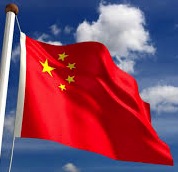
Flag of the People's Republic of China
Then in 1999, Britain gave up its colony of Hong Kong and it reverted to Chinese control,but with a difference. Socialist China realized the capitalistic powerhouse of Hong Kong, and allows it to so operate. If this summary offends you, then so be it, but money talks. And Americans should certianly be in favor of ending colonialism, shouldn't we?
Hong Kong operates under the saying, "one country, two systems." Its regional flag shows that. It carries the festive red of Chinese people. The Bauhinia flower, discovered in Hong Kong, is the main symbol, but it has five petals and stars to coincide the stars of the flag of the People's Republic of China.
The flag of China carries five golden stars, one  large and four smaller ones. The red is for the Communist revolution, the large star is for the Communist party and the others for the four classes, proletarian workers, agricultural peasants, bourgeoisie, and capitalists.
Across the straight of Formosa another Chinese flag flies, this one also red, but with the blue and white symbol of the Chinese Republic before WWII.
I have had students from both Chinese countries, and in sort of a wake up  to me, when I was working on my doctorate at OSU many years ago, one of my fellow students was from "Red" China. Her father had flown Migs in the Korean War.
With the death of Mao and of Chiang, both countries have changed. The Republic of China is now truly democratic and an economic dynamo, and The People's Republic of China, while still communist, is adjusting to the practical constraints of a world economic power. That includes allowing Hong Kong to be capitalist.
I find it fascinating, that the communist state, with control of so much media, and in the news for hacking US computers, has citizens who read this blog.  The world is small.
China is complicated, and will be a force in America for a long time, including most recently, in putting pressure on its not-so subservient North Korean rogue state.