"When dawn spreads its paintbrush on the plain, spilling purple... ," Sons of the Pioneers theme for TV show "Wagon Train." Dawn on the mythic Santa Fe Trail, New Mexico, looking toward Raton from Cimarron. -- Clarkphoto. A curmudgeon artist's musings melding metaphors and journalism, for readers in more than 150 countries.
Showing posts with label rural. Show all posts

Friday, July 7, 2017

Oklahoma Winter --watercolor

"Oklahoma Winter, 5 by 7 watercolor, 300 lb. d'Arches

"Sometimes in winter / Forgotten memories"
                                                                                    --Blood, Sweat & Tears

We weather with the seasons, as do aging buildings on Oklahoma farmsteads. I'm fascinated by the metaphors of rural life.
Memories, stories awakened especially in the winter, for some reasons deep inside. Thus today's #WorldWatercolorMonth challenge, Day 7.
Palette--Ultamarine blue, Burnt umber, Raw umber, Chinese white

Wednesday, December 23, 2015

Two days 'till Christmas--Mangers I have known

Rural icon, 5 by 7 watercolor, card
I never paid too much attention to barns until we moved to Iowa years ago. In the upper Midwest, they are more than just buildings...they're essential to survival, icons and testaments to hard work, symbols of the rural life. 
Then I spent two summers on a paint crew painting them, hog houses, sheds, houses...essential every few years because of the harsh winters.
Ever since, I notice barns where ever I go, in fact, they grab my attention and imagination--Oklahoma, Arkansas, Missouri, Nebraska, Iowa, Pennsylvania, Maine--every place where agriculture is as rich as the land. They tell me much about the people who built them, who live nearby, whose work depends on them. 
Many are in decay, and I love those too, having painted pictures of a fair share of them. They're being replaced by more efficient metal buildings, and I understand why, but the new have no history, no culture, no nostalgia like the old. Seeing a barn, visiting a barn is an adventure in storytelling.
After that summer I also vividly associate the odor of farm animals, hay, manure and more pungent odors with barns. Where there are barns, there are always mangers, feeding troughs for the animals, part of the fecund atmosphere. I have only to attend a country or state fair to be reminded...how close to the earth, to life and death we are, even when isolated in our air-conditioned cocoons and concrete streets these days. I can sense their texture, their reality.
I can't help but think about another barn, a manger, a shed, filled with  the fragrant odor of hay, livestock, manure and more. No antiseptic, sterile hospital or nurses or doctors...just birth in the face of death, building a strong immune system and character.
Such things influence you all your life, become a part of who you are, either remembered or deep inside--shaping your instincts and how you treat life and death and people. 
Ever think about what Jesus thought about when he walked by one in his dusty travels, catching a whiff of smell on the breeze?

Saturday, June 21, 2014

Mailboxes I have known

Rural route--6 by 9 watercolor, 140# d'Arches
I don't know how long I've been interested in rural mailboxes, but they always catch my attention, especially when several of them are lined up in a row. My dad did a great sketch of some years ago, but I suspect my interest goes further back, or is genetic.
Mailboxes are both metaphoric for stages of my life, and like windows and gates and cabins to me...they hint of stories, of unanswered questions, of hopes and fears and the drama of every day life.
Mailbox, 7 by 9
My wife asked me if I was in a mailbox theme after seeing this, or if I was dissatisfied with my previous recent paintings. I think I'm always a little dissatisfied, but it's more like a phase than a theme. I've had my cabin phases, and old buildings and cabins, and windows and gates. After four other mailbox paintings this past month, this just seemed a natural topic today. 
It was stimulated by attending the Prix d' West Show at the National Cowboy and Western Heritage Museum yesterday, where I spent three hours being astounded by great art, including watercolors where, among other questions,  I asked myself, "How did she do that? More on that show later.
No mail today, 8 by 10
I'm nowhere near that level of talent and inspiration, but it is contagious, thus today's painting.
Here are the previous four mailbox paintings, in various sizes, chronologically. Can you see the progression artistically?
Nobody home, 8 by 10

Mailboxes, 4 by 5 1/2

Saturday, May 17, 2014

No mail today, watercolor

No mail today, 8 by 10 watercolor, 300 #d'Arches
Coming up empty...a perfect day for en plein air painting, and to get out of the city, to less traveled roads, searching for subjects to paint. 
I take Saturdays to do that sometimes, and mainly to get out of the city and congestion and speed. I need space, and today I headed southwest of the city. east of the city are lots of trees. My last trip northwest was wide open yes, but not much to paint within at least 25 miles because of new houses and subdivisions cropping ump.
Alas, today was not much different. I followed ended up in subdivision after subdivision in eastern Mustang, followed Council Road south to a dead end, and except for a few old barns shrouded in trees and underbrush came up empty of interesting subjects. Today's new houses are cookie cutters without character. Depressing and frustrating. 
But along one roadside was an old rural mailbox. I couldn't stop to take a photo because of traffic coming and on my tail, even in "the country." But I remember. It was probably empty, but it helped fill my day. And it was painted en plein air, on my back porch.

Tuesday, January 21, 2014

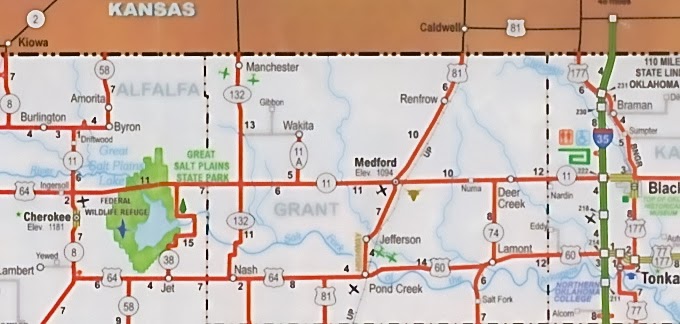
"Jetting" along, Blue Highways Journal--IV

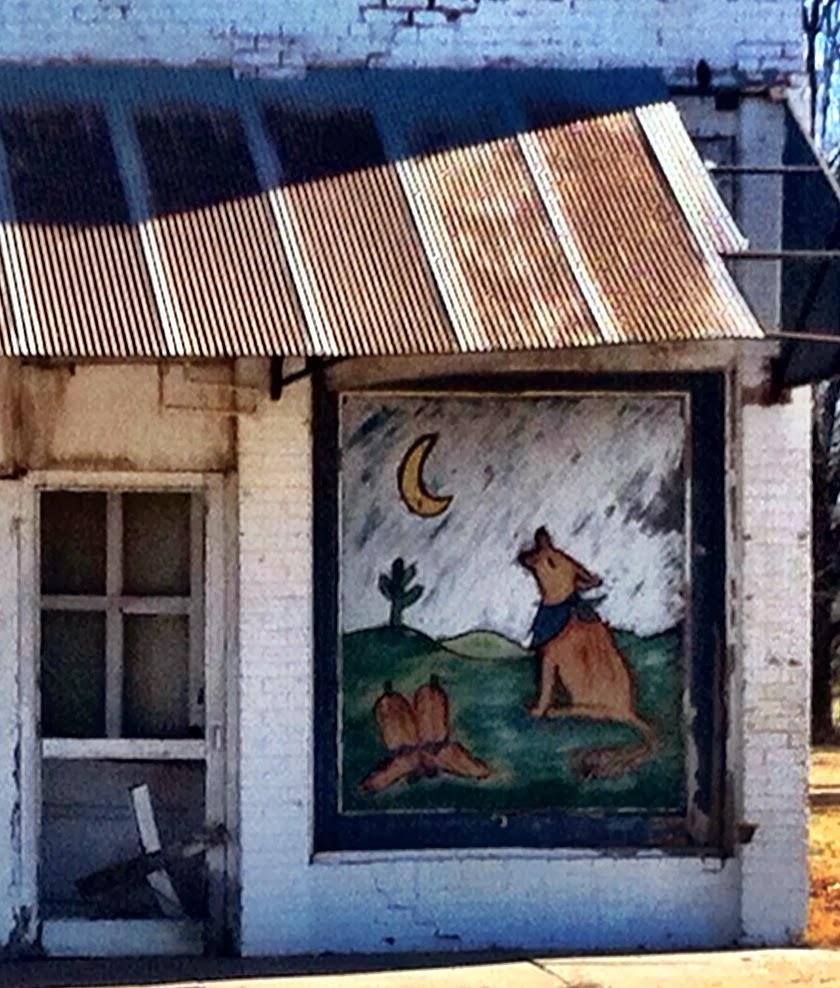
Oklahoma's small towns, while dwindling, are proud of their histories. Almost all of them have murals painted on old brick walls or signs, helping tell the stories of who the people are and were. No matter for these towns that the art work is in various stages of artistic ability. They represent dedication, hard work and pride by local rural artists and townsfolk.
Jet, population 213, on US 60-64, is no exception. On the eastern outskirts of town are four colorful murals on signs telling the story of the town. They're part of the town's veterans' memorial, etched in granite, behind  an old US Air Force jet trainer on stilts. That probably comes from nearby Vance AFB at Enid, where later that day I saw jets still zooming through skies in training.
In town were two more examples of brick buildings with finely crafted arches over windows and doors, typical of Oklahoma Territorial architecture. It was refreshing to see the local bank, Jet State Bank,  renovate one of the buildings for its operations, rather than building some ugly and modern box to do business in.
Also outside the town is a sign heralding it as the "goose hunting capital of the world." Now it may or may not be, but if they claim it, it is so. (This comes from someone who used to live in Waurika, "the parakeet capital of the world.") The town's location just south of the Great Salt Plains State Park and a federal wildlife refuge probably explains this.
Jet was established with a post office June 28, 1894, named for a local miller and the first postmaster, W.M. Jett.
Jet's school district for years was consolidated with Nash, seven miles east in Grant County. Nash's post office was established Feb. 14, 1894 as Nashville, and the named changed to Nash March 23, 1911. It was named for the first postmaster, Clark L. Nash.
(Information on town histories and names comes from Oklahoma Place Names, by George Shirk)

Monday, January 20, 2014

Back roads, no chain stores journal--Part III

Have you heard of Greasy Steve's restaurant or Ugly Fixer Liquor? If you get off the chain store main roads, and drive through Pond Creek, Oklahoma, population 856, you will.
I'm sorry I didn't stop and take a photo of those establishments, for they tell you a lot about the independence of living in rural Oklahoma. 
Straddling the center line of US 60 was a sign in front of the school announcing a bean and stew supper that night.  Everybody in rural Oklahoma knows of those Lions, Rotary, Kiwanis, volunteer fire departments and other clubs' pancake breakfasts and bean and cornbread suppers, raising funds for local events. 

I did turn around and snap photos of the water tower, an abandoned gas station, and two brick buildings with the distinctive arches of late Territorial and early statehood architecture. Such craftsmanship and care, instead of the plastic, all- look-alike facades of today's urban world.  No wonder we call them "Big Box Stores."
Distinctive arches of early Oklahoma archtecture
Pond Creek was originally named Round Pond, post office established in September 29, 1893. It was the county seat of Grant county from statehood till June 9, 1908 when it was moved to Medford. I bet there are all kinds of stories about those early day Oklahoma politics on the northern edge of Oklahoma, repeating a story about Waurika and Ryan in Jefferson County, at the  southern end of the same U.S. 81.
Oh, the stories to be told.
The original town site is now at Jefferson, four miles north, and Pond Creek is actually located closer to the Salt Fork River, on the intersection of US 60, 64 and US 81, which follows the old Chisholm Trail.
Oh, the stories to be told. There is a book, Trails to Old Pond Creek, by Jim Fulbright,  copyright 2006, that tells lots of stories about the Kansas connections.


(Information on Pond Creek from Oklahoma Place Names, by George Shirk)
  • Next:  the "goose hunting capital of the world."

Sunday, January 19, 2014

"Blue collar roads" Journal--Part II

Highway 60/64 west of Tonkawa may be red on our state map, but it is a blue collar highway these days, a testament to two Oklahomas--the urban affluent, and rural poverty. It is one of William Least Heat Moon's "blue highways" for me.
People who live in booming metro areas in medieval-thought gated communities or stuck like ants in rush hour traffic have no idea of the poverty in most of rural Oklahoma, and a trip down roads like this makes it clear.
Veterans' Memorial at Lamont
water tower and grain elevator in distance
I love roads like this, even though today there is increased oil-field truck traffic. There is some road construction on bridges, and wide open spaces, sparsely populated with cattle, old houses, vacant brick silos, barren fields and dwindling small towns, marked with water towers and grain elevators where railroads used to be.
First settled in the 1890s, and home to booming populations, the small towns every 10 miles are testaments to long gone prosperity and hope. Today, the highest paid people in town are probably school teachers--other than a few bank owners, probate lawyers, and retired large landowners. Everyone else is working in a garage, driving a truck, serving coffee at a cafe or cashiering at a convenience store, serving as a flagman on a road crew, all trying to make a living. You see this in the multitude of old frame houses and mobile homes, with a few brick homes interspersed.
There are two Oklahomas
There's usually a bank and a post office. Source of pride in every town, the last thing really holding it together, is the school, even if it is consolidated with another town.
At Lamont, population 417, 12 miles east of I-35, there's not much, but the street to the school is clearly marked. The Eagles roost here, and there are signs pointing the way, and eagle tracks painted on the pavement.
Urban folks and politicos who want all these small schools consolidated have no idea of the distances involved and the communities sustained with local tax dollars. They speak out of two sides of their mouths, fleeing intercity schools, but that is a different journey and subject, except that it illustrates the divide between urban and rural in this state in more than just economics and politics.
A testament to lost hopes...
Lamont, settled in 1893 was named for President Cleveland's secretary of war, Daniel Lamont. Today, there is a veterans memorial, with an aging armored military unit out front of the granite memorial, in the town park, with the slender water tower overhead. There are lots of boarded up buildings and houses, testaments to lost hopes and happy times. The most modern building in town is the Methodist church, a heritage of steadfast  faith that continues from settlement to now.
I could have spent more time here taking photos, and wish I had. In fact, as I kept driving west, I saw multiple grain elevators off on side roads, beacons or tombstones to other small towns, beckoning for a trip and more photos, more stories of the good people of rural Oklahoma.
First Methodist Church, Lamont, a heritage of steadfast faith
(Information on Lamont from Oklahoma Place Names, George Shirk)

  • Next, Greasy Steve's, and Pond Creek.