"When dawn spreads its paintbrush on the plain, spilling purple... ," Sons of the Pioneers theme for TV show "Wagon Train." Dawn on the mythic Santa Fe Trail, New Mexico, looking toward Raton from Cimarron. -- Clarkphoto. A curmudgeon artist's musings melding metaphors and journalism, for readers in more than 150 countries.
Showing posts with label sundagger. Show all posts

Sunday, March 20, 2016

The day when you can see time

Susan and I at Chaco Canyon, New Mexico
There are two days a year when I think specifically about New Mexico...and this was one of them.
Coincidentally, and really unawares,  in the past week, as a matter of fact last night, I'd talked about camping out at Chaco Canyon, the site of the Anasazi culture that more than a thousand years ago accurately recorded and measured the movement of the earth around the sun.
Equinox dawn at Fajada Butte, where the Anasazi measured time
This day --equinox-- figured deeply in their religion and lives, and since I've camped there several times, it figures deeply in my life cycle.
I've written about it on this blog many times, and may not be able to add much original this year, but I'm still drawn to it, to the memories, to the power that still resides in that place
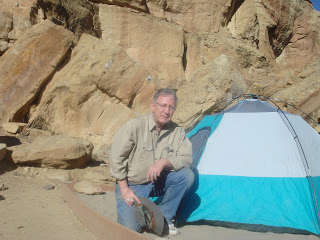
Camping on Equinox at Chaco
I was last there about five years ago, camping out alone, and it was freezing cold. I'd been to see my late uncle Mike in Santa Fe, and then headed northwest, eventually 25 miles off the paved road, to silence, to solitude, to imagination and much more in the high desert.
I don't know if I can convince my very urban wife to go there overnight in a tent on the ground, but the place is calling. It always does. To me it isn't about history, it's about eternity--present tense.
You can see time move... 
You can see time move there, from the stars wheeling overhead, to the shadows of  the rising and setting sun climbing up the sandstone cliffs, to the ancients' markers in their stone architecture. 
These ruins are not vacant
And those ruins are not vacant, as the Pueblo Indians will tell you. They are still inhabited by the spirits. That I believe, else why would my spirit be so drawn two specific days a year, and in between?
Fajada Butte--watercolor
Links to a few previous articles from the past seven years:
Where you can travel in time
When you can see time
Solstice dawn and days missed
When the sun stands still
Poetry in the canyon 
Where you can see time 

Friday, June 21, 2013

Solstice dawn and days missed

Dawn at Chaco Canyon
The longest "day" of the year, when time, the sun "stands" still--the literal translation of "solstice,"  
as the sun begins its journey toward shorter days. This marks also the end of an unintended  three week "blogcation," the longest interruption in writing in the five year history of Coffee with Clark.
It is appropriate to show a photo of one  of the places of power in the world,
one of my places--Fajada Butte in Chaco Canyon in New Mexico. Atop that 300-foot sandstone land mark is a "sunmark"--where the Anasazi more than 1,000 years ago erected  stones  to form a "sun dagger" to accurately record the solstices, equinoxes and even moon cycles. It probably had to do with planting seasons, and more, with religious rites. 
We increasingly urban folks mark the first day of summer or other seasons on a calendar, but are so out of touch with nature and the universe that  seasons don't have as much meaning as they used to. For us, "time flies." Time may not have stood still with multiple ideas that were "meant-to-have-been" blog posts, but weren't. Even this one is difficult, but like an eventual shaft of sunlight between rocks, there are more stories to tell. 
Alas, vibrations from the increased traffic far below Fajada, and the years, have shifted the rocks, even with restoration by Park personnel. So today's solstice didn't quite hit the mark.  I can not imagine the knowledge and patience it took to build a site like this, or the ones at Mayan and Inca sites, or at Stonehenge. Years were required.
The only way to see Fajada at dawn is to camp there overnight, 26 miles of gravel road off the highway in northwest New Mexico. It's cold, but so worth it. At night, you can see the stars move overhead, actually sense the earth moving. And as the shadows climb up and down the sandstone cliffs at down or sunset, you can see time.
so in the time that's flown by these last three weeks, there were going to be posts on Reduxion Theatre, on Frank Francese's watercolor workshop at IAO, on the 40th Prix de West art show, on music at Paseo, on freelance writers, on the 107th country blog reader, and more. You can't "catch up" in time, but you can get glimpses of the past, at Chaco, and in words, soon.