"When dawn spreads its paintbrush on the plain, spilling purple... ," Sons of the Pioneers theme for TV show "Wagon Train." Dawn on the mythic Santa Fe Trail, New Mexico, looking toward Raton from Cimarron. -- Clarkphoto. A curmudgeon artist's musings melding metaphors and journalism, for readers in more than 150 countries.
Showing posts with label UK. Show all posts

Wednesday, July 29, 2015

"Never on the Rocks"--investigating Scotch whisky

A whisky tasting  is an experience in Scotland
My story in today's Journal Record
Investigative journalism at its best...that's what I thought when I asked for a travel assignment from the Journal Record daily business newspaper in Oklahoma City this summer. 
"Sure," said Editor Ted Streuli, when he learned we were going to Scotland. "Report on the business of scotch"
So in our trip to the UK, Susan and I had to experience Edinburgh, and I made sure to investigate Scotch whisky. That meant multiple "interviews" of the subject--because a "one source" story is shallow.
(Note--AP style--scotch is capitalized only when preceding "whisky." "Whisky" is the spelling in Scotland--elsewhere it's spelled "whiskey" if produced elsewhere.)
Alan Rogerson in Edinburgh
It was a tough assignment, but someone has to cover this beat. I also interviewed friend Amie Hendrickson, manager and certified sommelier at Edmond Wine Shop, who provided important local information.
So today, my story appeared in the Journal Record. Ah, the power of a byline, it tastes almost as good as...well, maybe not.
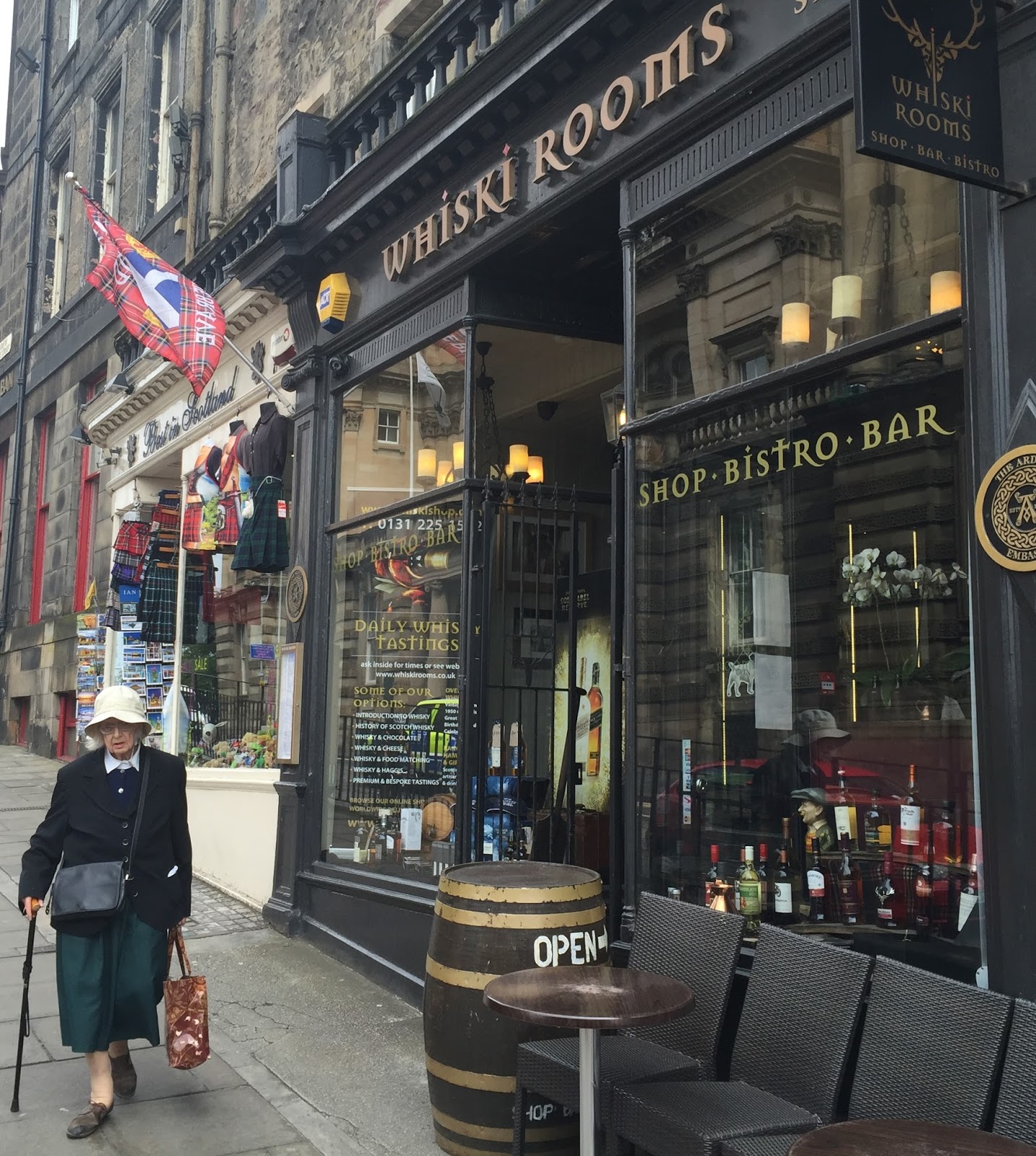
Whisky stores are everywhere in Scotland
I'll share the written story in a few days, but if you want to read it first, buy a Journal Record.
For perspective, there are more than 100 whisky distilleries in Scotland, which in land area is smaller than Maine. The next largest number of whiskey distilleries is in the U.S. with 15.
In the meantime, here are some of the photos I took.
Your investigative reporter at work

Wednesday, March 26, 2014

"Watercolour," Brit artists and social media

British influence in  "colour," trial watercolor, 8 by 6, 140 # d'Arches
Today's painting above has an international story with it, thanks to "social media." Notice I spelled "colour" the British way, for a reason.
Social media has made the world much smaller and more fruitful as I've met and contacted new people and old.
Thus it is that recently, someone in the UK favorited one of my paintings earlier this month on twitter, and we've begun following each other.
We have much in common. He's Ian McKendrick from Cambridge, U.K., and he's a watercolour artist and student, in addition to being a social media guru for business...fitting in with what I teach in journalism these days. His web site Ian McKendrick for his watercolours is really sophisticated. I'm envious and have been prodded to develop my own site, separate from this blog. 
I've noticed that his favoriting of my paintings added much to my blog traffic, and I've also favorited his paintings. 
He showed a painting, he calls them "projects," from another Brit painter's book, and so I ordered three of the books. One of them arrived today, and inspired this experimental painting.
What I gained most from the book "Landscapes in Watercolour" was new combinations of "colours." Oh, here's the link to this painters page, and his name is Ray Campbell Smith.
I do notice that much of his work has much more atmosphere and moisture in the air than we have here in Oklahoma, and certainly in my beloved West, where the landscapes are more dramatic. In addition, I've been experimenting more and more with brilliant color, but still I think anyone who is painting in watercolour is always a student, always learning. Thus this painting today.
And here too is Ian's web page as a Social media guru. His twitter handle is @watercolourJrny.
I hope to meet him in person when we travel to the UK this summer, but in the mean time, we'll certainly be sharing more and more. Now if this were really "British style," the comma would be outside those quote marks and in the following. I love the spelling of "watercolor," but though a direct descendant of King Edward Longshanks , the tyrant in "Braveheart," (ironically now married to a Campbell), I'm firmly an American (not a Yankee though) journalist, and periods and commas always go outside quote marks--over here in the "colonies."
Isn't it great the stories behind paintings? So much to learn.

Monday, April 8, 2013

New readers, closing on 100 countries

In the past week, the blog has attracted readers from two more countries, bringing the total to 98, not counting the USA. These come from countries with long histories that have been occupied, and their borders changed during history, before finally becoming independent. We in America with a short history, forget how much geography and political rule have changed around the world as various strong powers have exerted their rule.
These newcomers are from Lithuania and Uganda. That means the blog has readers from all the Baltic states, including Latvia and  Estonia. Uganda becomes the eleventh African country on the roll.
Lithuania formed a commonwealth with Poland to the south for about 200 years, but fell to Russia and others in the 1700s. It declared independence after WWI, but was occupied by the Soviet Union, and then  and Germany throughout WWII, when USSR took over. But before the breakup of the USSR, it was the first Socialist Republic to declare independence. A salute!
The flag was used between the wars, and then adopted in 1989, two years before the USSR fell. The history of the colors vary, but are prevalent in folk art.
Uganda's flag dates from 1962, the year it gained independences from the UK. The colors represent the African people, the son, and the blood of African brotherhood. The gray crowned crane, a national symbol, and the military badge of Ugandan soldiers during British rule.
The area was invaded by missionaries in the late 1800s, followed by the British which ruled under the East Africa Company. It imported 30,000+ workers to build the Uganda railroad, but many Indians stayed after completion. The final area took shape in 1914.
It's a troubled land. In the early 1900s, sleeping sickness killed more than a quarter-million---two thirds of the population. Since independence, it's had a history of military coups, the worse from Idi Amin in the 1970s, who killed more than 300,000 and drove out the remaining Indians. The current leader has been in power since the 1990s.  But it is a beautiful land, with wonderful people. Salute!