"When dawn spreads its paintbrush on the plain, spilling purple... ," Sons of the Pioneers theme for TV show "Wagon Train." Dawn on the mythic Santa Fe Trail, New Mexico, looking toward Raton from Cimarron. -- Clarkphoto. A curmudgeon artist's musings melding metaphors and journalism, for readers in more than 150 countries.
Showing posts sorted by relevance for query wooden leg. Sort by date Show all posts

Sunday, June 19, 2011

My dad had a wooden leg

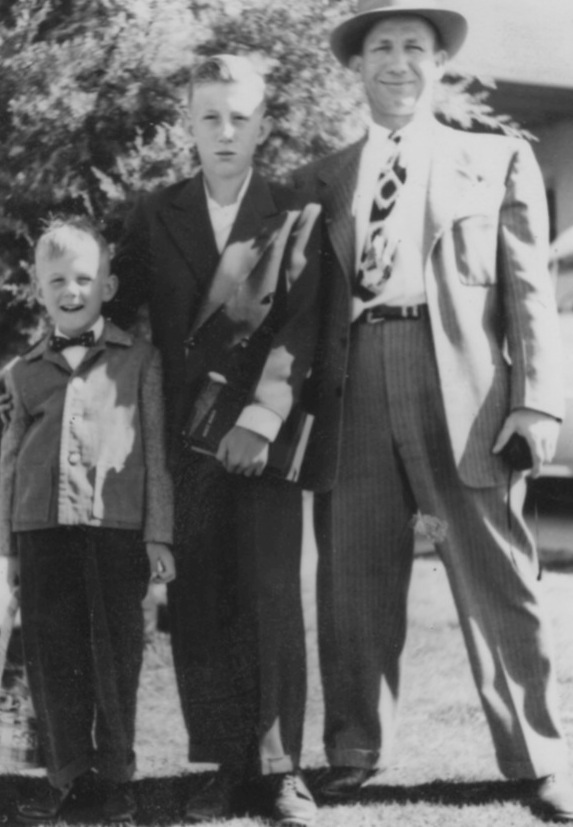
Dad, at right, with wooden leg. Mom in center, between Jerry and I. Grandmother and husband Worden.Uncle Rex and Edna. Oklahoma summer in the 50s at Thackerville


My dad had a wooden leg.
The Oklahoma teenager was trying to jump a freight train in Tucumcari, New Mexico in the Depression when he slipped or missed the handhold on the boxcar's open door.
The big steel wheels sliced off his right leg between the ankle and the knee and his little finger on the right hand. Somehow he lived, not bleeding to death, not dying from the pain.  I guess you could say he suffered the rest of his life for that moment, though he didn't talk about it much . . . I never asked him.
I remember him talking about coming home  "to die" and about "feeling sorry for himself," until someone chewed him out and got him "back on his feet again."  He hobbled on crutches for awhile and then eventually got a wooden leg.
It must have been quite a shock emotionally, because a few months earlier, he had been "Iron Man Clark" on the Comanche Indian football team.  Short at five foot nine, he was husky, thick-chested.  He played tackle. You didn't get by him on that scrimmage line. He and a friend went to Juarez to celebrate graduation.
And now, well now he was a "cripple."
My uncle Mike, who has two degrees, said he was inspired by Dad to go to college. Mike came up to visit Dad at OU, and there he was, on crutches, pants leg pinned up, washing dishes to pay room and board and tuition.
Later he'd joke that the graduation trip to Juarez was worth it.
But once he learned to walk again, the wooden leg didn't slow him down.
The family was poor, as were most in Oklahoma those days, but despite the leg, he went to college to study his first love . . . art. They said he learned to draw before he learned to walk.  If you see his early work and sketches from art school, you'd believe it.
     Dad specialized in portraits, later at landscapes.  He never completed a degree--probably running out of money, or perhaps just being too interested in art to finish the other requirements.
     He headed west again and earned a bachelor's living in Albuquerque and Santa Fe, Taos, Carlsbad, in bars, hotel lobbies and nightclubs across the state. There he'd do "quick sketches" of whoever would pay, and some who wouldn't.  But 50 cents for a sketch would buy beans and gravy and more in those years and Dad was doing what he liked . . . drawing and traveling and meeting people and talking and living free in "God's Country."
When the War started, instead of going off to fight the enemy like his brothers did in the Pacific, he stayed at home . . . although he tried to enlist.  The Army didn't want a "cripple."  Perhaps the wooden leg saved his life, and is responsible for my brother and I being here. But he did his part, getting a job with Consolidated and North American Aircraft in Fort Worth, doing some of the drafting on the big B-24 Liberator bombers and the sleek P-51 Mustang fighters, aircraft that helped win the war.
And the cripple also drew a portrait of famous war correspondent Ernie Pyle with a background war scene.  That portrait sold a million dollars of War Bonds in Dallas in 1944, and Ernie Pyle autographed the portrait for the "crippled" artist.  The portrait was given to Pyle and ended up in the correspondent's Albuquerque home, where his wife eventually burned it.
Years later, Clark and his family moved back to New Mexico where he could draw and paint landscapes in his leisure time.
His wooden leg became the brunt of jokes, which he enjoyed.  Even though he was a cripple, he went deer hunting in the New Mexico mountains with some archer friends one year. Someone wrote a humorous poem that if Clark didn't kill the deer with his arrows, he could beat it to death with his wooden leg.  He laughed.  We all did.
And the joke was on the others too.  Like the big dog that tried to bite his leg one day when he was riding to work on his motorbike. "You should have seen his expression," Dad laughed.
     Most people didn't know about his leg. But every once in awhile when the wooden leg started acting up or a blister on the stump would form because of a slipped stump sock, he'd have to go to work or to church on crutches, his right trouser leg pinned up. People would stare in horror, thinking that something horrible had happened.
It had, a long time ago, but Dad had learned to live with it and if he was a cripple, it didn't affect the way he lived much.
He was a talented landscape and portrait artist with a keen eye for details, color and realism . . . that was his love, that and the big blue skies and rolling vistas and rugged mesas and mountains of New Mexico.  Everywhere he went there was beauty to be captured by his paints, his pencils.
That was before they had invented the use of the words "handicapped"  or “disabled.” Dad was neither handicapped nor disabled.  He was so nervous that he had to hold his hand still as he painted, but he was not handicapped. Certainly not disabled. He was a cripple, physically, but he worked around it and most people never knew.
With only a small portion of the talent Dad had, and the more I try and study, I'm more and more amazed at what he could do.
There's no disgrace in being a "cripple" or in the word itself.  I look at Dad's paintings and art work every day in my home and my office and see no disgrace, and rarely think of the wooden leg.  "Cripple" may not be a pleasant word--it is jarring, perhaps painfully accurate--but it describes nothing disgraceful.
You see, Dad had a wooden leg.  He was a "cripple."   So what?
Terrence Miller Clark is buried in Fairlawn cemetery at on the north edge of Comanche, just a mile or so from where he was born. On his gravestone: "His spirit lives in his paintings."
Yes, it does.

Monday, September 15, 2014

Stumpy's Spur--'A Crutch to the Crotch'

Chapter Two
Stumpy had tried to jump a freight train in Tucumcari when he was 18, slipped and fell under the big steel wheels of a boxcar. He’d pushed himself away and that had cost him his little finger too.
“Came home to die—couldn’t rodeo anymore, play football, nothing,” he said when Greg Caldwell asked about the leg. “But my coach told me to quit feeling sorry for myself. He bought me a crutch and took up a collection for my wooden leg.”
“Worst part is when my big toe itches. I can feel it, but it ain’t there.”
Newcomers to town would be shocked when they’d see Stumpy without his wooden leg on the rare times his stump got irritated. He’d hobble down the sidewalk with a pant leg penned up, hopping along on crutches with a peculiar clop-plop sound, alternating with the one cowboy boot.
But if he was crippled, he wasn’t handicapped. Caldwell had heard his father Don, owner of the Panhandle Index, tell one story over and over.
Several years ago,  a drunk cowboy had been thrown out of a downtown bar and landed at Stumpy’s foot as he hobbled along.
The cowboy stood up, cussing loudly as a crowd gathered at the door of the bar. People from the adjacent Phillips department store watched from the window and he started threatening them.
Stumpy told the drunk to shut up and leave, that he ought to be ashamed.
The cowboy turned on Stumpy and pulled a knife.
What happened next happened so fast people weren’t sure it did, and the legend grew. Greg’s dad had been in the department store and saw it all.
Balancing on his one leg, Stumpy swung one crutch and quickly caught the cowboy in the groin. As the drunk bent over in pain, Stumpy brought the crutch around and slapped him on the side of the head with a loud pop, knocking off his dirty Stetson.
The cowboy slumped to the pavement, out cold. Stumpy hobbled over to his rusty pickup and drove off, while the bar owner called the police.
The next day the Index carried the story, with the headline: "A Crutch to the Crotch." The first two sentences still made Greg smile: “Stumpy stomped a drunk, leaving him out cold. He may be handicapped, but he’s not foot-capped.”
Stumpy was so proud of the article he had it laminated and tacked to the wall behind his cash register.
“That’s when we became friends,” Greg’s dad told him. “Only time he got his name in the paper. 'Course it embarrassed your mom to use such language in the paper, and the ministerial alliance thought I was giving him free advertising.
“They’re all for the First Amendment when they agree with it,” Greg said.
“Yeah, remember to put out the paper for the little people—the Stumpys,” his dad had said.

Wednesday, February 15, 2012

Remember your train rides?

Amtrak Surfliner, California
My oldest son, M/Sgt Vance Clark, USAF, called today, riding AmTrak Surfliner up the Pacific Coast from Los Angeles to Santa Barbara.  A beautiful view. He was thinking about memorable train rides in his life and he couldn't remember the date of one.

"Remember when we were in Canada on the steam train? He asked. "When was it?"

I pulled the date and place out of my mind immediately. " "Your Mom was pregnant with Dallas, so it would have been the summer of 1971, in Winnipeg." I asked him what he remembered. At age almost six, he could remember going to the bathroom, flushing the toilet and seeing the tracks underneath, afraid of falling through.

We chatted for several minutes, each remembering train rides, he with more than me, because in the service he's been on trains in Turkey, England, the Chunnel, France  and Germany, plus time on Amtrak from Glacier National Park to Chicago to St. Louis.

"It's amazing that you remember the train rides more than any plane rides, and they're always more pleasant," he said.

The Rock Island Rocket

Got me to thinking. Earliest train ride I can remember, just barely, is at about four or five, riding with my Dad in the Rock Island Rocket from Fort Worth, through Comanche where Granddad lived, to Duncan, where he'd pick us up. I most remember dark windows and night, wondering about the people living in the lighted homes.

Of course there was one train ride my Dad would never forget, when he jumped a freight in Tucumcari in 1932, lost his grip and fell under the big steel wheels, costing him a leg. See "My Dad had a wooden leg." But he never talked about it to us. http://clarkcoffee.blogspot.com/search?q=wooden+leg

In Albuquerque, long ago
After that, I don't know. There's a photo of Mom, Jerry and I boarding the Santa Fe at Albuquerque to go to east Texas, but I don't remember that trip. And when I got my Cub Scout Webelos badge, they packed us onto the Santa Fe at Albuquerque and took us to Lamy near Santa Fe for the ceremony.

I do remember Neysa and I boarding Amtrak in Ardmore to go to Houston, where we picked Mom up and moved her to Waurika in the early 70s. And we road the steam train out of Chama to Cumbres Pass and back years later. http://www.cumbrestoltec.com/

Cumbfres and Toltec
Since then, I've ridden Amtrak from Washington to Philadelphia one morning to meet a professor friend. Susan and I have ridden the Amtrak Heartland Flyer to Fort Worth a couple of times (taking students one time), and took the train from Rome to Florence a few years back.  In Utah, east of Salt Lake, I rode the steam Heber Valley Railroad for a short distance, riding in the caboose all the way. http://hebervalleyrr.org/

Forest Park Railroad
Most recent was a "kiddies" train, the Forest Park Railroad,  in Fort Worth two years ago, see August, 2010 post http://clarkcoffee.blogspot.com/2010/08/all-aboard.html   and I road one in Elk City  and Duncan before that.

On every one of the trips I remember the scenery outside the windows, the sounds, some of the people--pleasant, relaxing. Today I value such travel for its lack of stress. Isn't that amazing? As Vance said, the only plane trips you remember are the bad experiences.

Now I'm not a real railroad buff, but no wonder I'm attracted to old steam engines,  see October post, http://clarkcoffee.blogspot.com/search?q=Bartlesville  and prowl old depots like the one at Waurika where we owned the newspaper--vacant then but it's become a library and museum.

 I always want to climb on old steam engines and railroad cars, am captivated by cabooses, "Where's the 'boose?' http://clarkcoffee.blogspot.com/2011/07/wheres-boose.html , count the freight cars going past, attend train shows, yearn for a caboose in my back yard, look down those tracks wanting to go.

North to Alaska
And this May, the Lord willing, we'll board the Yukon and White Pass steam train at Skagway.

And with Dad's art in the house, and some of my efforts, especially Christmas cards for good friends Roy and Jill Kelsey, the pull of trains is more than just a fact.


All aboard!


My Dad's scratchboard of the turntable in Fort Worth. I was there as a kid when he drew this, and he later turned it into a snow scene for a Christmas card. So many memories
My watercolor from Neruda's poem, "Is there anything sadder than a train standing in the rain?"

Saturday, June 18, 2016

He was not the best father, a father's lament

Dad, Jerry and I,  Manzano Mountains, 1950s
But he was the only one I had.
 Neither am I, but I have tried.
Terrence Miller Clark, 1914-1973.
I've written about him a lot, the talented artist with a wooden leg, coming up out of the dirt poor Oklahoma Depression and red clay town of Comanche, Oklahoma, the oldest of five boys, all of whom fled that town to become successes. 
He could draw before he could walk, I think, and I have so many questions I'd like answered. You never asked as a child, and if it weren't for stories from my now late Uncle Mike, I'd know a lot less.
I want to know more about hopping the freight train that cost him his leg in Tucumcari in 1933. I want to know more about his playing football. I want to know more about his art. I want to study art with him. I want to know what his favorite drink was. I want stories of his teen years and 20s. Alas.
He was incredibly talented as an artist, but he had many flaws...an awful temper, an overbearing selfishness, a wandering eye...and more.
Easter Sunday, Albuquerque
I spent a good portion of my life trying not to follow in those steps, but I too have many flaws and failures, but I've really tried to be a good father, providing for my children, being respectable, being loving. I think he had more excuses, or reasons, for his shortcomings than I do mine, but as I get older the genes and art have kicked in and I know I treasure his influence, his life. He had hard-won guts, even speaking out loudly in church in one Sunday sermon, telling a preacher, "You're wrong."
I see so many posts this weekend from wonderful people saluting their fathers, as the best fathers ever. I am touched, and envious, and guilty, I guess. 
Keep posting those photos, keep mentioning those memories. Keep telling your fathers how great they are, regardless of flaws. You are so fortunate. My wife, with parents in their '80's, says it's hard to believe my parents have been so long gone.
I am not the best father...but I am so thankful my children and grandchildren still love me. All these years later, I'm in his debt, even with his many flaws.
My brother Jerry has commented that I should attempt a family history. That stumps me in many ways, but as I looked back at the previous posts on our father on this blog, maybe I've started.
Consider these articles:

My dad had a wooden leg 
Fathers' Day in black and white 
Fathers' day musings 
Pages from beyond death 
Pages from the past 
Ghosts from the past 
A spooky view of the past 
When iris bloom 
Forbidden art from long ago 
Of time and mortality 
Sitting still, portraits in time 
100 years ago and more 


Wednesday, July 20, 2011

Newspaper novel, chapter 2?

Stumpy had tried to jump a freight train in Tucumcari when he was 18, slipped and fell under the big steel wheels of a boxcar. He’d pushed himself away and that had cost him his little finger too.
“Came home to die—couldn’t rodeo anymore, play football, nothing,” he said when Greg asked about the leg. “But my coach told me to quit feeling sorry for myself. Same guy I’d cold-cocked the year before for picking on my little brother.” Stumpy laughed.  “Got expelled for three days.”
“The coach bought me a crutch and took up a collection for my wooden leg.”
“Worst part is when my big toe itches. I can feel it, but it ain’t there.”
Newcomers to town would be shocked when they’d see Stumpy ccassionally without his leg. He’d hobble down the sidewalk with a pant leg penned up, hopping along on crutches with a peculiar clop-plop sound, alternating with the one cowboy boot.
But if he was crippled, he wasn’t handicapped, Greg knew.
One time a drunk cowboy had been thrown out of a downtown bar and landed at Stumpy’s foot as he hobbled along.
The cowboy stood up, cussing loudly as a crowd gathered at the door of the bar. People from the adjacent Phillips department store gathered in the window and he started threatening them.
Stumpy told the drunk to shut up and leave, that he ought to be ashamed.
The cowboy turned on Stumpy and pulled a knife.
What happened next happened so fast people weren’t sure it did, and the legend grew. Greg’s dad had been in the department store and got the story though.
Balancing on his one leg, Stumpy swung one crutch and quickly caught the cowboy in the groin. As the drunk bent over in pain, Stumpy brought the crutch around and slapped him on the side of the head with a loud pop, knocking off his dirty Stetson.
The cowboy slumped to the pavement out cold, and Stumpy hobbled over to his pickup and drove off, while the bar owner called the police.
The next day the Index carried the story, with the headline: A Crutch to the Crotch. The first two sentences still made Greg smile: “Stumpy stomped a drunk, leaving him out cold. He may be handicapped, but he’s not foot-capped.”
Stumpy was so proud of the article he had it laminated and tacked to the wall behind his cash register.
“That’s when we became friends,” Greg’s dad told him. “Only time he got his name in the paper. Course it embarrassed your mom to use such language in the paper, and the ministerial alliance thought I was giving him free advertising.
“They’re all for the First Amendment when they agree with it,” Greg said.
“Yeah, remember to put out the paper for the little people—the Stumpys,” his dad had said.

Monday, May 25, 2009

My dad had a wooden leg

My Dad, Terrence Miller Clark, had a wooden leg. He lost it the summer after graduating from Comanche High school, when he tried to jump a freight in Tucumcari. N. M., and slipped.

That's another story, but that's why he didn't serve in WWII along with three of his brothers.

He helped the war effort, working for Consolidated Aircraft in Fort Worth as a draftsman, drawing some of the plans for the B-24 Liberators that would bomb Hitler. And he drew a portrait of Ernie Pyle, the war correspondent, that was auctioned off in Dallas for $1 million in War Bonds. That's another story too.

His last surviving brother, Michael, now lives in Santa Fe. He's an old sea dog...his words to me yesterday on the phone. He was Petty Office Second Class Clark, a signalman who used semaphore flags to send messages between ships. In WWI, he was on a small sub chaser, hunting German U-Boats in the Caribbean. When Korea came along, he was on an LST, landing troops at the Inchon landing. You can't believe the number of stories he can tell.

Uncle Rex T. Clark enlisted in the Army and was stationed in England in the medical corps. He was commissioned, and General Ike pinned his bars on. Uncle Champ Clark, the baby of the family, was stationed in the cold Aleutians, guarding us against the Japanese. I have the letter Champ wrote Dad when he heard over the radio that Dad's portrait had brought %1 million. More stories.

My granddad, Erle Thweatt Clark, served in the Spanish American War.
My great-great granddad Batte Peterson Clark, served with the U.S. Army in the Mexican War in an Alabama unit, and later with the Confederate State's Army in a Texas unit defending the homeland. More stories. Have you been to Vicksburg and seen the National Cemetery and the Confederate Cemetery?

Some of this last information comes from T/Sgt. Vance C. Clark, USAF, who has survived a stint in Baghdad, and is the first grandson of Terrence Miller Clark.
Sgt. Clark digs into family history like his granddad did.

To all of our kinfolk, and to all those who have served, and are serving...on this Memorial Day, don't let the stories die, and let's snap a salute!

Sunday, June 15, 2014

Father's Day memories in black and white

Father's Day is both a somber and wonderful time for me.
I watch with interest and envy the many people who post on Facebook photos and wishes to their fathers on social media. Be assured, your fathers  can't tell you how much it means to be remembered, to be loved.
As one who has lost both parents, I urge you to make sure you never fail to take advantage of every possibility to stay close to your parents. There will come a time when you won't be able to. So your wishes to the living are somewhat somber for me too because I can't do the same for my parents.
Father's Day means more to me each year as I anticipate and  treasure hearing my children's voices. I am not fortunate enough to live close to them where we can be in more contact, but I treasure them and their mates and children in ways words can't describe. I'm more aware of the influence of our genes and our choices, and thankful.
My Dad would have been 100 this year, and he's been dead 40 years. So the memories are fading, like the black and white photos we have. We were not close when he died, but we weren't estranged, and he was my father. I gained more from him than I ever suspected.
Dad, like me for sure, was a flawed person, but he did the best he could, with a wooden leg, an artistic temperament, and an uneven life. But he came a long way from a poor  red-dirt boy from Comanche, Oklahoma, and like everyone, had lots of good in him. I see my own self and individuality  in him, and in my brother's face, and in our mannerisms, even our laughs. I am astounded at the power and influence of genes.
Dad and I at my brother Jerry's college graduation
So the years have gone by, and what we really have are some black and white photos to help spark the memories. Here are a few memories through the years.
PS: Earlier story: My Dad had a wooden leg.
Genes--Dad with my firstborn, Vance

Friday, February 8, 2013

Ghosts, new stories, email and the CCC

Dad--"without work and without any resources
to which rely on for a living."
      The email address and subject line grabbed my attention as I scanned the usual barrage of soon-to-be-deleted daily stuff.
"Researching 1930s artists," and "cccstories@gmail.com."
The message from "out of the blue" brought back ghosts, and new information about my Dad, and his brother Louis from those hard times of the Depression in Oklahoma and Texas.
The sender, Kathleen Duxbury, explained she was doing research in the National Archives on a special group of artists assigned to the Civilian Conservation Corps to make a pictorial record of the work.
"I have come across information etc. regarding a young artist by the name of Terrence M. Clark who was age 22 and in his third year of college (art) in April 1936." she wrote.
"It seems a Terrence M. Clark of Lufkin, Texas was once approved (October 11, 1935) for a CCC artist position but declined because he was attending school. In 1936 he was in Norman Oklahoma and made a second application but was declined, by the Army, because he had an amputated right foot." 
Somehow she'd come across my blog about Dad having a wooden leg, and wondered if this was my father. http://clarkcoffee.blogspot.com/2011/06/normal-o-microsoftinternetexplorer4.html
Because of a notebook full of my Dad's old drawings, I knew he had been in both art school at OU, he never finished, and in Lufkin. His drawings usually mentioned dates and locations as he traveled around the country, his wooden leg not slowing his peripatetic life style. But I never knew he'd applied for the CCC. It's too bad he didn't get the job, because he could draw the human form  and portraits quickly and accurately, as you can see.
also knew that his younger brother Louis worked in the CCC helping build that old highway over the Arbuckles in southern Oklahoma, (I've seen an old group photo) but didn't know he'd gone to Lufkin too. I contacted Louis' first wife Lily on facebook, and today she wrote back that she had a letter Louis had written to his mother with return address "Texas District CCC, Lufkin, dated 9 December 1934." Ah, stories not known and questions not answered.
wrote Ms. Duxbury asking for information on sending me those documents, and she obliged--four letters from 1935 and 1935 that fill in a few pages of my Dad's life.
Ms. Duxbury's father worked for the CCC and going through his papers incited her interest into what must be a lifelong work now, recording the impact of the CCC on millions of lives in 48 states, then and now. She says she just has to find the "who, what,when and where" of those stories. Talk about a natural link with this old journalist/blogger.
Her sophisticated website just overflows with stories and information. Be sure and click on it and read away... you'll also find ghosts and stories. www.newdealstories.com 
What's remarkable to me is that she does this with her own funds, and asks for donations for the material she gathers. She didn't ask me, but I'll certainly send a check.
She mentions  that her research leads off on tangents. I'm glad she took the tangent on the artists. 
Letter from Ms. Roxbury's files with my uncle Louis' name on it.

Letter of rejection because of his amputated foot
(There was no Americans with Disabilities Act then).


Sunday, August 10, 2014

Old photos, cabins, art and genes

The table, with a "stump sock" just above my recent painting.
My brother Jerry and his wife Cathrina coming to town yesterday for a concert was a rare and welcome gathering for the two of us. They live in Lubbock and we're lucky to see each other once a year these days.
He reminded me that I need to send him some scanned photos of the cabin our folks owned in the 1950s in the Manzano mountains southeast of Albuquerque. So today I went through the old family album, digging out old black and white photos, and sending them to him. It reminded me why I have this attraction to cabins, to painting them and dreaming about them. But that's another post.
Jerry and I and the table, 1953
While doing it, I came across a lot of photos of he and I in those same years, which I also sent to him. But one really stood out to me. We were gathered at our dad's old oak art table.
That's where I paint today, 61 years later. So here is a photo of it today, including the last remnant I have of one of Dad's "stump socks" as a rag. Dad, as I've told you, had a wooden leg--his right leg a stump at mid calf--and he bought stump socks to make the leg comfortable. I use the rag as a sort of sponge for my painting, and I think Dad, the real artist, would approve, especially since he must have cut it up for that use years ago.
61 years later, last night, me, Susan, Cathrina and Jerry, OKC


Tuesday, July 21, 2009

Where my dad lost his leg


Deserted now, and he's in his grave, but he knew this view in Tucumcari. But he never talked about it, or took me by there. I wish he had.

See previous post, May 25, "My Dad had a wooden leg."

Thursday, June 6, 2019

By this time--five months and a day old---75 years ago

"For Them," 5 x 7 watercolor, 
By this time 75 years ago, I was snug in my baby bed, probably taking a nap in Dallas, Texas. Yesterday was my fifth month birthday.
Americans attacking at  Omaha Beach, D-Day
By this time, 75 years ago, about 3,500 young American men had been killed or were missing on Omaha Beach at Normandy. More than 6,000 had been wounded.  Bloodiest day for Americans since Antietam, in 1863.
By this time, 75 years ago,  almost 1,000 Canadian soldiers had been killed and wounded.
By this time, 75 years ago, about 2,500 to 3,000 British soldiers had been killed, wounded or missing.
By this time, 75 years ago, from 4,000 to 9,000 German soldiers had been killed or wounded.
The killing wasn't over, not for another year.
I've written many times on this blog about D-Day. It's personal. My oldest Son, Vance, an Air Force veteran, has visited Normandy and the American cemetery.
My Dad's brothers, my uncle Mike, signalman in the U.S. Navy, was on a ship hunting U-boats in the Caribbean. The reason his ship hadn't been sent for the invasion was that it was outmoded and spare parts weren't available.
My uncle Rex was in the Army in England, and probably dealt with the wounded. My uncle Champ was stationed with the Army in the Aleutians facing Japanese invasion. Today, his son, my cousin, Dan is in Normandy, where his choir took part in the 75th anniversary.  My Mom's brother, E.T. Culp was in the U.S. Navy, as was his son, my cousin, during Vietnam.
My Dad was working for Consolidated Aircraft in the Dallas area. He had lost his right leg jumping a freight train at Tucumcari, 12 years before--something I've written about before. If that hadn't happened, I wouldn't be here, nor my children and grandchildren.
If all those men hadn't died 75 years ago, and D-Day hadn't turned out the way it did, I would probably be writing this in German. Or not allowed to write it at all.
Think on these things. Be grateful.

Related photos, articles on this blog:
D-Day five years ago
D-Day written in blood
D-Day--Snug in my crib
10 years ago--Flying high on D-Day
Happy Birthday, Sailor
My Dad had a wooden leg

Thursday, September 17, 2015

Sitting still, portraits of growing up, and memories

Just before I went to college; Dad's last portrait of me
"Sit still."
That's what my brother Jerry said, when I asked him if he remembered our Dad probably said when we posed  as he was drawing our portraits.
He was wondering if anyone else had to sit for portraits when growing up, especially now that everything is done from photography.
Jerry's the one who suggested this article a while back, and I've been scrounging to find some examples.
Jerry as a teen
Got me to thinking that he provided us some excellent training perhaps...like being behind the wheel by ourselves on long drives. Of course the other side is that those sessions may have made us all the more ready to travel, and not sit still.
At any rate, we both grew up sitting still through the years. I don't think we can't remember not having to sit still. I only wish he could have drawn portraits of my children and grandchildren. Alas.
 Dad could draw before he could walk and had a remarkable talent for capturing the essence of a person, quickly, or even in more detailed work.
Cowboy--13x20,
He drew portraits all his life, living off them at times in the Depression, when beating around the country, especially in New Mexico. There he would frequent the  hotel bars and do "quick sketches" of cowboys and anyone else, who'd pay him 25 cents for one so he could buy meals. That was only a few years after he'd lost his leg hopping a freight train in Tucumcari. "My Dad had a wooden leg."
He also drew a portrait of correspondent Ernie Pyle that was auctioned off in Dallas in 1944 for $1 million to buy war bonds. And one portrait became his masterpiece, the detailed portrait of Will Rogers.
An early one of Jerry, and Jerry colored the background
Lots of his work hangs in our houses, and we have more stuffed away in files, with no place to put them. Here's a sampling.
Have you ever sat for a portrait? It's an exercise in patience and self control.
Now that I think about it, I'd like to ask him what he was thinking, as he watched us grow up, having chronicled us sitting still through the years.
 
Age 5--small one hanging in my bathroom
I also know he drew portraits of many family members, aunts, uncles, cousins, more distant relatives, and periodically someone will send me one he did long ago. Every one is a memory, a bit of personal history. Those deserve the next two posts.

Another of Jerry

 Some are tattered, like memories.
And some predate memory, maybe the first

Sunday, January 5, 2014

On a wing and a prayer

Six months before D-Day, this 9" by 12" birth announcement was sent out by my parents. My dad, a technical illustrator at Consolidated Aircraft between Dallas and Fort Worth where the B-24 Liberator bomber was built, drew this stork flying in, with a B-24  radial engine. 
"Coming in on a wing and prayer," was the war-time phrase of many bomber crews flying home with planes shot up in combat and perhaps with wounded on board. So here it is, glued to a  brittle and yellowing page out of a family album.
Dad drew the announcement, had some printed off, and then did the color paints individually. He didn't go to the war, like three of his four brothers, because he had a wooden leg, having lost it under a freight train in Tucumcari 11 years before. That's probably why I'm here at all. If he hadn't lost his leg, he'd never have met my mom. His example led me to do individual birth announcements for each of my children, but they were never works of art.
Seventy years later, I'm still trying to wing it, and praying.

Sunday, September 14, 2014

Stumpy's Spur--a story


Chapter One
Stumpy Clark wore wide-striped suspenders,  had a wooden leg and walked with a limp. But he was the fanciest  two-stepper in the Panhandle. His dance hall at the north edge of town, Stumpy’s Spur, reeked of beer, cigarette smoke and urine. Attracting country and western bands and dancers from all over West Texas,  the Spur was Darling’s biggest attraction, although the  chamber of commerce wasn’t too proud of it. The gravel parking lot covered two acres, and would be packed with pickups and cars every weekend.
Stumpy always drank Long Island teas, mingled with the crowd, picked the prettiest bosomy blondes  to dance with. His favorite songs were “Great Balls of Fire”  and "Red River Valley." When they were played at least twice a night, Stumpy would be at the center of the wooden dance floor, two-stepping to the wild music with some big-haired, boot-wearing girl in tight jeans. There was plenty of talk about how many sweet young things he’d taken upstairs in the office behind the DJ’s booth afterward for encores.
Somebody would yell across the room at him, after the dance, “Hey Stump, how ‘bout an encore?” He’d turn, tip the edge of his worn straw cowboy hat, wink, and lead his partner off the dance floor.

Wednesday, July 20, 2011

Weekly newspaper novel--Chapter one?

Greg Caldwell had scandalized the town when he starting running ads from Stumpy's Spur.  
Stumpy Clark wore wide-striped suspenders,  had a wooden leg and walked with a limp. But he was the fanciest  two-stepper in the Texas Panhandle. His dance hall at the north edge of Darling, Stumpy’s Spur, reeked of beer and urine and cigarette smoke. Attracting bands and dancers from the entire Panhandle,  the Spur was Darling’s biggest attraction, although the  chamber of commerce wasn’t too proud of it. The gravel parking lot covered two acres, and would be packed with pickups and cars every weekend.
The Darling Index needed the money. Even the Ministerial Alliance had called to protest what they saw as a newcomer changing the paper. Greg ignored them, reminding them they all wanted 20 percent discounts for their church ads, and were often late paying.
Stumpy always paid cash, pulling out a thick roll of bills and flipping out  twenties until the half page a week ad was paid for.
He and Greg would have coffee once a week at the Fat Lion, and Greg always got an earful about what was really going on in town—not the official view—but the gossip and behind the scene politics of the town’s leading citizens.
“What you hear at the Spur is usually reliable—once you clean the bullshit off the boots,” Stumpy would say, tearing off a wad of Beechnut tobacco and putting it in his cheek as they left the Lion.
He’d asked Stumpy about the brick thrown through the newspaper door.
Stumpy winked. “You ever dance, Greg?”
“Yeah, but not much…you know those Baptists.”
“Bet you step on toes when you do, then, right?”
“Yep,” Greg’s face flushed, thinking of the last person he’d held close to him and hurt her feet.
“What happened?”
Stumpy smiled. “Any more questions about the brick?”
Greg stopped, then laughed and waved at Myrt for more coffee.