"When dawn spreads its paintbrush on the plain, spilling purple... ," Sons of the Pioneers theme for TV show "Wagon Train." Dawn on the mythic Santa Fe Trail, New Mexico, looking toward Raton from Cimarron. -- Clarkphoto. A curmudgeon artist's musings melding metaphors and journalism, for readers in more than 150 countries.
Showing posts with label 911. Show all posts

Tuesday, December 7, 2021

When America is attacked

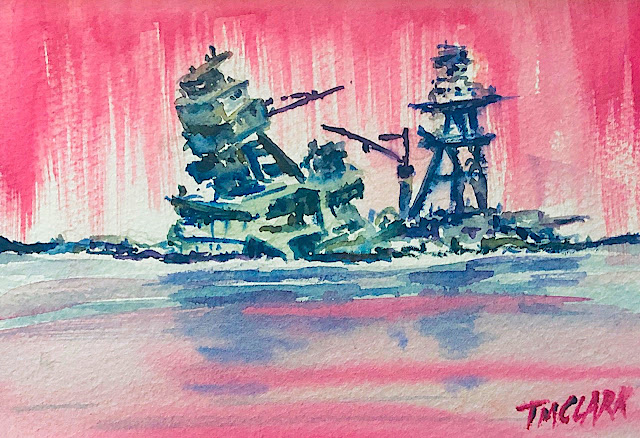
U.S.S. Arizona, Dec. 7, 1941, Pearl Harbor, 5 x 7 watercolor


Have you thought about what happens when America is attacked?
Eighty-years ago today, a divided nation united when the Japanese attacked Pearl Harbor. Four years later, two powerful foes were defeated in the world's deadliest war.
In April, 1861, a divided nation was attacked by South Carolina extremists, plunging a divided nation into our most deadly war, but eventually uniting the country. Before that tragedy, when referred to, the United States was always followed by a plural noun, "The  United States are." After that war, it's always been "the United States is." 
On 911, 2001, the United States was attacked by Muslim terrorists. The country united, and the world was on our side. Part of what followed was America's longest war, ending only this year.
On Jan. 6, 2021, domestic terrorists attacked the United States, threatening the lives of our elected officials in a coup attempt to overturn the U.S. Constitution. The last time the Capitol was attacked was by the British in 1814. A united country defeated a stronger enemy.
But this time, there has been no unity, only more division. Will America survive this attack?
I'm still waiting and hoping. That's why we need to remember Pearl Harbor today.


Thursday, May 23, 2013

Tornadoes and media critics

Disasters, whether natural like our tornadoes and hurricanes like Sandy, or man-made, like Newtown, 911, or the OKC bombing, cause an eruption of instant and continuing media coverage. And immediately also, a deluge of media criticism.
That's how it should be.
My students, and social media like Facebook, are almost instantly alive with discussions, mostly negative, with how media, especially TV, is covering what has happened. It is the most likely lightning rod, though increased use of social media, especially twitter, also comes under attack, usually for inaccuracy and insensitively.
I'm no exception, and two days after the tornadoes simply could not watch. I'm usually ranting and raving about broadcast peoples use of words, like "violent tornado." (Ever see a non-violent tornado?) And I cringe even more as the event wears on about interviewing little children, and asking parents stupid questions with no regard for their situation. The demands of the minute-to-minute news cycle is much to blame of course, and in disasters, much early information becomes inaccurate because of the chaos involved. It's not a lot different than pre-digital times, only in much more quantity and much more obvious.
We're all media critics
Much of this comes from my association and work with the Dart Center for Journalism and Trauma http://dartcenter.org/ which tries to train journalists on how to work with victims and to help journalists with PTSD. This relationship began following the OKC bombing when we received a grant to start a Victims and Media course at UCO. It continues today. And we've held workshops to help journalists as well. Check out their site. The Moore tornado is at the toe of their page.
So I'm super sensitive, but contrary to much media criticism today, mine is not politically oriented. Following disasters like ours, politics have no place, and everybody in the state knows it, I hope.
That's why I could praise a national Fox news journalist Shepard Smith, for his solemn, calming narrative about the tragedy the first and second day. No hyperbole, no yucky emotions or trite sayings. Good journalism always stands out.
I also continue to contend  that local newspapers are critical to  coverage in these times. I see that in Oklahoma this week, saw it in New Orleans in Katrina, after 911, in OKC after the bombing, and in many other places. They give people a source, an assurance that there is still a normal world, a standard of hope and humanity that victims can cling to in their devastated communities.
So while we're all media critics, and  usually negative, tragedies like this bring out the best in journalism as well.