"When dawn spreads its paintbrush on the plain, spilling purple... ," Sons of the Pioneers theme for TV show "Wagon Train." Dawn on the mythic Santa Fe Trail, New Mexico, looking toward Raton from Cimarron. -- Clarkphoto. A curmudgeon artist's musings melding metaphors and journalism, for readers in more than 150 countries.
Showing posts with label Buddha. Show all posts

Friday, July 24, 2020

Less is more

"Less is more," 5 x 7 watercolor, 140 lb Fabriano Artistico extra white cold press paper
Our materialistic culture values things, and the means to acquire more things. 
If there's one lesson that stands out during this pandemic of viruses, racism and political chaos, it is that America values things and money more than health and humanity. 
How can you tell? Listen to all the talk about the "economy," a short word for things and money. It has exposed the greatest weakness of capitalism...what happens when people can't work and earn money and acquire things? That's why there's so much pressure to "re-open" businesses, including schools and universities. 
Money is being lost, and that is more important culturally than lives. We equate lots of things, abundance, with success and quality of life.
People are suffering economically when they can't work to afford  even a house payment because our society, our government, is not prepared  nor equipped to care for those in dire need. Only look at the long lines and unemployment benefits disaster just in Oklahoma.
I'm not a communist, a socialist, nor a minimalist, but the lessons are clear...getting more things, a system built on that principle, is a disaster waiting to happen. It's happening
The last time this happened, in the Depression, it took 10 years to come to grips with, revolutionizing American society. Another depression is setting in, fueled by something more deadly than a Stock Market crash. 
This pandemic is changing American society  as we find we don't need to got to the store...it can be delivered. It's already bankrupted many smaller businesses, and laid off thousands of food service workers. Big retail is next. 
I read the other day that malls, those monuments and temples to materialism (euphemistically called "consumerism") will be the next victims --within a few years--of what this pandemic has wrought...death of retail stores. Think of all the people who will be out of work. 
And as I get older, I'm working on "divesting" myself of things and not getting more of them. I go to a store for something specific, and look at all those "things" I don't need.
Spiritual leaders like Jesus and Buddha,  revolutionaries like Gandhi, mystics throughout the ages, have warned and taught that material abundance won't make you happy. 
All these thoughts ran through my head as I tried to find something to paint in response to #WorldWatercolorMonth's prompt, "Abundance."
I started with the idea from Jesus saying he had come so we could have "life more abundantly," but couldn't figure out what to paint. In Psalms, "My cup runneth over" but that didn't sound fun, and sort of bland. 
Doing a little surfing the web on words and more, photos of people meditating or doing yoga on the beach showed up.
I'm not a practitioner, though I should be, and I know friends and relatives who are. 
Irony: this is an "abundance" of thoughts and words for a simple painting. Abundance? Less is more.

Sunday, February 7, 2016

A new year, new experiences, new thoughts, First Amendment

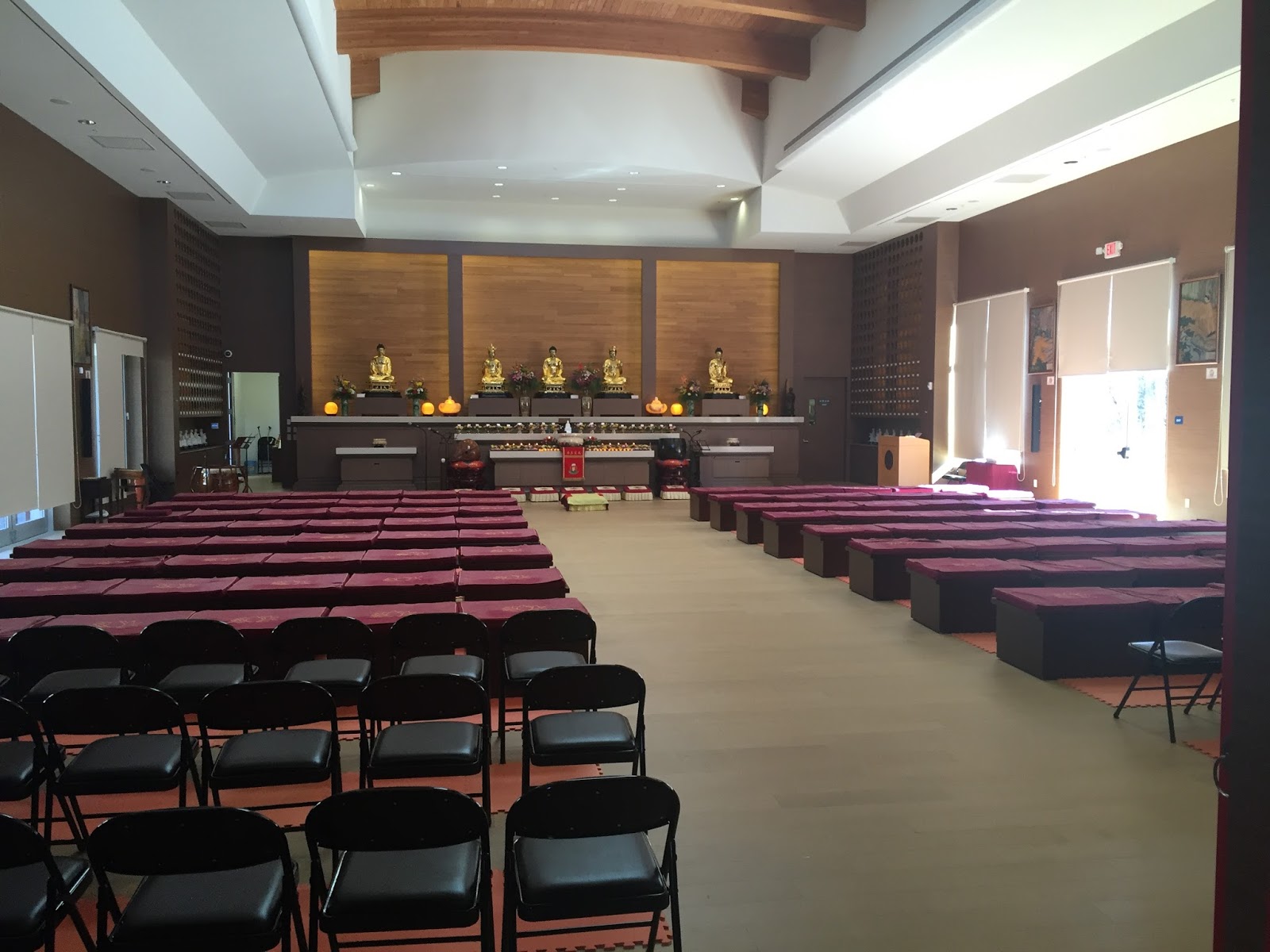
We attended the four-hour Chinese New Year celebration and worship and vegetarian meal at the Buddha Mind Monastery in far southeast OKC today.
Inside the foyer
Still processing and decompressing all that my senses encountered. Much to write. Susan and I and friend Christy Vincent attended. Thanks to friend and former student Sheri Guyse for inviting, and to Dave Rhea for joining us too.
As I drove up to this impressive building today, watching all kinds of Americans enter, I thought "First Amendment." Freedom of religion, not state-sponsored religion, but all religions welcome here. I wish our legislators and those who think we're a "Christian" nation could attend.
What Westerners would call the "sanctuary"
Those thoughts were fleeting as we took off our shoes and entered a different world, a world of peace and mesmerizing chants in a different language and an English homily, and strange liturgies with lots of bowing, and offerings of fresh flowers.
I took photos and now regret I didn't record some of the chanting, which transported you to a realm of peace. I wish I could have monitored my blood pressure as I'm sure it dropped.  There were about 100 or so folks there at 10:30, and then after the break and before the free meal, the place packed with more than double that for the liturgy of offering, more chants, and a visit by the Chinese dragon. More photos later.
Susan putting her shoes on after our visit.
There's so much about this I do not understand, humbled by my ignorance of an ancient belief with more than 500 million  followers. I don't even know what to call the woman who gave the homily, but it was compelling with advice on changing the world with our own thoughts and action, and including  the words, "every day is a new year."
Indeed, this is a new year's day.

Tuesday, September 10, 2013

Country at top of world, No. 119 on the blog

Mountains speak to me, and to many others, but I imagine they speak no louder anyplace in the world that in Nepal, where a reader clicked on the blog this week, making it the 119th country to have done so.
"The roof of the world" sounds trite, and understates this place I've always dream of visiting for two reasons. The first is the mountains. Nepal is home to the world's highest point, Mt.Everest, (Sagarmatha (सगरमाथा) in Nepali, "Forehead of the Sky"), at 29,029 feet, on the northern border with Tibet/China...and the country is home to 240 Himalayan peaks topping 20,000 feet.
It's not all mountains however, with a fertile, humid lowlands in the south. The other reason I'd like to visit is the name of its capital, Kathmandu. That is just so beckoning of adventure and being far away. I've been fortunate to have one Nepalese student here at UCO.
The country is a little larger than Arkansas and a little smaller than Oklahoma. It stretches 487 miles from from east to west, and from 150 to 250 miles wide, landlocked between Tibet--now ruled by China--and India, with a population of about 27 million.
About 80 percent of the population are Hindus, and, although Gautama Buddha was born in the country, about nine percent Buddhist.
The country was a monarchy  from 1768 until 2008, when a civil war ended and a federal multi-part republic was adopted. There is still turmoil between  the communist party and others, and elections are scheduled for this November.
The flag is unique in the world, the only one not a square or rectangle. Based on a design almost 2,000 years old, red is the national  color and that of the rhododendron. Blue symbolizes beach, and the triangles perhaps the mountains, the two symbols the permanence of the universe. (Some Material for this post came from Wikipedia.)
View a YouTube video of a flight over Everest below:
This gives me a chance to quote my favorite writer, John McPhee, who writes about geography. In Basin and Range, he wrote: "When the climbers in 1953 planted their flags on the highest mountain, they set them in snow over the skeletons of creatures that had lived in the warm clear ocean that India, moving north, blanked out. Possibly as much as twenty thousand feet below the seafloor, the skeletal remains had turned into rock. This one fact is a treatise in itself on the movements of the surface of the earth. If by some fiat I had to restrict all this writing to one sentence, this is the one I would choose: The summit of Mt. Everest is marine limestone."
At the top are 400-million-year-old fossils--the bones and shells of creatures that died in ancient seas--Ordovician limestone. The Himalayas began forming about 65 million years ago when the Indo-Australian plate of the earth's crust moved north and under the Eurasian plate, pushing the rocks up. 
The earth's crustal plates are still moving, India going north more than an inch a year, and the mountains rising up to 10 millimeters a year. That gives you an idea of how long this took, pushing mountains up more than five miles. We are small, and brief indeed.