"When dawn spreads its paintbrush on the plain, spilling purple... ," Sons of the Pioneers theme for TV show "Wagon Train." Dawn on the mythic Santa Fe Trail, New Mexico, looking toward Raton from Cimarron. -- Clarkphoto. A curmudgeon artist's musings melding metaphors and journalism, for readers in more than 150 countries.
Showing posts with label ghosts. Show all posts

Thursday, June 9, 2016

Two month flurry of pages read--II

The flood of reading started earlier when Vargas recommended the book on beekeeping I read in spring.
I found the author Hanah Nordhaus, had also written a book about Santa Fe, American Ghost, about a haunted house owned by the author's great great grandmother.
I learned much about New Mexico history in this book, and have walked by that house several times, never knowing it. I also found that the story is fictionalized in Paul Horgan's Centuries of Santa Fe. I own that book, pulled it off my New Mexico shelf and read that portion. Ahem. I found an error in this book too. She writes that the Santa Fe Trail originated in Saint Louis. Nope. First trip began in Franklin, Missouri in 1821, and I've been there, when visiting son Derrick and family when they lived in Columbia. 
But still, a valuable read. She also quotes Oklahoman and friend David Dary, from his book Frontier Medicine. And he agrees with me the trail started at Franklin.
Others:
Deep South, Four seasons on the back roads. Paul Theroux. One of my favorite travel writers, especially about trains (The Great Railway Bazaar). This book is an eye opener at the abject poverty in several southern states. He gets off the interstates, meets all kinds of rural people, and notes since the advent of NAFTA, most of the jobs are gone. He's no fan of Clinton.  The poverty he sees ranks with what he sees in Africa. Yet the US gives millions to help those countries, and almost nothing to our own citizens. As a Southerner I had to read this, and its storytelling and facts in the four seasons he travels there from his home in Cape Cod, are deeply disturbing. Some of it is not too far away, because the last state he visits in Arkansas. The only thing I found missing was a mention of the Confederate soldier statues on every  courthouse square. I just thought that was a given.
Across the Cimarron. Jerry Wilson. From my friend and small press owner Jeanetta Calhoun Mish of Mongrel Empire Press. I got halfway  through this novel before being distracted by another book. So now I'll finish it. It's a novel of the Oklahoma land run, and gives you a great idea of what those early settlers' lives were like. And it's a good history book too. 
Me with authors Corbett and Marmon
Laguna Pueblo, a Photographic History. Lee Marmon, Tom Corbett. I bought this at the Western Heritage Awards at the Cowboy Hall in April, as it is the Wrangler Award for photography. Marmon is a 90 something year old Laguna elder who has been photographing that beautiful New Mexico place for decades, and Corbett worked with him. It's full of black and white photography from years back, with up to date description and narrative. Of course I met the authors and had them sign it, though Marmon uses a stamp of his signature due to his age. 
Broken Open. How Difficult Times Can Help Us Grow. Elizabeth Lesser. Another book I have not finished, but I've skipped around in it, reading the chapters that most interested me. Much self help and understanding here. 
Reclaiming Conversation. The Power of Talk  in a Digital Age. Sherry Turkle. This book is part of a UCO book club, so I got it free. It's very scholarly and I won't finish it, but it discusses how digital phones are robbing high school students--an others--of empathy. I've read several pages. A recurring theme I just had a chat with our Uber driver this weekend.
The Krasingers
The Western Cattle Trail. Gary and Margaret Kraisinger. Ok, I haven't read much of this handsome book, but I and two other judges picked it as the best non-fiction work for the Wrangler Awards. Benefit of being a judge gets us into the back tie dinner and ceremonies. And we ended up sitting with the authors, two former Kansas school teachers who have devoted their lives to tracking, photographing and mapping, segment by segment of the historic cattle trails. Wow. So I also got their signatures.
The Wrangler winners
Not read, but pictured, Cimarron Crucible, Barbara James Fretwell. I bought this novel becuase it is set in Cimarron county at the far end of the Oklahoma panhandle. It is about a crime and murder of a little girl, and I'm not quite ready to tackle that subject yet.
Except for the gifts, the cattle trail book and the UCO conversation book, I buy all my books at either Full Circle Bookstore, or Best of Books in Edmond.


Saturday, June 4, 2011

Ghosts and legends

The last time they were all together, from left, Terrence Miller (you can see how sick he is in his eyes); Lewis Watts, Cuba John Miller Clark Reasor, Rex Thweatt, Michael Henry and Champ--oldest to youngest. Only Mike is now alive.  Photo from a long time ago in Whitesboro, Tex.,  by Terry.
It's been a week and day of ghosts for me, traveling to see Mike in Walsenburg, Co. It's located on the "Highway of Legends" as they call it in southeast Colorado, and it occurs to me that legends are ghosts.

So today I begin cleaning out the garage, sorting through old boxes  and filling two trash bins. but there is so much you can't throw away--lots of Dad's drawings; letters from grandmother to her sons and from them to her; family history charts; photos of the boys at different stages of their lives; mementos of my own life and children. Lots of things from Mike, after I cleaned out his Santa Fe apartment last year, moving him to a veteran's home. It's sad there is no place but the garage for them, but.... I don't want to dwell in the past, nor to ignore it, and it's good to jog memories, good and bad, hopes and loves and regrets. But. After four hours, I've had about all the ghosts I can handle for one day.

Much more to do--mailing photos to my kids and brother, sorting through the stuff, trying to put it together and tell the stories, the legends of these five boys from the red-dirt poor Comanche, Oklahoma, who all escaped it and the Depression.

But Mike's words to me yesterday stuck with me on the front porch of the veterans home, where he's captive of a wheel chair because he can't walk, the world traveler, now 89. "Terry, enjoy every day you live."

Lots of thoughts and ghosts on the way home, thankfully stopping to play with grand kids and visit daughter and son in law in Amarillo. I traveled 85 years in just a few hours. Mike in the morning, and grandson Max, 4, in the evening.

But today was a good day to start stirring the ghosts, but only a little. Someday someone will be going through my things like I did today. You can't escape the ghosts.

Sunday, May 8, 2011

Ghost towns

Traveling to Wichita Falls and then Waurika this Mother's Day to visit Mom's grave with my brother Jerry of Lubbock stirs ghosts in those towns and in my life.

We gathered last night for dinner and personal time, in the city where my grandmother on my Dad's side, Cuba John Miller Clark Reasor, had a watermelon stand and restaurant downtown back in the early 50s. I barely remember it, but it was hot then when we visited in the summer. It was already 101 yesterday. That's the city where we drove every week for 12 years to have the newspaper printed when I owned the Waurika, OK, News Democrat 25 years ago.

Crossing the Red River
Jerry and I drove north through Burkburnett, crossing the Red River, and turned east on US 70 toward Waurika and the cemetery where Mom is buried. It's a long 28 miles and it was hot already at 9:30, going into the sun through the rattlesnake-infested Red River breaks, the mesquite, the wheat--land largely unpopulated except by cattle. Years ago, we used to travel that route west going to New Mexico and Texas.

At the windswept hill west of Waurika, we pulled off  the road, crunched over the gravel and drove up by Mom's grave. I've come most years to plant real flowers at the grave, saturating the plot with water and cleaning off the gravestone. This is Jerry's second or third trip. He said he was "going to see Momma."

Jerry at Mom's grave
We planted the flowers, and stood around, talking, to each other, and to her too, remembering, thinking, wondering, about the past and the future, as the wind slowly dried the water off her marker, leaving only the incised letters of her name and her dates of life wet:
Francis Faye Culp Clark
June 15, 1909
July 5, 1980

It's not quite in the cemetery. The wind always blows and you can hear doves and meadowlarks all the time. But we were quiet inside, I think. We wandered around other graves, commenting on the names and the dates. Babies and children, and a lot of people I remember personally having known them or worked with them when we lived there before leaving in 1986. The names themselves are stories, and ghosts. I should have written them down. Maybe someday. Ghosts.
My great partner and wife, Donald J. and Lorene B. Morrison
His meeting me there revived other memories and ghosts. Every year I search for the grave of my former newspaper partner and his wife, Donald J. and Lorene B. Morrison. Never have found it, because I thought it was in an older part  of the cemetery.

Wandering with Jerry, not far from Mom's grave, I found it. More memories and ghosts.

We didn't spend long there, lost in our thoughts and he with a four to four and a half hour drive ahead.  I kneel down and kiss the gravestone and say goodbye.

Jerry asked if I realized that when we're gone, no one will visit those graves. Mortality hangs in the warm air.

Red brick streets
Ghosts of a past life
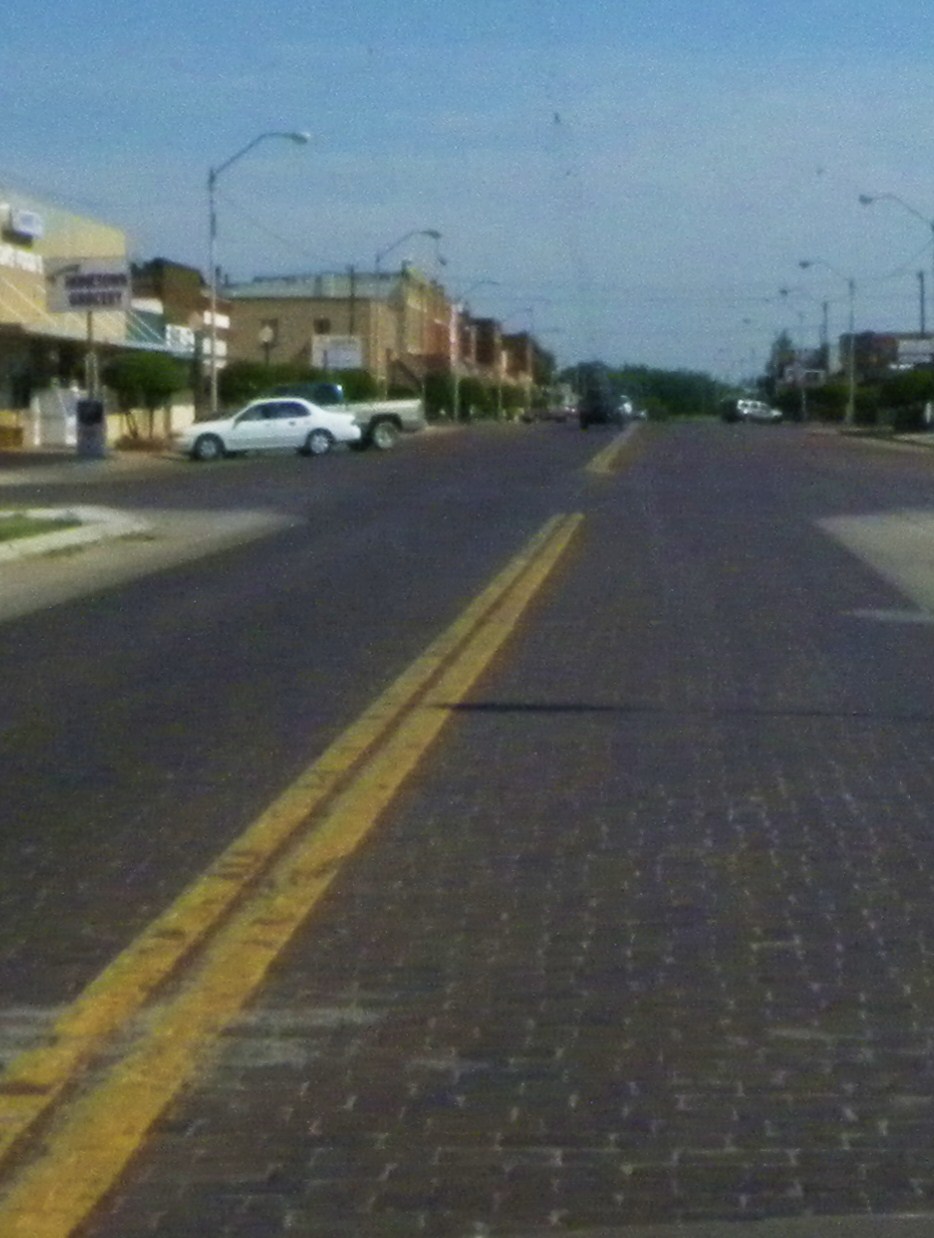
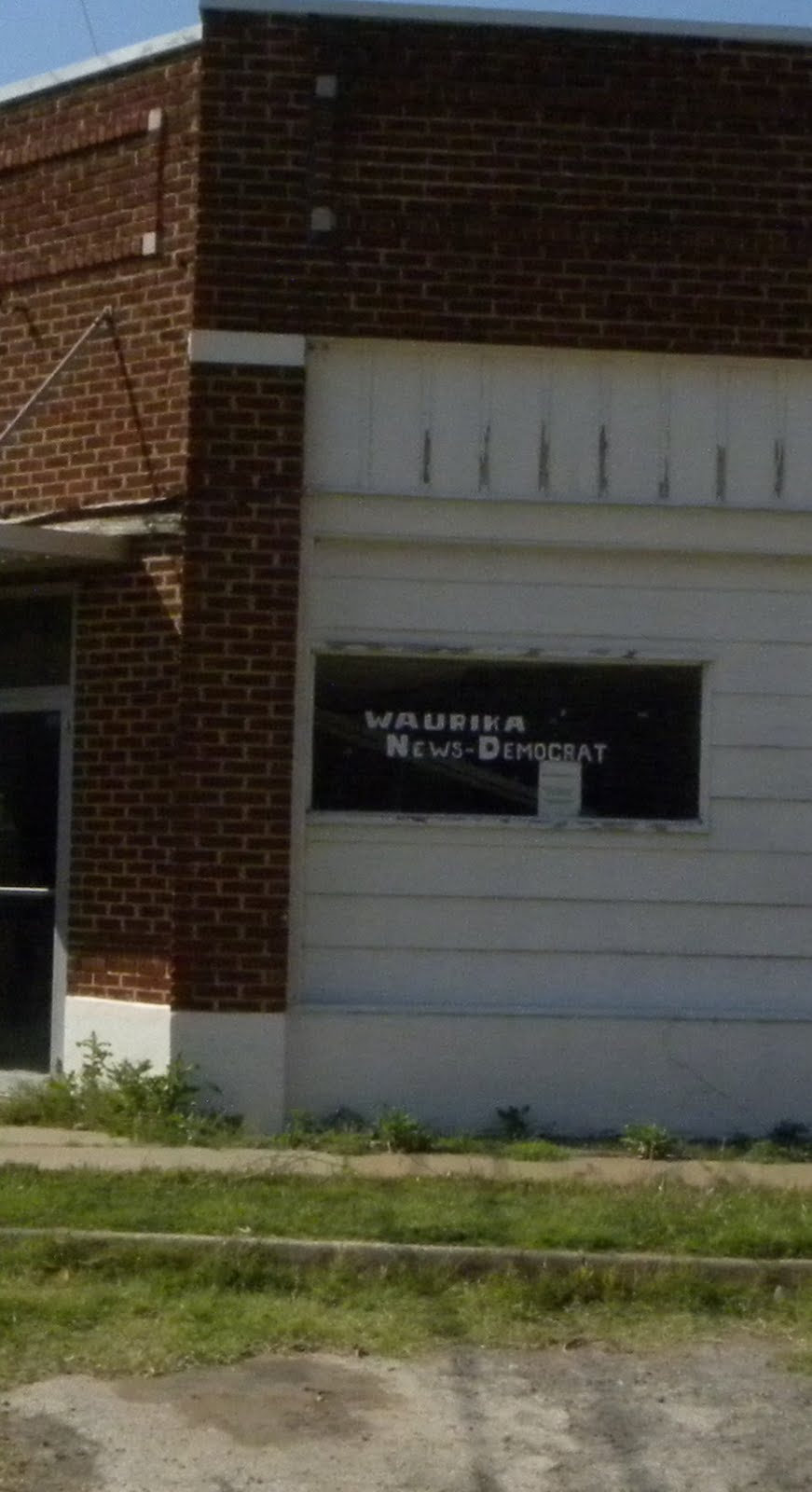
Then I drive through the little town of Waurika, about half the size of when we lived there...withering like most of the state west of I-35. I can tell you stories about many of the buildings--with the people involved, as I drove up those red brick streets, past the old newspaper office, the railroad depot, vacant store fronts once alive with people and hope. I drove past crowded parking lots of the church were we went, and the one where Mom went. More memories, more ghosts. Took a picture of the first house we had there, when our youngest was born. Drove past the high school, turned north on US 81.

The restored Rock Island Depot--now the library. It was vacant for years.
I stopped to take a photo of vacant buildings in Addington, which had a Socialist newspaper in 1909, and is now barely there. I think most towns have ghosts, but they're easier to find in small towns, rather than metro areas where "progress" erases them.  I pulled into Comanche, 15 miles north of Waurika where my Dad was born, past the boarded up brick school of the Comanche Indians he and his brothers attended.  More ghosts. A new bank building is going up on the corner, replacing the old Chief Cafe where granddad used to sip coffee. Around the block a few cars are in the gravel parking lot of the Comanche Church of Christ where Dad's funeral was.

Terry and Jerry at Mom's grave
North of town I stop on old US 81 and drive up more gravel to plant a few flowers at Dad's grave. He died in 1973. Beside him is the grave of his father, Erle Thweat Clark, who died in 1963. Just north of his grave are two more. Mary Unit Watts Clark, who died in 1926, and Batte Peterson Clark, who died in 1916. My brother and I carry their name and more. Who will visit our graves?

I talk briefly to Dad, and then head north, not stopping in Duncan, because there are ghosts there too. I'm eager to get to Chickasha and the turnpike and head home at 75 mph. Slower speed and memories and ghosts and ghost towns are important

But it's important not to try to live there, or stir them too much.