"When dawn spreads its paintbrush on the plain, spilling purple... ," Sons of the Pioneers theme for TV show "Wagon Train." Dawn on the mythic Santa Fe Trail, New Mexico, looking toward Raton from Cimarron. -- Clarkphoto. A curmudgeon artist's musings melding metaphors and journalism, for readers in more than 150 countries.

Sunday, June 12, 2016

Blog readers in 148 countries

I'm always astounded that my blog attracts readers--or they stumble across it--from so many countries in the world. 
In May, readers from five new countries clicked on these pages, bringing my blog visitation register to 149 countries total. Countries and dates someone visited the blog:
5-3--Benin


5-9--Senegal


5-10--Anguilla

5-11-South Sudan


5-18--Paraguay. 

That brings to a total of 25 countries in Africa, 12 in South America, and 11 in the Caribbean.
I love seeing these facts show up and delving into the maps, histories and flags of these countries. It's a continuing education in geography for me. And it always sparks my imagination about the readers and their lives, as well as my wanderlust to travel, especially to places like Anguilla and white sandy beaches.
Also note that the flags reflect the different histories and in these cases the colonization if these countries, French, Spanish and English.
Where I've had other readers on these continents and regions:
Africa--Morocco, Algeria, Libya, Egypt, Togo, Ghana, Ethiopia,  Uganda, Tanzania, Kenya, Nigeria, Tunisia, Gabon, South Africa, Mali, Mauritus, Mauritania, Cameroon, Angola, Botswana, Zambia, Mozambique, Benin, Senegal, South Sudan,
South America--Colombia, Peru, Chile, Uruguay, Argentina, Brazil, Venezuela, Ecuador, French Guiana, Guyana, Bolivia, Paraguay.
Caribbean--Caymans,  Sint Maartin, Trinidad and Tobago, Puerto Rico, Jamaica, Dominican Republic, The Bahamas, Netherlands Antilles, St. Kitts and Nevis, Bermuda, Anguilla

Friday, June 10, 2016

Excerpts, and philosophy, from an Alaskan's journals

The comments below, from Richard Proenneke back in the late 1960s are astounding to me.
Building his own cabin in the Alaskan wilds with only hand tools, he kept a daily journal.
The fete alone is mind- bending, but then his writing is also magnificent, and his reflections on time and technology and work are more true than ever.
Philosophy from the wilderness. 
Enjoy.


  • A man is on his own frequency out here. (about time of day)
  • The lake was moon still.
  • This country makes a man younger than his birthdays.
  • Its ears worked like a pair of scissors and its nose twitched  as if with an itch it couldn't reach. (A snow hare)
  • Strange to wake up at 3 in the morning and feel like daylight is being wasted.
  • …but risk now and then is good for a man. Makes him come alive and tunes his body to a greater efficiency.
  • There's no water in the world like that born in the high country.
  • The gates of heaven are near. (In the mountains)
  • ...took several sips  from the trickles that made music over the stones.
  • I just season simple food with hunger.
  • We have become accustomed to work on pieces of things rather than wholes. It is a  way of life with us now. The emphasis is on teamwork. I believe this trend bears much of the blame for the loss of pride in one's work, the kind of pride the old craftsman felt when he started a job and finished it and stood back and admired it. How does a man on an assembly line feel any pride in the final product that rolls out at the other end.
  • At my pace, I can notice things... . Nature provides so many things if one has the eye to notice them.   A bubble on the water, an arctic tern's breast tinged with the blue reflections of the lake.
  • News never changes much. It's just the same things happening to different people. I would rather experience things happening to me than read about them happening to others. I am my own newspaper and my own radio. I honestly don't believe that man was meant to know everything going on in the world, all at the same time…and the poor guy with all the immediate problems of his own life is burdened with those of the whole world.
  • I don't know what the answer is. In time man gets use to almost anything but the problem seems to be that technology is advancing faster than he can adjust to.
  • I don't like the look of progress, if that's what it's called.

Thursday, June 9, 2016

Two month flurry of pages read--II

The flood of reading started earlier when Vargas recommended the book on beekeeping I read in spring.
I found the author Hanah Nordhaus, had also written a book about Santa Fe, American Ghost, about a haunted house owned by the author's great great grandmother.
I learned much about New Mexico history in this book, and have walked by that house several times, never knowing it. I also found that the story is fictionalized in Paul Horgan's Centuries of Santa Fe. I own that book, pulled it off my New Mexico shelf and read that portion. Ahem. I found an error in this book too. She writes that the Santa Fe Trail originated in Saint Louis. Nope. First trip began in Franklin, Missouri in 1821, and I've been there, when visiting son Derrick and family when they lived in Columbia. 
But still, a valuable read. She also quotes Oklahoman and friend David Dary, from his book Frontier Medicine. And he agrees with me the trail started at Franklin.
Others:
Deep South, Four seasons on the back roads. Paul Theroux. One of my favorite travel writers, especially about trains (The Great Railway Bazaar). This book is an eye opener at the abject poverty in several southern states. He gets off the interstates, meets all kinds of rural people, and notes since the advent of NAFTA, most of the jobs are gone. He's no fan of Clinton.  The poverty he sees ranks with what he sees in Africa. Yet the US gives millions to help those countries, and almost nothing to our own citizens. As a Southerner I had to read this, and its storytelling and facts in the four seasons he travels there from his home in Cape Cod, are deeply disturbing. Some of it is not too far away, because the last state he visits in Arkansas. The only thing I found missing was a mention of the Confederate soldier statues on every  courthouse square. I just thought that was a given.
Across the Cimarron. Jerry Wilson. From my friend and small press owner Jeanetta Calhoun Mish of Mongrel Empire Press. I got halfway  through this novel before being distracted by another book. So now I'll finish it. It's a novel of the Oklahoma land run, and gives you a great idea of what those early settlers' lives were like. And it's a good history book too. 
Me with authors Corbett and Marmon
Laguna Pueblo, a Photographic History. Lee Marmon, Tom Corbett. I bought this at the Western Heritage Awards at the Cowboy Hall in April, as it is the Wrangler Award for photography. Marmon is a 90 something year old Laguna elder who has been photographing that beautiful New Mexico place for decades, and Corbett worked with him. It's full of black and white photography from years back, with up to date description and narrative. Of course I met the authors and had them sign it, though Marmon uses a stamp of his signature due to his age. 
Broken Open. How Difficult Times Can Help Us Grow. Elizabeth Lesser. Another book I have not finished, but I've skipped around in it, reading the chapters that most interested me. Much self help and understanding here. 
Reclaiming Conversation. The Power of Talk  in a Digital Age. Sherry Turkle. This book is part of a UCO book club, so I got it free. It's very scholarly and I won't finish it, but it discusses how digital phones are robbing high school students--an others--of empathy. I've read several pages. A recurring theme I just had a chat with our Uber driver this weekend.
The Krasingers
The Western Cattle Trail. Gary and Margaret Kraisinger. Ok, I haven't read much of this handsome book, but I and two other judges picked it as the best non-fiction work for the Wrangler Awards. Benefit of being a judge gets us into the back tie dinner and ceremonies. And we ended up sitting with the authors, two former Kansas school teachers who have devoted their lives to tracking, photographing and mapping, segment by segment of the historic cattle trails. Wow. So I also got their signatures.
The Wrangler winners
Not read, but pictured, Cimarron Crucible, Barbara James Fretwell. I bought this novel becuase it is set in Cimarron county at the far end of the Oklahoma panhandle. It is about a crime and murder of a little girl, and I'm not quite ready to tackle that subject yet.
Except for the gifts, the cattle trail book and the UCO conversation book, I buy all my books at either Full Circle Bookstore, or Best of Books in Edmond.


Two month flurry of pages read-I

I won't ever eat octopus again. 
Actually I've only recently tasted it, but after reading the Soul of an Octopus, sent by my friend and former student  Lauren Vargas of Boston, I discovered a new world of intelligence. Editor that I am, I discovered one small error in it. The author refers to a boat going so many "knots per hour." Ahem. knots are nautical miles per hour. But this is a book of discovery about life on this planet. Some things should not be human food.
That book was one of ten I've completed, two sampled and one half finished in the last two months, bringing my total read so far this year to 13 plus-surpassing my goal of one a month.
I usually read and write reviews of these, but blogging has been blocked, but books have not since early April.
I'm not inclined to comment much on each of these, but you'll note all but three are non fiction, and one of the others is poetry.
Notes:
Coyote America, Dan Flores, "a natural and supernatural history." If you're a Westerner, you know coyotes, but there's more information here than you ever imagined. They're the oldest deity figure in the Americas. they originated in America. They now inhabit all major cities east to west. In spite of man's best efforts, you can't wipe them out. In fact, we're responsible for them spreading everywhere. Lots of science and history here, plus a naturalist's viewpoint.
One Man's Wilderness-An Alaskan Odyssey. Sam Keith/Richard Proenneke. From the journals of a man who built his own cabin with handtools, telling how he built it a step at a time. He  lived alone in the Alaskan wilderness beginning in the late 60s. With his color photographs. He died in his 80s in 2003.
The Highwayman, Craig Johnson. A Longmire novel, set in the Wind River canyon in Wyoming, a ghost story involving highway tunnels. Shorter than most, also. A two-day read. You can look the setting up on Google maps.
The Great Spring. Natalie Goldberg of Writing Down the Bones fame (I have a signed first edition). Lives in New Mexico, a follower of Zen, teaches writing. This is one of those books I like because I can skip around and read the chapters I want first.  About writing, living, and more.
Woe to the Land Shadowing. Red Shuttleworth of Washington State. Won the National Cowboy and Western Heritage Museum Wrangler Award for poetry this year. I got to meet him and he signed it. It's my annual tradition to buy these books of Western poetry. He and his wife are real westerners, but this book stretches the mind with his sparse views of life in the modern west. 


Sunday, June 5, 2016

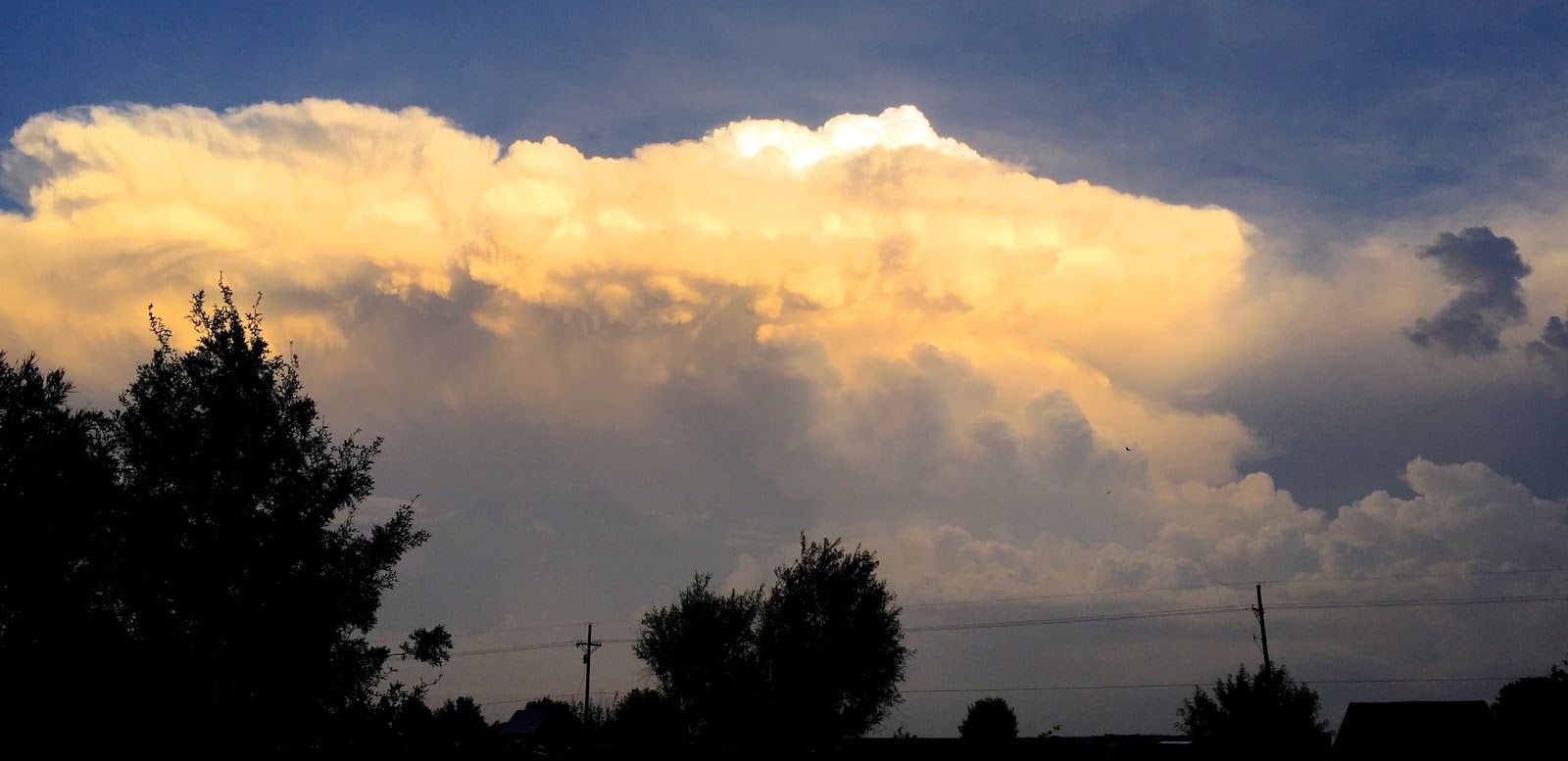
Out here there's the sky...West Texas

Other people faced long security lines during the weekend of heavy traffic. Not me, near Dickens, Texas, Republic of.

Memorial Day weekend trip to see my brother...the wide open spaces of West Texas...even when it's flat, it's not boring. "Out here there's the sky," Willa Cather.
We had thunderstorms, a cold front and Haboob sand storm, and more thunderheads. Love it.
"I will lift up mine eyes..."--Psalms 121.