 |
| Daily watercolor, 5.5 by 8.5--Stormy evening on the Great Plains |
Tuesday, April 26, 2016
Storm a'coming on the Great Plains


Saturday, April 23, 2016
Revelations, perceptions, realities and New Mexico
 | |
| Morning dreaming of the high road to Truchas, 5" by 6" journal watercolor on back porch |
Quiet time revelations after a walk
in Hafer Park this morning
"Since perception is reality, therefore all art is reality. There are no false views, wrong expressions, when artists put down what they perceive." -Terry M. Clark
Think about it--yes, some are better at perceiving than others--Mozart, Michelangelo, Cezanne, Picasso, Whitman, Conrad, Twain, Parker, Ansel Adams, McPhee, Prince, Mish, Jake Harms, and millions more in all the arts. Perhaps a few times, Clark?
"Above all, I want to make you see,"--Joseph Conrad. "When I'm on stage, I don't think, I feel,"--Keith Richards.
As an uptight first born journalist I began painting by trying to get every detail photographically right. Some freedom eventually came with more practice, and especially watching my grandchildren paint, for who there are no rules. Looking at early work, or at work now when I'm in a dry spell, I see this morning, that every angle is different, every color is different, every shape is different, depending on how I look at things, and knowing you will see them differently. Why have I not had this insight before on my work--whether watercolor or writing?
It helps to attend the Oklahoma City Festival of the Arts and be bombarded with a multitude of perceptions and realities.
Thus home from the walk to take out my leather bound watercolor journal--art and perceptions of reality in its own right--from Mind's Eye Journals--bought last year, but renewed with a visit at the art show with owner Teresa Merriman and her husband of Colorado.
The high road to Taos, at Truchas, New Mexico, painted from memory, because that perception, that reality, is so deep within.
Saturday, April 16, 2016
Unsettled skies
 |
| "Unsettled Oklahoma skies"...today's watercolor, 9 by 12 |
Unsettled skies and more...
Plenty to write about, plenty of books and people, and yet like the skies in the opening pages of Steinbeck's Grapes of Wrath, the rain won't come. Part of the drought is an almost aversion to the computer and keyboard, part a "rain shadow" from the peaks of activity in the past months, and probably, part just because of the years and miles.
But at least, there are the skies of the Great Plains, and the promise of rain.
Thursday, March 31, 2016
143 countries--from a land of beauty, brutality, slavery


I sure wish I know who this reader was, and the joy of new readers is my journey into discovery of countries, people, history and my beloved maps.
The central Asian country is one of only two doubly landlocked countries in the world (surrounded by landlocked countries).
 |
| One of the ancient mosques |
Samarkand, a major city on the route, contains a landmark of Islamic architecture--the Registan, a plaza bordered by three ornate, majolica-covered madrassas dating to the 1400s.
It's officially a democratic republic with a diverse culture and its official language is Uzbek, a Turkic language written in our Latin alphabet. Russian is also widespread as a language.
 |
| What's left of the huge Aral sea |
Uzbekistan also has the world's second highest rate of slavery with 3.97% of the country's men, women and children living in bondage to slave masters in both domestic and industrial labor, being forced to pick cotton for the country's main export. There are currently 1.2 million slaves in the country.
Who's invaded? Alexander the Great, Genghis Khan, the USSR. Ever hear of Tamerlane? This is his home, and his real name was Timur. His man name struck terror across the Asian world, seeking to emulate Genghis Khan.
 |
| Timur's Empire |
It's interesting to me that in America, we never studied any of this in history. Why?

Thank you Uzbek reader. I learned so much. And you got me back to blogging.
Sunday, March 20, 2016
The day when you can see time
 |
| Susan and I at Chaco Canyon, New Mexico |
Coincidentally, and really unawares, in the past week, as a matter of fact last night, I'd talked about camping out at Chaco Canyon, the site of the Anasazi culture that more than a thousand years ago accurately recorded and measured the movement of the earth around the sun.
 |
| Equinox dawn at Fajada Butte, where the Anasazi measured time |
I've written about it on this blog many times, and may not be able to add much original this year, but I'm still drawn to it, to the memories, to the power that still resides in that place
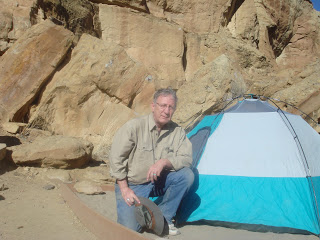 |
| Camping on Equinox at Chaco |
I don't know if I can convince my very urban wife to go there overnight in a tent on the ground, but the place is calling. It always does. To me it isn't about history, it's about eternity--present tense.
You can see time move there, from the stars wheeling overhead, to the shadows of the rising and setting sun climbing up the sandstone cliffs, to the ancients' markers in their stone architecture.You can see time move...
 |
| These ruins are not vacant |
 | |
| Fajada Butte--watercolor |
Where you can travel in time
When you can see time
Solstice dawn and days missed
When the sun stands still
Poetry in the canyon
Where you can see time
Subscribe to:
Posts (Atom)