"When dawn spreads its paintbrush on the plain, spilling purple... ," Sons of the Pioneers theme for TV show "Wagon Train." Dawn on the mythic Santa Fe Trail, New Mexico, looking toward Raton from Cimarron. -- Clarkphoto. A curmudgeon artist's musings melding metaphors and journalism, for readers in more than 150 countries.
Showing posts with label Anasazi. Show all posts

Thursday, December 17, 2020

Desert star--8 days to Christmas

"Desert Star," 5 x 7 watercolor Christmas greeting card

Desert
dwellers know the stars.

It's no accident that much of astronomy as we know it began in the desert.

Muslim inhabitants of north Africa and the Middle East  followed the stars--in cold clear nights where they became beacons...and science.

Go to the desert southwest of New Mexico and see how the Anasazi at Chaco Canyon, and elsewhere, studied the stars... .

Our urban world has lost the stars, through light pollution, through indifference and technology...but

We've also lost magic, and a sense of eternity, and humility, and spirituality.

That's why the fabled star of the New Testament's Middle Eastern skies matters...a signal more important today that there is much more to life than our materialistic, self-centered so-called "universe."

Friday, December 21, 2018

Chaco Solstice - 4 days 'til Christmas

Chaco at solstice, 5 x 7 watercolor
The stars are aligned, including ours. The moon is full. 
In the Anasazi "ruins" of the Southwest, including Chaco Canyon in New Mexico, all the buildings were aligned vertically and with the points of the compass.
They knew because they watched and studied and measured the heavens 1,000 years ago.
We have separated ourselves from the cosmos, trading the milky way for neon lights so we can barely see the stars in a world devoid of dark.
Chaco's pictograph of the 1054 nova
The star we read about this season? Probably a nova, an exploding star, such as the one they observed and painted by a forgotten artist on their sandstone cliffs in 1054.
These are not  "ruins" either... the spirits of the people still inhabit them. If you've ever camped there, you know, because they harnessed the power of the universe to build and thrive.
If you've camped there, you can almost feel the earth move beneath your feet and watch time as it passes, shadows sliding up and down the cliffs, and the stars wheeling overhead.
They measured and recorded all of this by observation over the years, setting up a rock calendar of the sun and moon's movement atop Fajada Butte.
They would have know what today was, its significance, just as other "primitive" peoples did even long before the Anasazi.
Of course we're too "civilized" for that, barely noticing the changes, other than it's the shortest day of the year.
No wonder the magic of solstice is gone, and Christmas merely a worship of materialism, rather than the eternal.

See also:
Solstice Dawn
When the Sun Stands Still

Sunday, March 20, 2016

The day when you can see time

Susan and I at Chaco Canyon, New Mexico
There are two days a year when I think specifically about New Mexico...and this was one of them.
Coincidentally, and really unawares,  in the past week, as a matter of fact last night, I'd talked about camping out at Chaco Canyon, the site of the Anasazi culture that more than a thousand years ago accurately recorded and measured the movement of the earth around the sun.
Equinox dawn at Fajada Butte, where the Anasazi measured time
This day --equinox-- figured deeply in their religion and lives, and since I've camped there several times, it figures deeply in my life cycle.
I've written about it on this blog many times, and may not be able to add much original this year, but I'm still drawn to it, to the memories, to the power that still resides in that place
Camping on Equinox at Chaco
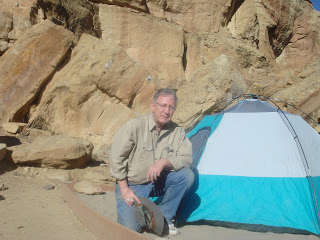
I was last there about five years ago, camping out alone, and it was freezing cold. I'd been to see my late uncle Mike in Santa Fe, and then headed northwest, eventually 25 miles off the paved road, to silence, to solitude, to imagination and much more in the high desert.
I don't know if I can convince my very urban wife to go there overnight in a tent on the ground, but the place is calling. It always does. To me it isn't about history, it's about eternity--present tense.
You can see time move... 
You can see time move there, from the stars wheeling overhead, to the shadows of  the rising and setting sun climbing up the sandstone cliffs, to the ancients' markers in their stone architecture. 
These ruins are not vacant
And those ruins are not vacant, as the Pueblo Indians will tell you. They are still inhabited by the spirits. That I believe, else why would my spirit be so drawn two specific days a year, and in between?
Fajada Butte--watercolor
Links to a few previous articles from the past seven years:
Where you can travel in time
When you can see time
Solstice dawn and days missed
When the sun stands still
Poetry in the canyon 
Where you can see time 

Sunday, December 20, 2015

Four days 'till Christmas--never 'alone'

"...since we are surrounded by such a great cloud of witnesses... ." --Hebrews 12:1
"They walk with us" 5 by 7 watercolor, card
We are not alone at Christmastime or any other time when you think deeply about it. We may be by ourselves, or wishing we were with others, or feeling lonely, but... .
Travel into the Southwest and visit the ruins of the Anasazi, and you can sense what we would call ghosts, but today's Native Americans will tell you those places are not vacant, but still inhabited.
We are inhabited by our genetic past, our kin and friends who have been a part of our lives. They have become a part of who we are--some are fresh memories, some are perhaps long forgotten, some never known still imprinted deep within, the way we laugh or the look of our smile, or certain gestures or talents and more than we can imagine.
In a sense, they walk with us. Everyone we have known becomes part of the compost that makes us who we are today.
It is good to be "alone" sometimes, and at others we crave companionship but as we gather with friends and families this holiday season, think about all those others who walk with us in this journey.
We miss those who have left this life, or who are far away, but we are literally "surrounded by a great cloud of witnesses."

Thursday, December 17, 2015

Eight days 'till Christmas--sacred places


Taos Pueblo, 5  by 7 watercolor, card
Where are your sacred places and why? Regardless of religion or beliefs, I think most people have some, especially as we grow older. 
They begin as special places and sometimes grow over the years in significance. They're based on memories, on events, on traditions, on cultures, perhaps even on genetics and barely understood instincts. Other living things apparently have them...witness the migrations of insects as small as Monarch butterflies to larger wildlife--birds, animals, fish and reptiles for breeding.
For humans, special places grow over years and centuries, especially with oral traditions, and dramatic geography or resulting architecture or more. Sacred implies spiritual as these places take on more than just a physical existence or presence. They become places where the the division between physical and eternal is thin.
Most sacred places in the world are old--Stonehenge, Easter Island, the Pyramids, Machu Picchu, Asian Temples, Temple Mount at Jerusalem, Mecca, The Vatican--places that were built because the land itself  was sacred and demanded attention and remembrance.
There are other places in all cultures I believe, when you visit them, that have become sacred on their own--have you been to Gettysburg? To the USS Arizona memorial? To the Normandy American Cemetery? To the Vietnam Wall? To Wounded Knee?
In nature, the mountains, the high places, the remote places became sacred also.
I see all that my New Mexico, where the Anasazi and their kin found sacredness in the landscapes and spirituality of all creation.
It is especially so for me both at Chaco Canyon and at Taos Pueblo--the oldest continuously occupied place in North America, the centuries old adobe and people still so in contact with the elemental sacredness, and their imposing sacred mountain.
In this season that is supposed to be sacred for one religion, let us respect all religions, beliefs  and  peoples who have sacred places and times. They are a part of our very existence.

Wednesday, September 23, 2015

Equinox--where you can travel in time

Fajada Butte at dawn

Equinox--I always think of Chaco Canyon, having camped there a few  years ago on a personal pilgrimage. You travel 25 miles off the paved road in northern New Mexico, back in time. 

Actually, you travel back into time on those special days. 

I camped there one spring equinox, and about froze to death, but I'd do it again...to be alone, to see the stars, to see the universes glowing in the campfire coals, to write that poetry.

Silhouetted against the night sky is the bulk of Fajada Butte, where the old ones built the "sun dagger" on top of it a thousand years ago to accurately measure equinox and more, their guide to the seasons and life and the powers of the universe.

What follows is from an earlier post.

Camping at Chaco Canyon, watching time move in morning shadows on equinox
The sun blinds you, driving due east or west, morning or evening. You can almost feel the earth move under your feet, each day this September as the sun inches due west or east. It's not moving, but we are.
As urban dwellers, as citizens of the age of science, as people removed from nature, we may not notice, other than the inconvenient glare in the windshield or rear view mirrors early and late in the day.

Our media will announce the official start of autumn, but we miss the point that our ancestors, and those still in tune with the earth, know well.
Equinox--the day the night and day are of the same length, the slow tilt of the earth's axis that will bring the end of the planting seasons, the start of the harvest seasons, the coming of the cold seasons, the preparation for another year's "end."
Many people will gather at ancient sites like Stonehenge in England and Chaco Canyon in New Mexico to observe the day, to relive rituals lost in time, trying to retouch our instinctual past, and something more.
There is something powerful about the day, about those sites, that transcends science, but we've largely forgotten it the more removed we are from the physical world as we dwell in air conditioned cocoons. Perhaps, like our appendix and shortened tail bone, there is a vestigial element in our memory that calls out to us. I hope so.

'You can see time there, time moving, shadows moving up and down sandstone cliff faces'
Having camped in  Chaco on more than one spring equinox, I know you can see time there, time moving,  shadows moving up and down sandstone cliff faces. Those ancient "Anasazi" measured and marked with great accuracy over the years-- in feats of patience and civilization--the movements of the sun and moon. 
It may have been of necessity for an agricultural society, and it almost surely had religious significance. When you're that close to nature in  everyday existence and survival, the earth and universe are certainly alive and spiritual. You know who you are and how small you are. At night there, watching the stars wheel across the sky, you can almost  feel the earth move beneath your feet. 
You are not in charge of the world, or your life, but just a small part of it, and it's best to honor and respect that universe.
You can still feel that power at Chaco, and  dwell on what we "civilized" people have lost with science, as you watch the sun "come up," on equinox here in Oklahoma and elsewhere.


Friday, June 21, 2013

Solstice dawn and days missed

Dawn at Chaco Canyon
The longest "day" of the year, when time, the sun "stands" still--the literal translation of "solstice,"  
as the sun begins its journey toward shorter days. This marks also the end of an unintended  three week "blogcation," the longest interruption in writing in the five year history of Coffee with Clark.
It is appropriate to show a photo of one  of the places of power in the world,
one of my places--Fajada Butte in Chaco Canyon in New Mexico. Atop that 300-foot sandstone land mark is a "sunmark"--where the Anasazi more than 1,000 years ago erected  stones  to form a "sun dagger" to accurately record the solstices, equinoxes and even moon cycles. It probably had to do with planting seasons, and more, with religious rites. 
We increasingly urban folks mark the first day of summer or other seasons on a calendar, but are so out of touch with nature and the universe that  seasons don't have as much meaning as they used to. For us, "time flies." Time may not have stood still with multiple ideas that were "meant-to-have-been" blog posts, but weren't. Even this one is difficult, but like an eventual shaft of sunlight between rocks, there are more stories to tell. 
Alas, vibrations from the increased traffic far below Fajada, and the years, have shifted the rocks, even with restoration by Park personnel. So today's solstice didn't quite hit the mark.  I can not imagine the knowledge and patience it took to build a site like this, or the ones at Mayan and Inca sites, or at Stonehenge. Years were required.
The only way to see Fajada at dawn is to camp there overnight, 26 miles of gravel road off the highway in northwest New Mexico. It's cold, but so worth it. At night, you can see the stars move overhead, actually sense the earth moving. And as the shadows climb up and down the sandstone cliffs at down or sunset, you can see time.
so in the time that's flown by these last three weeks, there were going to be posts on Reduxion Theatre, on Frank Francese's watercolor workshop at IAO, on the 40th Prix de West art show, on music at Paseo, on freelance writers, on the 107th country blog reader, and more. You can't "catch up" in time, but you can get glimpses of the past, at Chaco, and in words, soon.