"When dawn spreads its paintbrush on the plain, spilling purple... ," Sons of the Pioneers theme for TV show "Wagon Train." Dawn on the mythic Santa Fe Trail, New Mexico, looking toward Raton from Cimarron. -- Clarkphoto. A curmudgeon artist's musings melding metaphors and journalism, for readers in more than 150 countries.
Showing posts with label Vietnam. Show all posts

Sunday, June 14, 2020

a reminder...Red roses too...

"Red Roses Too," 8 x 10 watercolor, 140 lb Fabriano Artistico cold press 
It's a grim world out there, just as grim as in 1968 in the midst of the Vietnam War when thousands were suffering and dying, daily. This year, we're in  daily wars with a deadly pandemic, and with just as deadly and more violent racism and bigotry

Yet in 1968 Louis Armstrong could sing and play  "Red Roses Too," trying to bring some brightness and comfort to the world. There was still a wonderful world.

Yes, we need color and comfort, and red roses. There can still be a wonderful world.

"I see trees of green, red roses, too,
I see them bloom, for me and you
And I think to myself
What a wonderful world.

"I see skies of blue, and clouds of white,..."

Thus today's watercolor, inspired by those lyrics.

Saturday, March 21, 2020

When we need the color, the music of a "Wonderful World"

"Trees of Green, Red Roses too," today's watercolor, 5 x 7 140 lb. d'Arches cold press paper
These are bleak days in a pandemic when we all need calming color, and music.
After thinking of my bluebird and rainbow paintings, someone asked for the the song from The Wizard of Oz.
That song, those lyrics, sung by Judy Garland, came out in  the bleak days of 1939 of the Depression as the world plunged into a human nightmare of WWII.
Almost 30 years later, in the midst of another bleak human nightmare of a longer war between America and Vietnam in 1967, Louis Armstrong sang some of the same lyrics.
Amid the gloom and doom, the writers and singers  poured forth those words and tunes. Why?
Because. 'Twas not a time for sugar-coating. But amid bleakness, there needed to be color and music and hope.
Here are some of the colorful lyrics from those bleak years. You can look them up on You Tube and hear them.
And thus today's watercolor, "Trees of Green, Red Roses too."

1939--"Well, I see trees of green and red roses too
I'll watch them bloom for me and you
And I think to myself
What a wonderful world
Well, I see skies of blue and I see clouds of white
...
And I think to myself what a wonderful world."
    --Harold Arien/Yip Harburg.

1967--"I see trees of green
Red roses too
I see them bloom
For me and you
And I think to myself
What a wonderful world
I see skies of blue
and clouds of white."
  --Bob Thiele 

Thursday, August 25, 2016

Back-tracking on the "wrong" track for 45 years

Neruda: "Is there anything sadder than a train in the rain?"
Americans apparently like being in the dumps, or blue, as my small watercolor from Pablo Neruda's poem suggests.
We think the country has been "on the wrong track" for almost a half century, apparently, including now.
Let's "backtrack" some.
That dissatisfaction fueled the Democrat's mid-term election "whuppings" of George Bush and the Republicans' of Obama.
Warning...I spent almost as much time searching my photos for appropriate train photos as I did writing. Hey, I like trains.
This "old one" is rusting  and abandoned on an old track at Skagway, Alaska, but perhaps that is the right track for old ones like me.
So what is the history of the country being on the "wrong track"?
Since 1972, polls have found most Americans have thought the country is on the "wrong track." Some pollster reported asked in 1971: " “Do you feel that things in this country are generally going in the right direction today, or do you feel that things have pretty seriously gotten off on the wrong track?”
Keep in mind that was in the middle of the Vietnam War, inflation was climbing, unemployment was up. Source, the Daily Beast: Wrong track. 
In fact, polls show that Americans have rarely thought we're on the right track. When did we derail and hit the ditch?--Eight years ago, in the fall of 2008, when the economy imploded. Per Gallup, between September through about November 2008, only 7 to 9 percent of the country thought the country was in the right direction. 
What were the highest points in the past 45 years? Three times--(Gallup polls)
In Reagan's second term it bounded to  60 percent on the right track. It soon dropped  to under 50 percent; during Clinton's impeachment, the economy was great and 71 percent thought the country was on the right track; and after 9/11, it soared, but seven  months later it dropped to 60 percent thinking we were on the "wrong track."
My conclusion, (opinion), Americans are fickle, short-sighted, spoiled, and whiners.
 
Canada in the background as the locomotives switch ends on the right track.
Getting on the right track politically is a matter of many opinions. But not in railroads. At the White Pass and Yukon railroad between Alaska and Canada, they take you up to the pass made famous in the Gold Rush, and the locomotives park you just inside Yukon Territory, Canada on a siding. They then move around and attach to the other end of the train for the trip back to Skagway. There's always a "right" track. So simple, in railroad operation if not democracy. 

Next--more tracks.
 

Thursday, December 17, 2015

Eight days 'till Christmas--sacred places


Taos Pueblo, 5  by 7 watercolor, card
Where are your sacred places and why? Regardless of religion or beliefs, I think most people have some, especially as we grow older. 
They begin as special places and sometimes grow over the years in significance. They're based on memories, on events, on traditions, on cultures, perhaps even on genetics and barely understood instincts. Other living things apparently have them...witness the migrations of insects as small as Monarch butterflies to larger wildlife--birds, animals, fish and reptiles for breeding.
For humans, special places grow over years and centuries, especially with oral traditions, and dramatic geography or resulting architecture or more. Sacred implies spiritual as these places take on more than just a physical existence or presence. They become places where the the division between physical and eternal is thin.
Most sacred places in the world are old--Stonehenge, Easter Island, the Pyramids, Machu Picchu, Asian Temples, Temple Mount at Jerusalem, Mecca, The Vatican--places that were built because the land itself  was sacred and demanded attention and remembrance.
There are other places in all cultures I believe, when you visit them, that have become sacred on their own--have you been to Gettysburg? To the USS Arizona memorial? To the Normandy American Cemetery? To the Vietnam Wall? To Wounded Knee?
In nature, the mountains, the high places, the remote places became sacred also.
I see all that my New Mexico, where the Anasazi and their kin found sacredness in the landscapes and spirituality of all creation.
It is especially so for me both at Chaco Canyon and at Taos Pueblo--the oldest continuously occupied place in North America, the centuries old adobe and people still so in contact with the elemental sacredness, and their imposing sacred mountain.
In this season that is supposed to be sacred for one religion, let us respect all religions, beliefs  and  peoples who have sacred places and times. They are a part of our very existence.

Saturday, August 8, 2015

Reasons I love Texas--Part 5--Two Studebaker Sunday

A Vietnam vet's memorial on the outskirts of Shamrock, Texas, with Studebaker
I love Studebakers
If you slow down...get off I-40 and take the old US 66 exit at Shamrock in the Texas Panhandle, and drive leisurely down the old mother road.
I did that last Sunday, ahead of schedule before stopping in Canyon. I love back roads, and the memories they provoke. Shamrock is known for its art-deco US 66 gas station buildings and more, but on the fringes of this town are boarded up windows, mechanic shops, old gas stations and more.
Such class
Out of the corner of my eye I saw an old Studebaker rusting away in an automobile junkyard, went past it, turned around and went back to take photos. When you drive through a small town on Sunday there's almost no traffic. 
Edsel graveyard
Understand that my first car was a Studebaker, and I've driven one and ridden in one on US 660 and parts of unfinished I-40 as a college freshman from Albuquerque to OKC years ago.  I've been in love with them ever since. There I also found the largest collection of old Edsels I've ever seen, a Hudson, a Corvair, and an old, old Ford, plus more.
Imagine if those cars could talk and  tell their stories, of their drives and roads they'd traveled and places  they'd been.
After taking those  photos, I headed on west and passed another later model Studebaker, next to another old Ford. This was outside a mechanic's shop, with a display that tells me he is a Vietnam vet, because it's also flying the American and POW/MIA flag.
It was a two Studebaker Sunday in Shamrock--more reasons I love Texas. 
*
Here's my poem for you: 
"Once there was a fellow, a raker
Who told his beautiful wife and homemaker
He'd never, ever forsake her,
If he could just buy a Studebaker."
 

Can you imagine the stories?


Wednesday, November 5, 2014

'I've never had a geography course'

"I've never had a geography course."
So said a senior in my International Media class this week, after I gave them a blank map quiz on Asia, and posted another of Southeast Asia for next week...mistakenly putting it on this blog, instead of the class blog, ClarkInternational.
We started with the Mideast, then South America, Europe and then to Asia. Next on tap will be Africa.
One student said he'd last had geography in eighth grade. I don't understand. I'll admit, with the breakup of the Soviet union and independence of many African Nations, I don't know all the countries, but I sure know most of them, and especially all those who are in the news.
It tells me something about our education and politics that students no longer know basic geography--we are becoming more isolated  and provincial as we are being more affected by the rest of the world.
I'll admit, filling in a map doesn't make you less provincial and ethnocentric. Only travel will do that, but still, howcab to function in this world without some grasp of "Where"?
"How can you function in this world without some grasp of 'Where'?"
One of the students quipped, asking for a map of the United States. I shot back, "Ok, and also name all the capitals." They balked.
I learned all that stuff in seventh or eighth grade when it mattered a whole less than it does now. Come to think of it, I think I'll give the students a blank map of the U.S., without state borders, and make them draw them, label them and name the capitals.
I'll admit, I also grew up in a home with National Geographic maps on the walls, and have been fascinated with maps ever since. They hint of places I can only dream of, of places I want to go, of faraway places and peoples and stories.
You don't get that perspective of a big world with a GPS system or a computer...especially if you don't know where countries are in relation to each other.
I know, I'm a dinosaur, and the students probably get amused and talk about me, when I start telling them about why Korea split, or Vietnam and a brick from the Hanoi Hilton that is in Oklahoma City (few know what the Hanoi Hilton was). But that is precisely why I incorporate these map quizzes in my International Media class. Thus the map of Southeast Asia.

Wednesday, February 27, 2013

A "Red" state's flags and impact on America


Among the readers of this blog are citizens of another of the real "red" states, Vietnam, a country with a long history of invasion, colonization, and war, again deeply involved in American history and now culture.
For my generation, Vietnam went from someplace we'd never heard of to a years-long nightmare for the country and thousands of servicemen and families. That country has had a huge influence on America.
Vietnam first gained independence from China in 938 and flourished until the mid-1800s when the French occupied and colonized by the French. Today's flag, with the yellow star on the communist red background, was first used in 1940 in a communist uprising against the French, and later in 1941 against the Japanese in WWII. Ho Chí Minh declared Vietnam independent in 1945 and it became the flag of North Vietnam in 1954 after the French were defeated and the country divided.
The flag of South Vietnam
That's when the yellow flag with three red stripes--for the country's tree main divisions, became the flag of South Vietnam, the one that adorns U.S. veterans'  combat medals today. Fearing Communism and the so-called "domino theory," the US was drawn into the country's conflict less than five years later, to repeat the French mistakes. Those were the years, in the mid- 1960s to the early 1970s,  I lived in fear of the mailbox bringing a draft notice. I wouldn't have run, and came close to serving. Ironically, my final deferment is now a member of the U.S. Armed Forces.
With the capture of Saigon, the American retreat,  the end of the Vietnam War in 1975 and the reunification of the country, the red flag now flies,  the red background of the communist part honoring the Paris commune of 1871, symbolizing blood and revolution with the yellow star representing the unity of workers, peasants, intellectuals, youths and soldiers in building socialism.After the war the country languished but initiated free-market reforms beginning in 1986 to become a robust Socialist country, with a burgeoning American tourist trade.
Some American notes on the effects of Vietnam:
  • The war divided America politically as much as Vietnam was divided. 
  • Thousands of Americans who fought and died in that war are named individually on the stunning Vietnam Memorial in Washington D.C. 
  • The war is still with us. Sen. John McCain, and newly appointed Defense Secretary Chuck Hagel are both survivors and veterans. Servicemen still hate Jane Fonda, "Hanoi Jane."
  • Among the healthiest, hardest working, most vibrant and growing populations in America are the Vietnamese. You have to look no further than the "Asian District" of Oklahoma City around Classen and 23rd to see.
  • Conclusion: fresh blood  and diversity revitalizes and energizes America. But the costs to both countries has been huge.  
"French" Indochina in 1913--including what is now Vietnam, Laos and Cambodia 
 

    Tuesday, February 26, 2013

    Real "Red" states, rebellion, flags and freedom-1

    This is a complicated story of several countries and flags, two of their descendants. and a heritage of war, communism and independence.
    Slovenia's flag today
    How else could I summarize the countries  and flags of many readers of this blog, Slovenia and Vietnam, both of which have involved American history and affected American politics? In fact, Slovenia ranks tenth in the number of all time readers, and I, who pride myself on geography, had to look it up on the map, even though I knew where Yugoslavia and The Balkans were.
    When I grew up in the Cold War, These were "Red" states--Communists. Slovenia was a member of the country Yugoslavia, headed by the dictator Tito who had fought the Nazis in WWII. But when we were all afraid of communism, Tito was as close as we could get to a good Communist because he maintained independence from the USSR. Still though, Yugoslavia's flag carried that dreaded red star we associated with Russia.
    Yugoslavian flag, 1945-1991
    The area of Yugoslavia, which means "Southern Slavs," has and long and turbulent history, part of the Balkans where World War I was started when Serbs assassinated the Austrian Duke Ferdinand in 1914 in Sarajevo, fighting Austrian dominance. After the war, the country was formed in 1918 as the Kingdom of the Serbs, Croats and Slovenes. It became the Kingdom of Yugoslavia in 1929.
    Invaded by the Axis in 1941, the Partisan Resistance Movement, led by Tito, added the red star to the middle of their flags, including Slovenia's. At the end of the war, the national flag of the Socialist Republic of Yugoslavia continued the red star, until the breakup of Yugoslavia in 1991.
    That again brought a three-year war to the region and involved American, NATO and Russian forces trying to settle conflicts between the new countries of Bosnia / Herzegovina and Croatia, neighbors to Slovenia and Macedonia--all former parts of Yugoslavia. As a matter of fact,  residents of all those countries have been readers of this blog.
     Today, the national flag, designed in 1991, features three equal horizontal bands of white, blue and red, with the Slovenian coat of arms in the upper hoist side of the flag centred in the white and blue bands. The coat of arms is a shield with the image of Mount Triglav, Slovenia's highest peak, in white against a blue background at the center; beneath it are two wavy blue lines for the Adriatic sea and local rivers, and above it are three six-pointed golden stars arranged in an inverted triangle which are taken from the coat of arms of a great Slovenian dynastic house of the late 14th and early 15th centuries.
    The flag's colors come from a medieval coat of arms. The existing tricolor dates from 1894 in the Spring of Nations, designed by a group of students in the capital of Ljubljana.
    I told you it was complicated...flags have such interesting stories matching those of their countries.  Next, Vietnam.


    Tuesday, August 7, 2012

    Growing up in the long shadows of 'The Bomb'

    Death at Nagasaki
    These days mark the anniversary of the atomic bombs being dropped on Japan, a prelude to the end of World War II 67 years ago. I was home snug in my crib when thousands of similar aged children were incinerated in Hiroshima, Aug. 6, 1945, and Nagasaki, Aug. 9, 1945.
    I won't join the debate over dropping those bombs, killing a quarter million civilians within four months, and perhaps saving thousands of American lives from an invasion. That will go on a long time. Let is pray that it won't ever happen again.
    But when I grew up in grade school through high school in Albuquerque, N.M., ten to 15 years later, the long shadows of those mushroom-shaped clouds hung over us. They still do..
    We lived on Sandia Base, close to some of the scientific labs involved in nuclear activity, next to an airbase with Strategic Air Command bombers,  and only 60 miles south of Los Alamos, where those bombs were perfected. Our enemy wasn't Japan, but the Soviet Union, which had stolen and developed its own atomic and hydrogen bobs, plus Intercontinental Ballistic Missiles (ICBMs), capable of hitting Albuquerque in about 30 minutes of launch time.
    It affected our lives every day. Our parents had two cases of canned food stored under the kitchen sink in case we had to evaluate to the nearby mountains on the east of town. The entire base went through evaluation practice, driving to empty mesa land nearby to be escorted in an orderly manner to the supposed safety  of the mountains. Albuquerque only had about 200,000 people then, but there was literally only one road to the mountains, old US 66 coming through Tijeras canyon. I thought even then that there was no way the entire town could get evaluated in 30 minutes. I'd seen photos of allied planes strafing jammed retreating Nazi armament in WWII along a single road in North Africa.
    Then we were shown grainy black and white films of  the bombs blowing away test structures  and people. But still we practiced getting down under our Desks and covering our heads. That didn't make sense to me either, but we all did.
    In junior high our textbooks were filled with information on how much better America and capitalism was than the USSR  and communism. This followed the defection and brainwashing to Americans by communists in the Korean War in 1950, and the Communists of Mao Tse-tung defeating Chang Kai Shek who retreated to Formosa.  It's the same time that McCarthyism in the latest "Red Scare" became a national witch hunt for supposed "Commies."
    We knew we had reason to be afraid, because of Russia's isolation of Berlin, the split of Germany and Churchill's "Iron Curtain" speech. We'd seen what Russia did to protesters in Hungary in 1956, and their infiltration of African countries. Europe was divided, with tanks massed on both sides.
    You cannot imagine the fear in 1959 when Russia launched the first satellite--we were all vulnerable.
    The shadow of those bombs really accounts for use ending up in Vietnam to prevent the spread of communism, and our continuing isolation of Cuba, which fell to Castro in the early 60s. Kennedy and Johnson  and then Nixon were following the national mindset of fear. I can remember high school debate where "detente" between the US and USSR was a controversial subject. With Russia getting ready to put missiles in Cuba, 90 miles south of us, what could we think. Khrushchev banging his shoe at the U.N., and threatening to bury us fit right in. The building of the Berlin Wall only cemented that fear through the '60s, and led to accusing hippies and war protesters as infiltrated by communists.
    With the perspective of years, I react to much of the fear I see in America today after 911 against another enemy we don't understand. How else but fear do you recommend putting duct tape on your windows? That's as effective as getting under your desk or evacuating an entire city. Yet the long shadows of the bombs still linger, as we debate options of dealing with Iran and its nuclear development, and bandied fearful political name calling of "Socialist."
    That's one  perspective of growing up in the shadows of nuclear bombs.
    Hiroshima

    Saturday, May 12, 2012

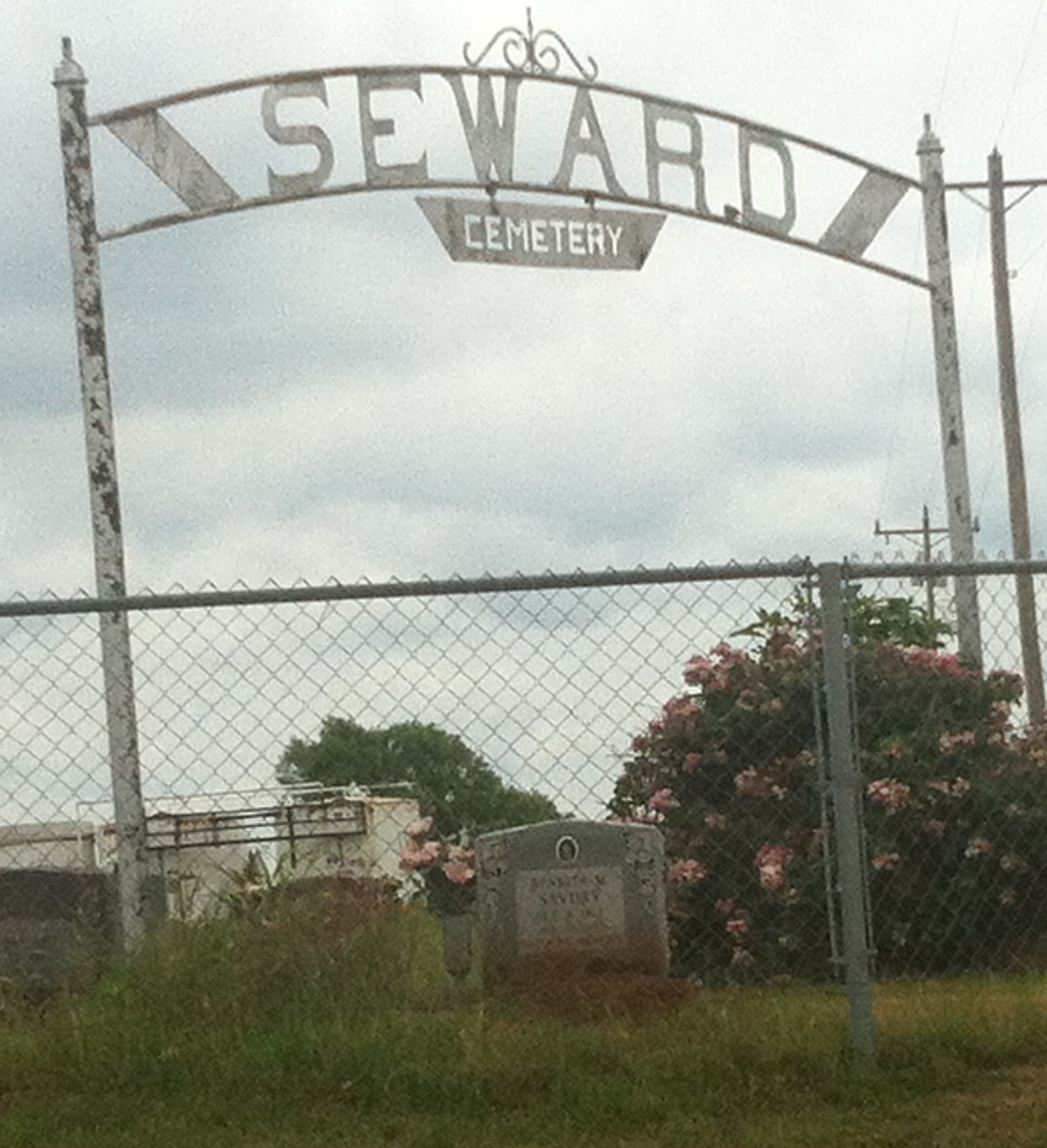
    Mystery of two cemeteries, part 1--Saturday sightings

    I came across this tattered flag in a rural cemetery today, a cemetery filled with veteran's graves. It was one of those Saturdays to spend meandering through the country.
    North of Edmond in Logan County I came to Seward Road, and there were two graveyards, one on the northeast corner "Seward Cemetery" and one on the southwest corner, "Seward Memorial 1897." They're old, and I stopped at the northeast one because I could see some old gravestones.
    It wasn't until I visited the one catty-corner from it that I discovered a mystery, a mystery answered by calling a Guthrie funeral home, and doing a little research on the computer when I got home.
    Can you guess? We've zoomed past Seward Road hundreds of times on I-35 a few miles east of here, never thinking about how the road got its name. Most folks who turn off it, go east to the Lazy-E Arena, I suspect. I had driven north on the backroads, eventually  ending up on what is Broadway, but north of Waterloo road. It was cloudy and a morose kind of day for me, and the cemeteries were just there waiting for me. Solving the mystery was the best reward, after wandering around, taking photos of veterans and other graves, wondering about the stories.
    Before I tell you about the mystery, the other mystery was why there were so many veterans graves in the first one. It's out in the country, but there were more than 20 veterans graves there, starting with veterans of the Civil War and Mexican War.
    The oldest veterans' grave I found belonged to this man, buried in 1898. Most of the graves of the Civil War veterans you have no idea when they lived or died, because they're identified just by their units. Twentieth Century graves identify people by what service they were in. Civil War graves list their states and units--and here were graves from Missouri, Kansas, Illinois and Indiana infantries. They're also distinctive, with their whitish gray marble and slightly rounded tops. I think it is remarkable that people still decorate these old graves. How American.
    This cemetery also has newer graves, including veterans of WWI, WWII, Korea and Vietnam. Here's the most recent I found.
    It's interesting to me that he lived and served about the same times as my uncle Mike who died in October.
    One footnote before we return to the mystery. I found this grave, of someone who would be my age, but he  never made it. His name must be on the Vietnam Wall in Washington. Can you imagine the heartbreak of parents and loved ones? Why do I visit, why am I interested in cemeteries and veterans graves? I guess it is mortality, and history, but there's more. I hoped to find a Confederate's grave...they are scattered throughout Oklahoma, but I didn't here. Still, there are so many stories to tell.
    Now, back to the mystery of the two cemeteries.  I'll post more veterans graves photos later.