"When dawn spreads its paintbrush on the plain, spilling purple... ," Sons of the Pioneers theme for TV show "Wagon Train." Dawn on the mythic Santa Fe Trail, New Mexico, looking toward Raton from Cimarron. -- Clarkphoto. A curmudgeon artist's musings melding metaphors and journalism, for readers in more than 150 countries.
Showing posts with label WWII. Show all posts

Saturday, December 17, 2022

Home...eight days 'til Christmas

"Sanctuary," 5 x 7 watercolor Christmas card

"I'll be home for Christmas...if only in my dreams." 

That 1943 song recorded by Bing Crosby, written by lyricist Kim Gannon and composer Walter Kent, captured the emotion and hopes of all those American servicemen in the anger and violence of remote WWII, so far away from the warmth and safety of loved ones.

It still does for so many people, perhaps even more, scattered  around the world though the years, or threatened by danger and violence of war and homelessness.

Last week on a cold day, I saw a homeless person huddled in a sleeping bag at the corner of Penn and Memorial. Near downtown recently, we saw a homeless camp of tents not far from the sparkling lights of OKC's "Renaissance." In Ukrainians, their homes are being bombed. I wonder what their Christmas dreams are like, what kind of "Holy-day" they are having.

For me, with my children and grandchildren so far away, at least I can see and talk to them through modern technology, and enjoy the love of in-laws. Long ago, returning from a Culp cousin reunion in East Texas, I wrote a poem of my thoughts during this season that  includes these lines:

 "Driving in East Texas is like going back into the womb.

It's warm, and wet, and ... green.

Where families are born, and grow, and spread out like runners 

from the ivy growing up the trunks of the hardwoods, 

across miles and years."


So as we approach Christmas eight days from now, with our "decorations so bright," let us savor the sanctuary of "home," and be thankful and enjoy every second and loved ones, remembering those who can't. 

This card captures those emotions for me, the warmth and joy of adobe, red chilis and a Christmas wreath on a white Christmas.


Wednesday, September 1, 2021

The cost of war ending and beginning

Early Civil War cemetery, America's most deadly.

America's
longest war, 20 years--ended yesterday. American's second most costly war began today  82 years ago, when Hitler invaded Poland.

This current 20-year episode, without victory, cost 3,372 American lives and 320 wounded. After almost four years of WWII, 407,316 Americans died, and 617,278 were wounded. 

By comparison, about nine million Russian soldiers died, with civilian deaths bringing a total close to 20 million.  Germany lost as many as five million soldiers, and Japan more than three million soldiers. That doesn't include millions of civilians including six million Jews.

In the 20 years America was involved in Vietnam, another war without victory,  with active combat from the mid-60s to 1975,  58, 200 Americans died, and 153,303 were wounded. That toll doesn't count the Vietnamese, North and South, that was much higher.

Most fatal was the American Civil War, from 1861 to 1865. Estimates vary on the deaths after all these years, counting both sides, but range from about 650,000 to 850,000, at least 450 soldiers a day. A huge percentage  were those who died from wounds and disease. That was more than two percent of the population, and in today's numbers it would equal about 7.5 million people.  The Confederacy lost upwards of 270,000 soldiers and the U.S. upwards of 260,000. About 22 percent of Southern soldiers in their early '20s died, and the total of both sides devastated America's economy. 

A retired U.S. Air Force officer told me this week, paraphrasing "Wars are political, with the military acting as a mechanism for political gains."

And human lives are the price.

Tuesday, November 10, 2020

Nine years ago, memories and missing

Uncle Mike, me and Susan in the bar at La Fonda, Santa Fe. Cuba Libre in the glass a few years ago

"Quartermaster
Clark. Shipmate," said the white clad sailor as he concluded and presented a folded flag  nine years ago. Another sailor played taps.


A
few minutes earlier at the Santa Fe National Cemetery,  I had given the eulogy for my favorite uncle, Michael Henry Clark, WWII and Korean War U.S. Navy combat veteran.

I've written about him and this many times as the years go by, and the memories pile up. I have a photograph of him teaching me, then a first grader, how to kick a football in Fort Worth. He was headed Korea. 

Now I miss most the late night stories in his apartment where he lived for years, across the Taos highway from the cemetery. Every night you could hear taps played at 9 p.m. And I miss the laughter and too much Cuba Libre as the night went wore on. I still have one of those glasses sitting on a shelf. 

A photo of he and Susan and I sits on my desk. I may need a Cuba Libre tonight.

Saludos, Sailor. 

+++

My post from nine years ago:

A Sailor's Final Port of Call

Saturday, March 21, 2020

When we need the color, the music of a "Wonderful World"

"Trees of Green, Red Roses too," today's watercolor, 5 x 7 140 lb. d'Arches cold press paper
These are bleak days in a pandemic when we all need calming color, and music.
After thinking of my bluebird and rainbow paintings, someone asked for the the song from The Wizard of Oz.
That song, those lyrics, sung by Judy Garland, came out in  the bleak days of 1939 of the Depression as the world plunged into a human nightmare of WWII.
Almost 30 years later, in the midst of another bleak human nightmare of a longer war between America and Vietnam in 1967, Louis Armstrong sang some of the same lyrics.
Amid the gloom and doom, the writers and singers  poured forth those words and tunes. Why?
Because. 'Twas not a time for sugar-coating. But amid bleakness, there needed to be color and music and hope.
Here are some of the colorful lyrics from those bleak years. You can look them up on You Tube and hear them.
And thus today's watercolor, "Trees of Green, Red Roses too."

1939--"Well, I see trees of green and red roses too
I'll watch them bloom for me and you
And I think to myself
What a wonderful world
Well, I see skies of blue and I see clouds of white
...
And I think to myself what a wonderful world."
    --Harold Arien/Yip Harburg.

1967--"I see trees of green
Red roses too
I see them bloom
For me and you
And I think to myself
What a wonderful world
I see skies of blue
and clouds of white."
  --Bob Thiele 

Sunday, January 5, 2020

A new year, or some old ones

Birthday Card to Self, 5 1/2 by 8 140 lb. cold press paper
First painting of the new year celebrates a new year, or some old ones--birthday thoughts inspired this--a birthday card to myself.
If you don't get the significance, think about it. Hint, it would probably help if you were from Iowa.
There's another clue in my original birthday card ( announcement) drawn by my Dad, long ago, pictured below. It's tattered, and I'll frame it this year. By the way, that's a B-24 Liberator engine from Consolidated Aircraft in Fort Worth where Dad worked as a draftsman, and a familiar saying from those WWII pilots returning from missions.
I've spent the morning musing, gain observations and writing about past and present and certainly future, thus even this painting. Palette: Quin gold, aureolin, yellow orange, and a little royal blue.


Friday, November 10, 2017

Veterans' day memories

The Flag at Santa Fe Cemetery
Six years ago today, I spoke the eulogy at the funeral for my fav uncle, Michael Henry Clark, at the National Cemetery in Santa Fe, with full military honors for this WWII and Korean Navy combat veteran. 
He and I go way back, and it only occurred to me in recent years that the reason my middle name comes from him is that he was my Dad's favorite brother, the middle of five boys from dirt poor Depression Oklahoma, all of whom escaped. 
Rest in peace sailor, thank you, and salute.

From six years ago:
Reflections on a Final Port of Call 
A Sailor's Final Port

Many years ago at the Grand Canyon, Mom, Jerry, Mike and I
A few years ago, with Susan and Mike in the bar at La Fonda, Santa Fe, and Cuba Libres

Thursday, January 5, 2017

"Coming in on a wing and a prayer..." long ago

In the depths of World War II, the Army Air Force bombers returning from raids over Nazi Europe sustained terrible losses.  Many with heavy damage would barely get their crews home. 
When they made it home to a safe landing, the crews knew they were "coming in on a wing and a prayer."
My Dad was a technical artist for Consolidated Aircraft in Fort Worth, working on those bombers, the B-24 Liberators.
Thus my birth announcement, drawn by Dad--that is a B-24 Liberator engine on the stork.
My fascination with aircraft began early.
 

Wednesday, December 7, 2016

A profound stillness and whispering

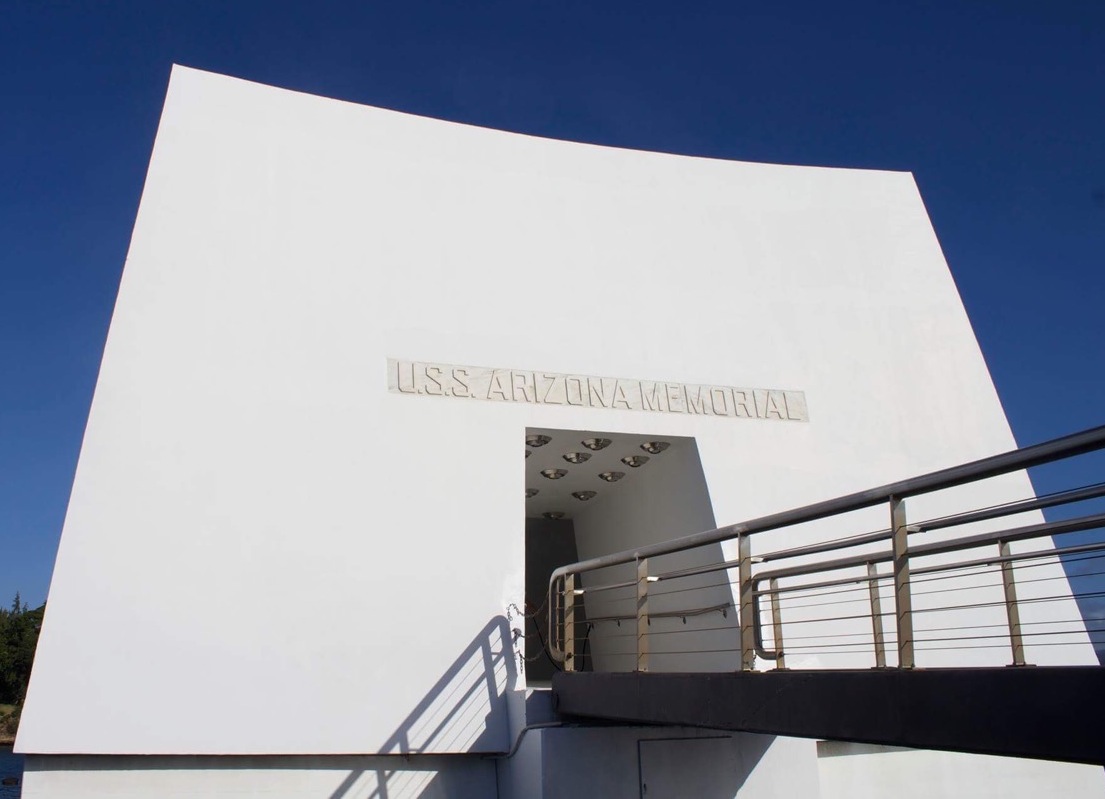
Approaching the Arizona Memorial
December 7, 1941...75 years ago.
Today, at the U.S.S. Arizona Memorial, daily tours bring hundreds to stand over the sunken, rusting hulk of that battleship off Ford Island in Pearl Harbor, Hawai'i.
You take a ferry, operated by U.S. Navy sailors,  out to what was battleship row, where she and her kin were destroyed in a surprise attack from the Empire of Japan, plunging us into WWII.
A bomb struck her ammunition magazine and exploded, sending 1,177 men to instant death. 
Their remains are still there, beneath the water, their ship still oozing oil after all these years, from translucent slicks on the clear water, where you can look down and see the rusting remains of that ship.
I knew all this, but was reminded even more last week when visiting a bookstore, and noticed many new books displayed about that day.
It's more than a Memorial, it's a cemetery. I was privileged to visit there a few years ago when my son M/Sgt. Vance Clark, and family, USAF, were stationed.
When you get your ticket to the ferry from the visitor center at the World War II Valor in the Pacific National Monument on the island of Oahu, it carries the name and biography of every sailor killed that day. I can't find mine now, though it crops up when cleaning out a closet every few years. Mine was from a young sailor from Hominy, Oklahoma.
As you board the ferry from the visitor center, it's striking that the directions on the wall are in both English and Japanese. I'd guess from my visit that half the visitors are young Japanese. 
There's chatter in the visitor center, but when you board the ferry and head across Pearl Harbor, approaching the Memorial, it gets hushed.
When you pull up to the quay, and head down the ramp onto the Memorial that spans the ship, there is a profound silence, a whispering as people read the names of the victims on the walls, view the rusty circular mount of a forward turret rising above the gently lapping, oil stained waves, look at the rusting steel below, or gaze astern stern to the battleship U.S.S.  Missouri, moored as another museum. It was on her decks that Japan surrendered almost four long bloody years later.
Pearl Harbor is still a major Navy, Army and Air Force bastion in the Pacific.
Our servicemen do not forget. There are still machine gun bullet gouges in buildings at Hickham Field, in the seaplane ramps and other reminders of that day when the Pacific was not pacific.
USS Abe Lincoln passing the USS Arizona and USS Missouri
But most impressive to me is that on every U.S. Navy ship that enters, or departs, Pearl Harbor, sailors "man the rails" in their dress uniforms, and salute, in profound silence, as they pass the Arizona Memorial, and their dead "shipmates."
Salute.


**
I've blogged about this before. Click these links if you're interested. 
Pearl Harbor Thoughts
Here's to the Navy

I can't find my photos from my trip, and my son can't locate his either, after multiple moves, but my daughter-in-law Kerin sent the top three photos above from a friend of theirs, Airman Jonelle Snyder. Others are from the National Monument.
USS Abraham Lincoln arriving at Pearl

Wednesday, September 7, 2016

Old photos, article in a look at Albuqureque's past

We arrived in Albuquerque, N. M., in the summer of 1951, driven there from Fort Worth by our uncle Mike, since Dad had already taken a job as a technical artist at Sandia Corp. on Sandia Base.
While scrounging through a box of old photos and more, I can across this 1952 article and photos in the Sandia Bulletin, the base newspaper.
It tells the history of the base and includes some astounding photos of how remote the base was from Albuquerque just a two to three years before we arrived. Look at that bare mesa stretching to the Sandia Mountains. Now it's full of subdivisions, up to the mountain's very base.
20+ years ago, at the house on Sandia Base where we grew up, now gone
Sandia was at eastern the edge of the city when we came, but we never knew all this, and lived in base housing for several years. 
Reading the history, I found another interesting fact. The base was the after-WWII dumping ground of "war-weary" B-24 Liberator bombers and P-51 Mustang fighters, both planes that Dad had been a draftsman on when at North American  and Consolidated companies in Fort Worth during the war, when I and my brother Jerry was born.

Friday, July 22, 2016

The Russians are here

Coffee with Clark page hits this week
I have no idea why, but the number of hits on this blog in the past two days has skyrocketed, because of good people in Russia.
I haven't even written about Russia, that country that lost 9 million people defending their country from Hitler. Even though this is is a non-political blog, I wonder if they wonder what's happening in this country, when the great Russian chess master Kasperov, compares Trump to Putin and Hitler.
Don't know, but welcome Russians, and a toast to freedom loving people everywhere who fear the iron fist of ego-driven authoritarian government.

Saturday, June 6, 2015

D-Day's blood

Some of the American dead, killed on D-Day at Normandy, June 6-1944
I think it is probably impossible to write anything original any more about D-Day, but I hope we never forget the blood and bravery of June 6, 1944. I've written about it many times, here on the blog and elsewhere, reminded that I was five months old, snug in my safe crib in Dallas, Texas, when so many died so I would grow up as a free American.
White crosses and flags at half staff march across the American cemetery at Normandy now, and bring tears, but it is good to be reminded of the real carnage, the real human cost. 
Almost 5,000 men died that day, 2,499 of them Americans, many on horrible Omaha Beach. Our allies lost 1,914. While it doesn't match the carnage of our Civil War, nor the horrible losses of  WWI, or of Russia losing nine million people in the entire war, these men are the symbol of war's terrible cost.
Here's an excerpt from War Correspondent Ernie Pyle's visit to the beach that puts that tragedy better than any writing has:
    "The strong, swirling tides of the Normandy coastline shift the contours of the sandy beach as they move in and out. They carry soldiers’ bodies out to sea, and later they return them. They cover the corpses of heroes with sand, and then in their whims they uncover them.
    "As I plowed out over the wet sand of the beach on that first day ashore, I walked around what seemed to be a couple of pieces of driftwood sticking out of the sand. But they weren’t driftwood.
    "They were a soldier’s two feet. He was completely covered by the shifting sands except for his feet. The toes of his GI shoes pointed toward the land he had come so far to see, and which he saw so briefly."

Ernie Pyle 


Friday, May 22, 2015

Memorial Day amid the graves

A Civil War veterans grave in rural Oklahoma, decorated for Memorial Day
I didn’t know Buster, but I wish I had.
BUSTER E. WILLIAMS
OKLA
CPL 501 PRCHUTE INF
101 ABN DIV
JUNE 30, 1922 SEPT. 24, 1944
I don’t know how he died, but this 22-year-old Oklahoma paratrooper with the Screaming Eagles of the 101st Airborne fell in Europe not long after D-Day, fighting for freedom, when I was home safe, a few months old. His name is etched in marble on one of the headstones in the U.S. National Cemetery at Fort Smith, Arkansas.
This Memorial Day there will be speeches and flags and flowers and 21- gun salutes and prayers and Taps at this cemetery just across the border from Oklahoma. There will be similar services in other cemeteries all over America, saluting the veterans.
Roses the color of blood grow on the fences, as about 9,500 grayish-white headstones of veterans from frontier days to the Gulf War sweep over the grassy green hills, like the white stripes on the American flag, gently rippling in the free breeze.
JOHN HERBERT MAYBERRY
PFC USA
KOREA
JUNE 2, 1932
NOV. 28, 1950
Most of the headstones are uniform, 24 inches out of the ground, 15 inches wide, gently oval at the top, 3 feet from the next gravestone to the side, 10 feet from the ones above and below it. On some there are small crosses above the names, the service, the dates. Simple. Sparse, Military. The precision is perfect and from any angle the headstones maintain perfect rank order--marching like rows of men going into battle--only here there are no more gaps where comrades are cut down by enemy fire. Here the ranks march on forever, into eternity.
WALTER WAYNE POGUE
2LT USAA
JUNE 16, 1919 APRIL 13, 1944
PURPLE HEART
KILLED IN ACTION
The cemetery office doesn’t have biographical records on how all the veterans died, but some stand out. Like Lt. Pogue of Fort Smith, missing in action since April 13, 1944 over Europe. German historians and the pilot who shot down Lt. Pogue’s P-38 fighter  located his remains a few years ago. They were buried with full military honors on Dec. 21, 1996--52 years later. His widow, who never remarried, couldn’t attend because she was in a Ft. Smith hospital, and she’s since died. But his son, Walter Wayne Pogue Jr., who probably never met his daddy, received the folded American flag with triangle of stars showing as his father was laid to rest with 21-gun salute.
WADE HALTON COTTONHAM
USN WWII
JUNE 29, 1920 JAN. 1, 1945
There is a section where men who were buried at sea, and those whose remains were never recovered, are buried. Those graves are closer together, clustered for companionship. They may have died alone, but they’ve joined more than a million other American veterans who’ve died in the defense of their country.
C. COLDER WHITMAN
CO A 14TH KAN CAV
1834 SEPT. 11, 1863
This is one of the few national cemeteries where Union soldiers are buried alongside Confederates, because the South occupied the Fort in the War. Most Southerners are buried in Confederate cemeteries or in thousands of private cemeteries. More Americans died in the Civil War than in any other, and people still put flowers on those graves.
NORMAN DEASON
PVT WWII
1924 1986
About 350 graves a year are added to the Fort Smith cemetery. Any veteran may request burial in a national cemetery, and the surviving spouse, or a child who dies under 21 years of age, may join him. Every veteran receives the regulation tombstone, and the folded flag for survivors. Retired veterans and those who were killed in action receive full military honors, including the 21-gun salute. A fresh bouquet of red carnations was placed at Pvt. Deason’s grave recently. People remember a long time in a national cemetery.
UNKNOWN
U.S. SOLDIER
And there are more than 100 Unknowns in the ranks of these headstones--no stories, no names, no dates--of men who died and are forgotten, except for a marker in a graveyard of heroes, ordinary men who fought and died in the Army, Navy, Marines, Air Force, Air Corps, Coast Guard. All are equal in the cemetery--officers rest beside enlisted men.
The cemetery is quiet but not deathly silent. In the spring and summer, meadowlarks and mockingbirds add their songs to the air. The sky is hazy. There is the smell not of bodies cut down, but of fresh-cut grass. Life. In autumn, breezes swirl falling  leaves into garlands on every grave as a year slowly dies. And winter brings snow to bury the graves in dignity and silence once again, over the gentle swells, up and down the long ranks of graves, past the etched names of states--Iowa, Kansas, Tennessee, Texas, Illinois, Arkansas, Oklahoma--past the years--1819, 1864, 1918, 1943, 1950, 1969-- preserving the order of march, marshaling forces for a final charge.
I wish I’d known them all. Don’t you?
At the two-story brick house that serves as cemetery office and headquarters, a plaque carries President Lincoln’s words as he dedicated a national cemetery at Gettysburg 147 years ago. Hallowed ground. Above, the Stars and Stripes wave in the breeze over the grass patterned with headstones.
Memorial Day was first called Decoration Day, started in 1868, three years after America's bloodbath. Survivors and families began decorating the graves of those brave men who died, with flowers and flags.
The practice continues, not just in national cemeteries but in public and private ones all over America. 
Every day at 5 p.m., the haunting, plaintive notes of Taps echoes across the green hills, caressing each white gravestone.
Goodnight, Buster. Goodnight, Lt. Pogue.
And thanks.

Editor's note: An earlier version of this was a newspaper column of mine.

Wednesday, January 7, 2015

Vive la France, Liberte!

Liberty Leading the People, Delacroix, The Louvre
When we visited France and The Louvre, my favorite painting is the gigantic Liberty Leading the People, by Delacroix.
It so captures the independent spirit of the French, and when narrow minded Americans criticize that country for not always agreeing with us, I am angered. We would not be free  today if it were not for the French in the Revolution, and they would not be free today except for us in WWII.
We are brothers in freedom and blood.
And today, I hurt because of the atrocity in Paris, attacking a very symbol of that freedom, a magazine, the free press, known for attacking "anything that moves," say the French. Those terrorists killed people, but they cannot kill freedom.
I pause, and can only salute the French and their flag. 
Vive la France!

Tuesday, November 11, 2014

'Thank you for your service,' Veterans!

The Thunderbird atop the monument outside the 4th Division Museum
"Thank you for your service, sir," said my veteran, M/Sgt Vance Clark, USAF, last week as we toured the 45th Infantry Thunderbird Division museum in Oklahoma City.
At the base is the roll of combat
He'd been talking to a Korean War vet who was one of the staff.
That veteran replied to him the same way, "Thank you for your service."
They are a unique band of brothers, especially those who have been in combat.
If you haven't been to the museum on NE 36th street, don't be fooled by all the military vehicles outside. That's impressive, along with the monuments  and comments.
Inside is an amazing museum of more than just a division that fought and died in WWII and Korea. There are Bill Mauldin originals, a history of military firearms throughout American history, a room dedicated to WWI, relics from the divisions  WWII battles across Nazi Europe, including Nazi flags and gear, relics that belonged to Hitler. Most moving to me is the room commemorating the concentration camp at Dachau, which the division liberated.
On this Veterans' Day, or on any other, you come out of there, and you know the value of the words,
"Thank you for your service."
Snap a salute, and be thankful.

Thursday, June 5, 2014

D-Day, 70 years ago, respect written in blood

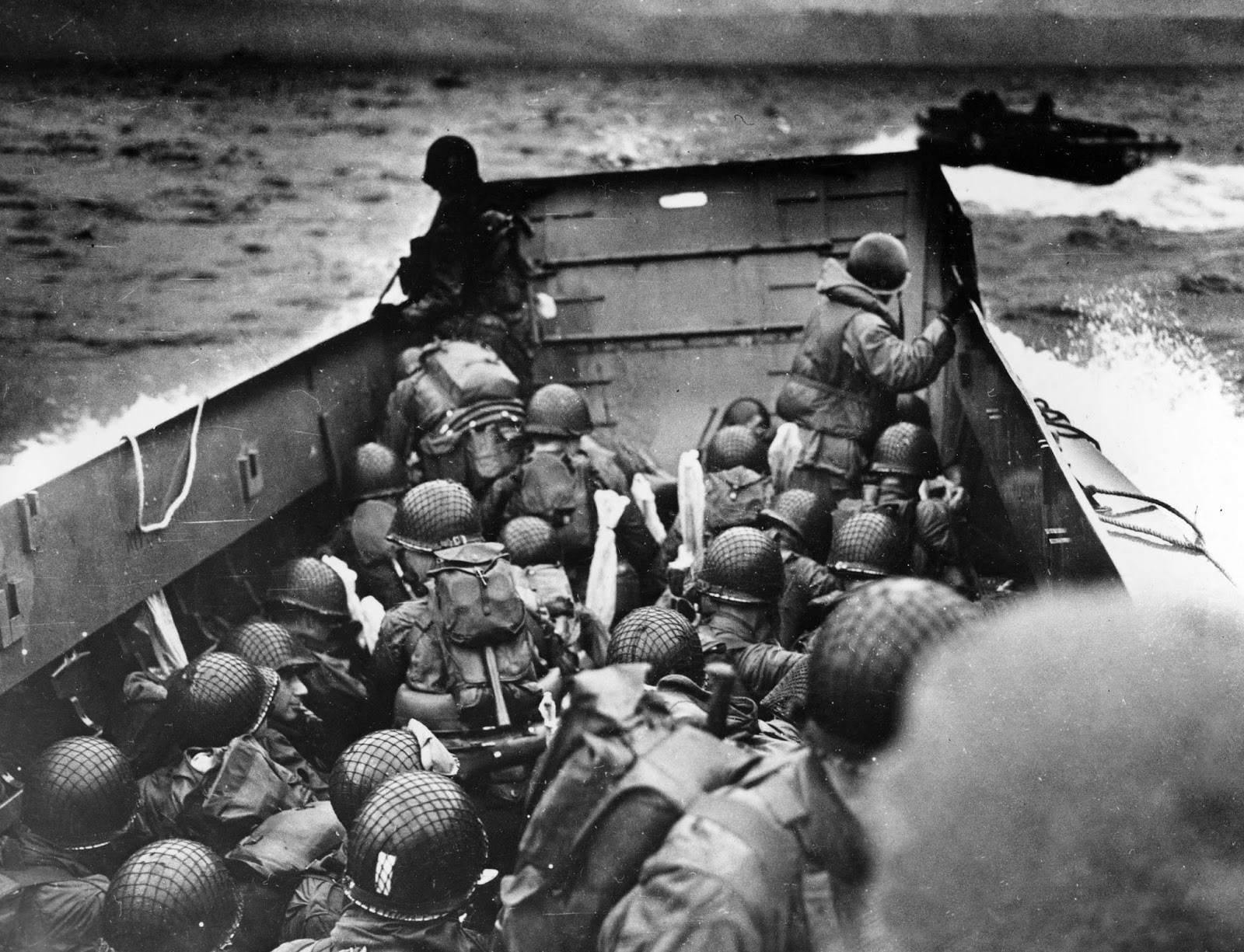
American soldiers heading to Omaha Beach in Normandy, 70 years ago.
It is now June 6 in England. At the end of that terrible day 70 years ago, 1,465 Americans were dead, 3,184 were wounded, 1,928 were missing, and 26 were captured. Omaha Beach claimed almost 2,000 of the total casualties.
Other Allied forces, mainly Brits, lost 1,914 dead. They were part of 156,000 Allied  troops who on D-Day crossed the English Channel to invade France and help defeat Germany in WWII. The Germans lost from 4,000 to 10,000 men.
I was five exactly five months old, home snug and safe and free in my crib in Dallas, Texas.
American and French flags honor each grave.
Today, the 172-acre American Cemetery atop the bluff at Omaha Beach at Colleville-sur-Mer, France, contains the remains of 9,387 American military dead, most of the killed during the invasion and other operations in WWII. Included are the graves of Army Air Corps crew shot down over Europe as early as 1942. A total of 307 of the graves are of unknowns.
These men died and served to spare me the fate of much of the world which believed that all people should think alike, that free thought and expression are dangerous, that people are supposed to be subservient, that individuality and differences in beliefs, religions, races, languages is suspicious and should be squelched by force, that the might of military makes anything right, that individuals have no rights.
What frightens me is not that tyrants in other parts of the world still believe this.
The flag in the cemetery

What frightens and disgusts  me are the fanatics in America who still believe those ways. You can easily find specific recent  examples of each of those intolerant beliefs, echoed in the rhetoric by narrow-minded ideologues in our own state government, national government, political movements and media. They have invaded America by spouting thinly-designed hatred and mindless propaganda, threatening this country built on reason and respect of others. Yes, they are free to do so because of the sacrifice of those Americans 70 years ago, but they are not worthy of the mud on our soldiers' boots.
If D-Day means anything to us as a free people, we will  respect the rights of others who differ from us, encourage free thought and expression. Our vows should be written in the blood of those men who served on that day, 70 years ago.


Tuesday, March 4, 2014

Color for a gray day

Where footsteps and time blur...5 by 7 watercolor, 140# d'Arches
Yes, the sun was out, and bright on the snow.
But around the world and in Oklahoma, it was a gray day. And more winter weather is coming.
 We're about to see Russia swallow an independent Ukraine, with Putin using the same tactics Hiter did in Austria, Czechoslovakia and Poland. And the world is powerless. Putin is the new Hitler.
And in Oklahoma, the narrow-minded legislature and puppet governor Fallin are attacking the arts, science  and education, cutting funds, stifling creativity, gutting the quality of life and future for normal people, and the good of the state as a whole. They are the new  "No-Nothings," sending us back into new Dark Ages.
It's hard to be anything but disturbed or depressed. 
We need color in our lives more than ever, and thus today's painting, where the colors run together and our footsteps and time blur.

Sunday, January 5, 2014

January, 1944, while I was snug in my crib

 We sometimes forget how fortunate we are to live where we do, amid the turmoil and dangers and poverty and disease elsewhere in the world. 
While I was snug in my crib 70 years ago, children and grown ups were starving, being murdered, dying, with no possibility of safety, much less warmth.
Here's the evidence:

Jan 1st - Army defeats Navy 10-7 in football "Arab Bowl," Oran, North Africa
Jan 1st - Gen Clark replaces Gen Patton as commander of 7th Army
Jan 2nd - 1st use of helicopters during warfare (British Atlantic patrol)
Jan 3rd - Top Ace Major Greg "Pappy" Boyington is shot down in his Corsair by Captain Masajiro Kawato flying a Zero.
Jan 4th - Ralph Bunche appointed 1st Negro official in US State Department
Jan 5th - The Daily Mail becomes the first transoceanic newspaper.
Jan 7th - Air Force announces production of 1st US jet fighter, the Bell P-59
Jan 10th - British troops conquer Maungdaw, Burma
Jan 11th - Crakow-Plaszow Concentration Camp established
Jan 12th - Churchill & de Gaulle begin a 2-day wartime conference in Marrakesh
Jan 15th - European Advisory Commission decides to divide Germany
Jan 15th - General Eisenhower arrives in England
Jan 15th - Vught Concentration Camp puts 74 women in 1 cell, 10 die
Jan 16th - Gen Eisenhower took command of Allied Invasion Force in London
Jan 17th - Korvet Violet sinks U-641 in Atlantic Ocean

Jan 18th - 1st Chinese naturalized US citizen since repeal of exclusion acts
Jan 18th - The Metropolitan Opera House in New York City hosts a jazz concert for the first time. The performers were Louis Armstrong, Benny Goodman, Lionel Hampton, Artie Shaw, Roy Eldridge and Jack Teagarden.
Jan 20th - RAF drops 2300 tons  of bombs on Berlin
Jan 21st - 447 German bombers attack London
Jan 21st - 649 British bombers attack Magdeburg
Jan 22nd - Allied forces begin landing at Anzio Italy
Jan 24th - Allied troops occupy Nettuno Italy
Jan 27th - Leningrad liberated from Germany after 880 day seige with 600,000 killed
Jan 28th - 683 British bombers attack Berlin
Jan 28th - U-271 & U-571 sunk off Ireland
Jan 29th - 285 German bombers attack London

Jan 29th - USS Missouri the last battleship commissioned by the US Navy is launched.
Jan 29th - The Battle of Cisterna takes place in central Italy.
Jan 29th - About 38 men, women, and children die in the Koniuchy massacre in Poland.
Jan 30th - US invades Majuro, Marshall Islands
Jan 30th - United States troops land on Majuro.
Jan 31st - Operation-Overlord (D-Day) postponed until June
Jan 31st - U-592 sunk off Ireland
Jan 31st - US forces invade Kwajalein Atoll

On a wing and a prayer

Six months before D-Day, this 9" by 12" birth announcement was sent out by my parents. My dad, a technical illustrator at Consolidated Aircraft between Dallas and Fort Worth where the B-24 Liberator bomber was built, drew this stork flying in, with a B-24  radial engine. 
"Coming in on a wing and prayer," was the war-time phrase of many bomber crews flying home with planes shot up in combat and perhaps with wounded on board. So here it is, glued to a  brittle and yellowing page out of a family album.
Dad drew the announcement, had some printed off, and then did the color paints individually. He didn't go to the war, like three of his four brothers, because he had a wooden leg, having lost it under a freight train in Tucumcari 11 years before. That's probably why I'm here at all. If he hadn't lost his leg, he'd never have met my mom. His example led me to do individual birth announcements for each of my children, but they were never works of art.
Seventy years later, I'm still trying to wing it, and praying.

Sunday, September 15, 2013

New Reader, 121 on the nation list

The High Tatra Mountains, northern Slovakia
I want to go there. So I thought when a reader from the 121st country to click on the blog arrived...Slovakia. Of course, when I grew up it was part of Czechoslovakia, carrying a long history of invasion and turmoil in central Europe. But not now.
Map from the CIA
After a "Velvet Divorce" as part of the "Velvet Revolution" in 1992, the former country became two. It had the highest economic growth rate for three years  in the late 2000s, before voting against the Greece bailout by the EU. But it is still flourishing, and made recent news for women business people emulating Steve Jobs. See the New York Times article.
Ancient castle overlooking Danube, in capital of Bratislava
originally build including stones from Roman ruins.
It's taken a long time to get there, since the Slavs began arriving in the area in the fifth and sixth centuries. It's been part of various empires and invasions, including the Moravian Empire, testified to by castles on many hills. any castles. Longest was the Kingdom of Hungary from 1,000 to 1919. Relatively peaceful after WWI when it became Czechoslovakia, the country was sold down the river by Britain in 1938 when Chamberlain gave in to Hitler at Munich. Slovakia caved to Hitler during WWII.
A communist coup in 1938 put the country under the control of the USSR until 1989-90 with the fall of the Berlin Wall, and the dissolution of the USSR.
Now the country has about 5.4 million people and is somewhere between the size of South Carolina and Mississippi. Slovakia has its own website or if you spell it in Slovak, Slovensko .  More about the country can be found on the European website.
There is one famous Slovakian you've heard of--Andy Warhol, whose parents were Slovakians. Another Slovak of note, to whom many aviators owe their lives, was  Štefan Banič--who invented the parachute in 1913.
The country's flag colors echo several Slavic countries, with white, blue and red. Except for the Slovak coat of arms, it would be identical to Russia. It's also very similar to Slovenia's flag, a country it is often confused with, even by world leaders. 
The Slovak name for the country, Slovensko, is identical to Slovenian word for the Slovenian language,That’s just one of the near-similarities between Slovenia and Slovakia that cause confusion for outsiders.  And the fact that they’re both in the EU, both in NATO, both formerly part of Austria-Hungary, and both border Austria.