"When dawn spreads its paintbrush on the plain, spilling purple... ," Sons of the Pioneers theme for TV show "Wagon Train." Dawn on the mythic Santa Fe Trail, New Mexico, looking toward Raton from Cimarron. -- Clarkphoto. A curmudgeon artist's musings melding metaphors and journalism, for readers in more than 150 countries.
Showing posts with label U.S. Navy. Show all posts

Wednesday, November 10, 2021

A decade ago--a sailor's final port of call

Ten years ago on this day before Veterans' Day, I officiated at the funeral of my uncle, Michael Henry Clark in the Santa Fe national Cemetery. A U.S. Navy color guard provided the ceremony for this combat veteran of WWII and Korea.
Mike and my Dad, the war years

 He
was the last of the five living "Clark boys" from Comanche, OK, (Terrence, Louis, Rex, Mike and Champ)   my favorite uncle, and perhaps the closest brother to my father Terrence, the oldest. I took me a while to figure that out, since my middle name comes from him. "Llamarse como," he would say.

Mike and I, Bandelier, years ago
I've
written about him many times, and will not repeat, except to note this day and how many memories I have of him from when I was a kid, a teenager, and then in later years as adults, especially in the last 30 years. He died Oct. 24 in the Veterans' Home in Walsenburg, Colorado, and it took a few weeks to get things organized. 
Mike, Susan and I in the bar at La Fonda, a few years ago

And the last photo is my sketch of the Manzano Mountains, southeast of Albuquerque, the day after the funeral on a somber Veterans' Day, as I looked out the window from the airport, waiting on a flight home.

Rest in Peace, Sailor.


If you wish to see more photos and comments, just search "Mike" in search box above.


Tuesday, November 10, 2020

Nine years ago, memories and missing

Uncle Mike, me and Susan in the bar at La Fonda, Santa Fe. Cuba Libre in the glass a few years ago

"Quartermaster
Clark. Shipmate," said the white clad sailor as he concluded and presented a folded flag  nine years ago. Another sailor played taps.


A
few minutes earlier at the Santa Fe National Cemetery,  I had given the eulogy for my favorite uncle, Michael Henry Clark, WWII and Korean War U.S. Navy combat veteran.

I've written about him and this many times as the years go by, and the memories pile up. I have a photograph of him teaching me, then a first grader, how to kick a football in Fort Worth. He was headed Korea. 

Now I miss most the late night stories in his apartment where he lived for years, across the Taos highway from the cemetery. Every night you could hear taps played at 9 p.m. And I miss the laughter and too much Cuba Libre as the night went wore on. I still have one of those glasses sitting on a shelf. 

A photo of he and Susan and I sits on my desk. I may need a Cuba Libre tonight.

Saludos, Sailor. 

+++

My post from nine years ago:

A Sailor's Final Port of Call

Monday, May 6, 2013

Blog favorites on the birthday

At Black Mesa, March, 2012
Those of you who read this blog, which is now five years old, know I have some favorite topics.
Watercolors, art, traveling, New Mexico, books, family, trains, writing, a little religion. So as I started looking back over these 48 months of blogging, several articles and postings stood out. Here are my favorites.
My favorite--Best writing, humor, mingled with fun and tears--"Booth is a verb--A Love story," which stretched to more than 10,000 words in several posts over two months in August and September, 2009. Here's the link to the first episode, http://clarkcoffee.blogspot.com/2009/08/booth-is-verba-love-story-prologue.html
Travel--lots of these but three are my favorites. First was a tie-- several posts about the USS Abraham Lincoln sailing from San Diego to Everett Washington in April 2011, thanks to former student and officer Steve Curry. When I was summarizing travel since the blog started, I left this out, and should have listed "Pacific." Sorry Steve. Here's the link to the opening post of seven about that "Pirate Proof Cruise" as I called it. http://clarkcoffee.blogspot.com/2011/04/tiger-cruise-part-one.html.
I'd be hard up to rank it ahead of several posts a year ago this month, on our trip to Alaska...one of the items on my bucket list. Here's the first of 13  posts  in May and June with photos and video and writing. Here's the first link: http://clarkcoffee.blogspot.com/2012/05/alaska-itinerary.html
Also at the top of the list, or near it, was the flight I took on a WWII B-17 bomber on D-Day, 2010. Brother in law Jim Henry and I each paid $300 for the flight over Oklahoma City. They wouldn't let me bomb Republican headquarters, but the posting includes video as well as photos. What fun for a fan of WWII aircraft. Here's the link to one of about four related posts that month: http://clarkcoffee.blogspot.com/search/label/B-17
Other favorites in travel included the trip to India, in March 2011, and to hike Black Mesa in Oklahoma in March, 2012, each with several posts and photos.  http://clarkcoffee.blogspot.com/2011/03/flight-timeindia-journal-thoughts-i.html
http://clarkcoffee.blogspot.com/2012/03/to-top-of-oklahoma-and-back.html
Then there are other blog favorites, like humorous conversations with God on tenure, heaven's bar, and church services--check the months of Feb., 2010., Oct, 2011 and July, 2012.
Too many paintings, book reviews , photos and family history, and New Mexico to share. Yes, it's multimedia, but after all these years, it practices what I preach...you have to have good writing first. Thanks for reading. More to come.

Monday, December 12, 2011

A year of journeys

I'm trying to plan a trip to Alaska for us in May, and it's not easy, unless you go to a travel agent and get stuck on one of those gargantuan cattle trucks called cruise ships, and I don't want that.

So planning the trip will be an adventure too, and as I pour over brochures, scan books, contact friends and scour the Internet, I'm aware of the journeys, planned and unplanned, to places know and unknown, that have made this year memorable.

First was a trip to Chennai, India, in February to SRM University for a conference. It was a trip of utterly new sensations, experiences and people.

Then in March, I spent a week aboard the nuclear carrier USS Abraham Lincoln, in the Pacific, thanks to a former student, the Public Affairs officer aboard one of the largest ships in the world, Lt. Cdr. Steve Curry. Much more first time living.

In April I drove to the third Culp cousin reunion at my cousin Sarah Beth Foote's house in East Texas. Ten of us were there--only one barely known was missing--the children of my Mom and her three sisters and two brothers. A journey of mixed emotions of laughter and stories and good times, mixed with the awareness of passing time, and wondering if we'd ever do it again.

May was packed. On Mother's Day, I met my brother Jerry of Lubbock, to spend a boring evening in Wichita Falls before visiting our Mom's grave in Waurika, for an emotional trip into memories. In mid-May, Susan and I went to Florida and Savannah and soaked up southern food and comfort and history.

On Memorial Day, I visited grandkids Erin, Abby and Max and daughter Dallas and son-in-law Todd  in Amarillo and then on to Walsenburg to  my last uncle, Mike, in the veterans home. A happy,  and sobering trip, where the adventures are mental and emotional.

On the Fourth of July, I flew to California to spend time with my son Vance, his wife Kerin, and granddaughters Katherine, Sarah, and to see the new baby, Neysa, for the first time. Emotional for sure, but also the adventures of touring Vandenburg AFB where they launch satellites.

There were summer  trips on Oklahoma's back roads, including US 66, taking photos, exploring, and visiting friends at newspapers, and to Guthrie to show artwork there. There was a whirlwind trip to Vales Grande in New Mexico on roads I hadn't driven  before in early August--not much, but it helped satisfy a New Mexico attack.

In October, we celebrated anniversary in Kansas City, and spent full days in Columbia, Mo., with son Derrick, daughter-in-law Naomi, and granddaughter Liberty Faye.

Then in late October, a different journey began, when I received a phone call at night about the death of my uncle Mike. That journey isn't over yet for me, even though a resulting journey was burying him in the National Cemetery at Santa Fe, across from where he lived for-30 plus years. It was only my second trip to beloved New Mexico since a year ago when I had to move him out of that apartment that had become a second home to me in the last 10 years. I've traveled many places and miles in my mind as a result.

Those are the out-of-town trips, not counting getting artwork in Adelante Gallery in Paseo and multiple trips to the frame shop and studio. Nor around town to visit in-laws, go out to eat, visit many museums, attend the press convention, go "boothing" with friends and colleagues,  attend parties, travel over chess boards,  move brushes over blank paper and words on blank computer screens, and at Thanksgiving, tour the city with myAmarillo grandkids.

Then two days ago, my oldest cousin, Charles Rogers Lutrick, died in Beaumont, beginning a new journey for him and for those who love him. His funeral is tomorrow, and while Jerry and I are too far away to make it, his passing sets us off on another mental and somber journey contemplating passing life, a passing year and passing time.

It's been a good year--I've seen all my children and grandchildren, spent time with cousins and friends and colleagues, and faced mortality.

Although I'm trying to plan the Alaska trip, and also renewed my passport last month, I'm very aware that I really have no idea what the journeys will be this coming year, nor what kind of journeys they might be. I do know that Charles and Mike make me focus on my own journey, every day.

Charles Rogers Lutrick
Aug. 29, 1930
Dec. 10, 2011

Terry M. Clark
Jan. 5, 1944

Saturday, November 19, 2011

Reflections on a final port of call

I asked if I could open the urn, and the funeral director said yes. I was in the visitors center-headquarters of the Santa Fe National Cemetery, and I'd come to bury my favorite uncle, Michael Henry Clark. I carry his name as my middle name, and I believe he and his oldest brother and my dad, Terrence, must have been the closest of all the five brothers from Comanche, Oklahoma.

They opened the small black box and I reached inside to touch the clear plastic bag that held the sandy-white chalky remains of the old sailor. I did so, and shut the urn. I don't know why. I just did. The last time I'd touched Mike was to say goodbye at the veterans home at Walsenburg on Memorial Day.  We'd spent the day together, telling stories, eating, me wheeling him around in his wheelchair.

Last week we went up the hill to bury him. After reading the obituary I've posted earlier, and reading Psalm 23, I made the following remarks.


We gather here in sadness and loss to celebrate and honor the life of Michael Henry Clark.
While we mourn, I know there’s a big reunion at a bar in heaven where Mike and his four brothers are laughing and swapping stories again.
I prefer to think of Mike like this, of the many stories that he told and the many stories of ours that we all know and can laugh about.
Mike brought travel, stories and laughter to us all.
I have pictures of me in diapers being held by him in his WWII Navy uniform, of him teaching me to punt a football, of camping. Growing up in Albuquerque, my brother Jerry says there was always excitement when Uncle Mike was coming—he brought gifts and stories and we had midnight breakfasts just to keep listening. In the last 10 years I can tell you stories of him picking up hitchhiking veterans and pueblo residents, and many more retracing these years.
I know you have many more than I do, having known him as his adopted family who adopted him.
Isn’t that a great gift to us all?
Remember his big toothy smiles, large Clark ears and nose, easy laughter, Depression era toughness and stubbornness as he taught generations of young people or stocked his pantry with enough food to feed the US Navy, as he navigated life, a sailor docking his ship in Santa Fe.
As a friend told him, “Mike you couldn’t have found a better place to park your magic carpet.”
Stop a moment and think of one of those happy memories and stories, and laugh with him one more time…..
When I last saw Mike on Memorial Day, he said to me, “Terry, live every day.”
Mike Clark did that.
Now his remains are just across the road from his apartment of 32 years. He didn’t care where he was buried but I told him earlier it had to be here…where the sound of the bells of St. Francis Cathedral and taps at 9 p.m. will touch his grave every day.
He always said to me, “You couldn’t have come at a better time. You’re home.”
Mike is home.
On the last day of his life, we chatted away in the afternoon, and he told me to tell Jo and Lynn and Mon how much he missed and loved them. Later he watched the World Series and was being put to bed, chatting away, and probably flirting, with the nurses.
They sat him down on the edge of the bed. There was a sound, and they laid him down and he was gone.
When I’d call every week, he’d always say, “Don’t forget me.”
We can’t forget you, Mike.
Santa Fe is just not the same without Mike Clark. We miss you.
Saludos, sailor.

God, thank you for Mike Clark. Comfort us with the many good memories of the years we knew and loved him. Amen.


The next morning I went up the hill again to take photographs of the resting place of his ashes.
Graves of those cremated at Santa Fe National Cemetery, with Santa Fe Baldy and the Sangre de Cristos in the background,t he view Mike could see from his apartment across the road. Mike's temporary marker is the closes name tag five right of the orange marker.
Mike's ashes final resting place, the temporary marker at right.


Michael Henry Clark
U.S. Navy
QM2S
WWII Korea
Sept, 4, 1922
Oct. 24, 2011

And what is eerie about this, as I post it, my blog music starts playing Ravel's Ports of Call.

Saturday, April 16, 2011

Tiger cruise, part 2

This is the second part of the story I wrote about my trip aboard the USS Abraham Lincoln, which appeared in Edmond Life and Leisure.


Clark and Lt. Cmdr. Steve Curry at the end of the cruise in Everett, Washington.
The Navy public affairs office on board--of which Lt. Cmdr. Curry is now in charge--readily makes all these facts, and much more, available to the public, as does the ship’s website. It, and the Tiger cruise, is the ultimate in public relations as the Navy does its best to take care of its crew.
His department only hints at the size of this ship. He has about 15 officers and enlisted in his command. It puts out tabloid, full color “Penny Press,” (Just named the best newspaper in the Navy) a daily newsletter, a twice-a-month TV show called “The Boat Show,” and much more, including photography, Facebook http://www.facebook.com/USSLincoln, webpage    http://navysite.de/cvn/cvn72.html and PR ashore. I got to meet these journalists and see them work. Their attitude and professionalism is contagious, as it is all over the ship.
With the airwing gone, I learned the mood of the ship is different, because, well, they wouldn’t say it, but the pilots and rest of the airwing tends to be on a bit of an ego trip.
You catch that when you listen to a Chief describe the nuclear department on board. The two reactors are absolutely safe. You get more radiation from a day on the beach than from them. That was the only place on board we were not allowed, and doors to that area are guarded.
“The Nukes” as they call themselves, are the largest department on ship—from 300 to 400 people operating the reactors, that produce steam from heated water to run the four 75,000-shaft-horsepower steam turbines that power the ship’s engines and electricity.  As the Chief said in his lecture to us on a tour: “The flight deck is just a canopy to keep the reactors dry and in the shade.” 
Size dominates again. We went aft to “Shaft Alley” 20 feet below the waterline to see the rapidly revolving shafts coming out of the turbines that drive the four five-bladed 20-foot diameter 45.5 ton screws powering the ship up to more than 30 knots.  The steam comes from the reactors heating water—400,000 gallons a day are scooped up by the ship and desalinated for use.
The Nukes spend most of their time below decks—“We don’t tan very well,” the Chief joked.
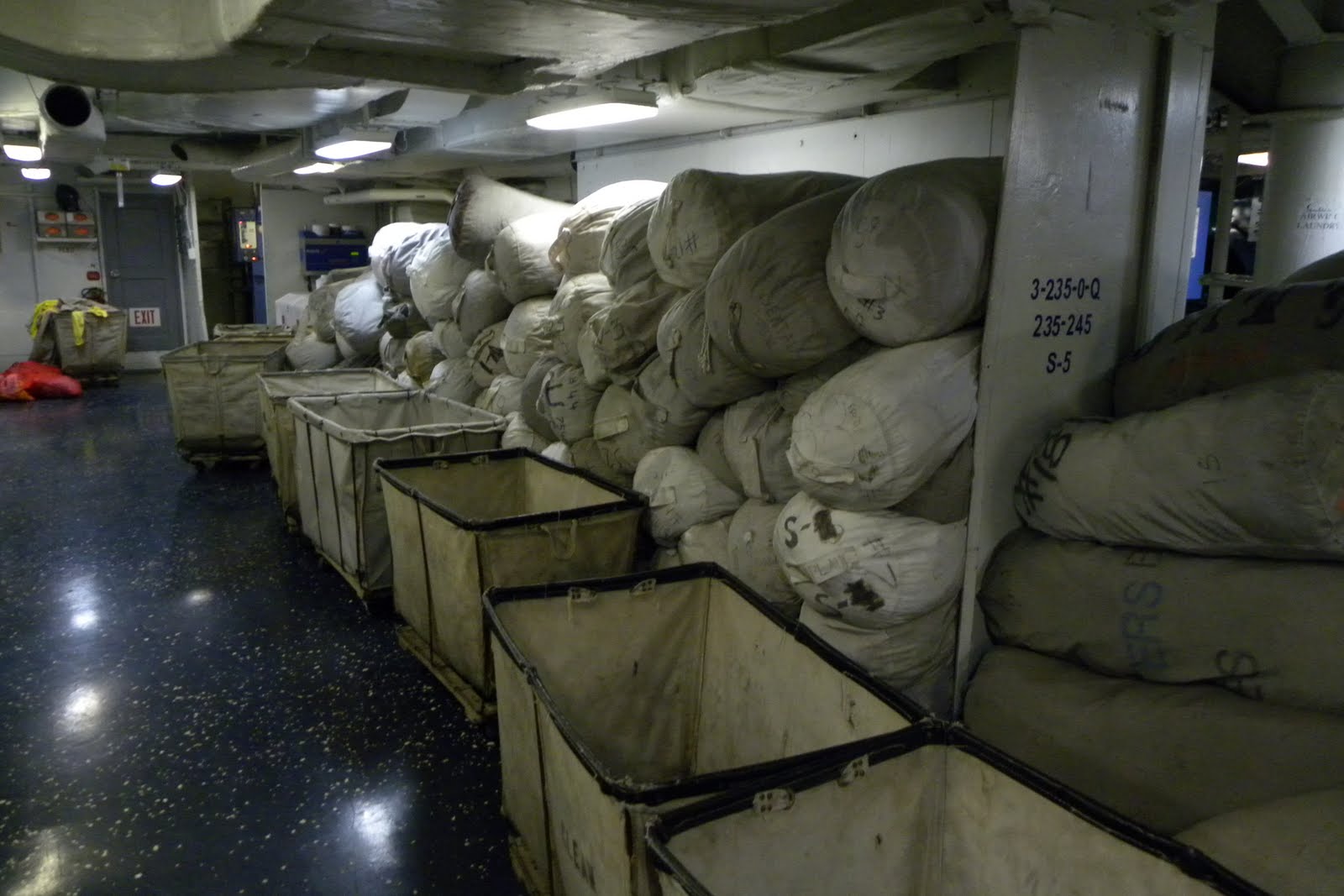
Part of the day's laundry

There are more such stories…a complete welding shop that can make anything; “Precinct 72”—the brig and its crew run by the law enforcement officer know as “The Sheriff”; the laundry that cleans 5,500 pounds of laundry every day; the barbers giving 250 haircuts a day.
In the fo’c’sle, a bosun’s mate, with an anchor tattooed on his arm, tells of the two 1,082-foot long anchor chains, die cast in 90-foot lengths, and each chain link weighing 385pounds. 
Sailor created art of the logo, on the floor of the bridge.
Pride shows in an untold story aboard is the art I found on hatches, doors and decks, done by sailors. The Lincoln’s logo, designed by a sailor, is the 1972 Lincoln Head Penny (for CVN 72), with the carrier coming right at you, and the slogan “Shall Not Perish.” Officers have the Lincoln Head on their name tags. Statues and symbols of Lincoln abound on the ship, including the Gettysburg Address.
Sick bay is full of stories, staffed by about 40 people, including a surgeon and four other MDs, a psychiatrist and a physical therapist. There are also dentists. Most common operations aboard, according to the SMO (Senior Medical Officer) who gave us a tour, are vasectomies and circumcisions, although they’ve had appendectomies and more. Most common injuries have to do with injured hands and feet from the hatches and other obstructions. They also deal with a lot of skin and respiratory problems
“This isn’t a cruise ship,” he said.
It’s a warship. You know that as you go up and down steep “ladders” between watertight hatches between decks. The only elevators on board are four for lifting aircraft from the cavernous hangar deck to the flight deck and freight elevators for loading food and more between decks. Bright red fire lockers and equipment are everywhere—remember bombs and jet fuel are stored everywhere. Every room has EEBDs—Emergency Evacuation Breathing Devices).
The hangar deck stretches more than 600 feet long and 200 feet wide three stories below the flight deck. By the time you’ve walked from quarters to the mess area, or to your mustering and duty station, you’ll probably cover at least a mile a day, including climbing the ladders.
Still, there is fitness equipment everywhere. And the admiral aboard, still certified to fly, conducts sessions like “Jump rope for jocks.”
The Lincoln is part of a strike group that includes frigates, destroyers, a missile cruiser and a nuclear sub. It has 10 “sisters” similarly equipped around the world—including the USS Ronald Reagan that was dispatched to Japan.
Pride and people. There’s the  lone round table with a white table cloth set up in the mess area. The chair is empty. An empty plate with a slice of lemon and silverware awaits.  There is a vase with a red ribbon and a single rose.  The glass is turned upside down because the guest won’t arrive.  Everything is symbolic. Beside it is the black POW/MIA logo.
Witnessing the ship coming into home port after being gone six months stays with you emotionally forever. Lining the pier are hundreds of family members, with signs of names and welcoming and hearts for loved ones. The crew, manning the rails around the entire four-and-a-half acre flight deck, stands at attention in their dress blues.
Then as the ship, aided by tug boats dwarfed by its size,  gingerly eases backs toward the pier, the rear mooring line is shot ashore. The crowd cheers and a band plays, “Anchors Away.”
Here comes the crowd, mothers and children pushing baby carriages to await the sailors ready to disembark. It takes an hour to secure the ship, but the first off are the “first dads.” On the Lincoln there were about 30 of them, going down to the pier to see their new children for the first time.
In the 30-minute navigation briefing in the wardroom the night before, the Captain told his officers of the successful trip, but cautioned them to end the voyage of the 97,500-ton warship without a mistake.
“Don’t goon it up and bump the pier,” he said.
The USS Abe Lincoln didn’t bump the pier.

***
·        The best writing on carriers is by Steve Twomey of The Philadelphia Inquirer, “How super are our super carriers?” won the Pulitzer Prize in 1987 about the USS America, the predecessor of the Nimitz carriers. I use it teaching feature writing. For your reading pleasure, check:
·        bit.ly/twomey
·        I asked only one question I couldn’t get an answer for, yet. How many Okies on board?

Thursday, April 7, 2011

Tiger cruise, part one

Note: This is the first part of a story I wrote for Edmond Life and Leisure edmondlifeandleisure.com about my cruise aboard the nuclear aircraft carrier USS Aberaham Lincoln. It will be continued next week, so you'll have to wait. I'll include photos of this trip of a lifetime. Moral--be a good teacher and take care of students, and they always manage to say thank you, in ways you never expect.


“We’ve got a really big gas tank,” said the Navy officer, a former UCO journalism student.
He was talking about one of 11 of the world’s largest and most powerful warships, the aircraft carrier USS Abraham Lincoln, CVN 72. Commissioned in 1989, it’s still running on the original uranium in its two nuclear reactors.
Lt. Cmdr. Steve Curry, UCO 1993, is the new public affairs officer aboard the ship, which just returned to its homeport in Everett, Wash., after a six-month deployment.
The size of the “gas tank” aboard the Nimitz-class carrier only hints at the enormity of the pride of the U.S. Navy, a virtual city—or castle--at sea.
Me and Lt. Cmdr. Steve Curry, aboard "The Abe" in San Diego.
Lt. Cmdr. Curry had invited me as his former professor, and a cousin from Fort Worth, aboard for a four-day “Tiger Cruise” from San Diego to Everett. We were among about 300 other “Tigers”—family members, relatives and friends--on what I refer to as my “Pirate-proof cruise,” the last days of its trip home across the Pacific.
You can’t adequately describe an experience, a warship like this that costs $1million a day to operate. But four words stand out to me: size, science, people, pride.
The stunning size of the ship is the first thing that hits you—20-foot-tall rudders, 4.5 acre flight deck, 20 stories tall, 1,092 feet long, 257 feed wide. The more you learn and see, you’re equally awed by the science and engineering that makes it work. But the crew is the real story, 5,500 counting the airwing and its 70 aircraft.
Since the airwing departed for on shore deployment between Hawaii and San Diego, I didn’t see any of the cool catapult launchings that can take a jet fighter from 0 to 180 mph in 2.4 seconds.  Or can stop one in less than that, from 180 to 0—in all ddkinds of weather, day or night.
But there were still about 3,500 men and women aboard (15 percent of the crew is female). Average age is about 20-22. And everywhere I went, I was impressed by the dedication and professionalism and pride of the sailors…they’re proud of their ship and the job they do, every day, 365 days a year.  The Lincoln just earned the coveted ‘Battle E’ award. The crew refers to “The Abe” as the best ship in the Navy.
“Good morning, Abe,” comes the announcement over the ship’s intercom. It’s either the XO or the Captain talking to the Tigers and crew about the coming day. But old salts would feel at home, because the Bosun’s whistle precedes it and all announcements. But if you’ve waited until this announcement to be stirring, you’ve missed breakfast.
Serving stops at 0700. So you’ve missed omelets and eggs cooked to order, fresh biscuits and gravy, and more. But you can still stop by the officer’s wardroom or the enlisted mess areas for fresh fruit, cereal, milk, juice, toast, energy bars, and of course coffee, any time of the day. You won’t go hungry.  The crew consumers 180 dozen eggs a day. The 15,000-20,000 meals cooked daily include 600 gallons of milk and 900 pounds of fresh fruit. And of course, 80 pounds of coffee. “Coffee keeps the Navy afloat.”

Monday, December 6, 2010

Uncles are special

Uncles are special.
Oh, aunts are too, but to a boy, uncles--your dad's brothers--fill a special place in a young life, more perhaps than they realized.
When you’re the first nephew in a large family, uncles become part-time parents, and their letters and phone calls over the miles and years to the home place are always welcome, enjoyed and anticipated.
But their visits were the highlights, because it meant the family together once again, despite the war, or the miles, or the years.
Stop and recall the memories, the influences, the happy times uncles bring into your life. The more you think, the more comes flooding back.
Your earliest memories include uncles visiting the house during Christmas or Thanksgiving, family reunions at home or at the grandparents during the hot summers, special words of advice, and trips together.
Uncle Mike and terry--at Bandelier, N.M.
You always remember a gift from Japan or Korea from the favorite uncle in the Navy--a model, motorized balsawood PT boat--having him home from Korea to help teach you how to kick a football, watching him sleep on the couch with his head propped up on one arm, the way they did in the Navy on the LSTs to get another moment or so of sleep.
In later years he was a teacher, a world traveler. His trips home would mean long-past-midnight sessions listening to stories, eating scrambled eggs and bacon, watching slides of faraway places like Machu Pichu and Tunisia. I'd go through the Indian southwest with him, a special trip to a pueblo in a land he adopted at home. Years later, as an adult, you could always call and find safe haven for a night’s rest in Santa Fe, a good steak, and more stories.
The youngest uncle, the first you can remember with a car, driving down the road at night in between him and your dad, watching your reflections in the vertical chrome strips on the dashboard, hearing him tell--between puffs on a cigarette--never to smoke. And you never did.
In later years you went trout fishing with him when Red River, New Mexico, was still a wilderness, before the ski rage destroyed the country.
He was a salesman, and a good one too, and you vividly remember him getting on a plane at an airport, wondering if you’d ever fly or do exciting things like that.
This uncle--the baby of the family--was the one who last saw your father alive. He was a spitting image of grandfather, and had a hearty laugh that you still imitate. He died from too much smoking.
Another uncle was most distant, with all the cousins your age, a professor who drove old cars, and quoted poetry and chemistry. You rarely saw him because he was, well a genius and sort of out to lunch--except during brief summertime visits to college towns. You wrote letters to all the cousins before you lost track of them forever.
The fourth uncle was a military man who didn’t seem military at all, but one you remember for his broad grin and laughing eyes. It was an adventure traveling with him on a genealogical hunt in the Texas back county, having Thanksgiving dinner on a patio at San Antonio with banana and fig trees still green, seeing slide shows of life in the Army in Hawaii. Tall and straight and balding. When he died several years ago, an unselfish source of cheer departed the world.
Once dad died, these men are the only living images of him. You see their faces and see their eldest brother all over again, and a lifetime comes back, a lifetime of good times, of years gone by never more to be relived. Now though, you only seem to see relatives at funerals.
Improbable lives as five boys spread out across the world from a small red-dirt southern Oklahoma town, touching lives all around them, leaving their imprint on you forever.
I don't see old men.
Other people may just see old men, but not you. You see bright smiles, wavy hair, sharp military uniforms, people who lived and loved life, people from the depths of your memories, including black and white snapshots with you when you were too young to remember.
Much of my November and early December has been caring for the last uncle, 88-year-old Michael Henry Clark. Dad thought so much of him that he gave me his middle name. The old WWII and Korean War Navy combat veteran had docked his ship in Santa Fe for the past 40 years. It's become my home away from home especially the last 10 years. But now thanks to the VA, he's been moved to a VA home in Colorado. He's mobile and alert, but is frail and has trouble navigating.
Grandmother used to say, like she was talking of race horses: “You Clark boys come from good stock.”
When I last saw Mike in early November, we laughed and told stories and drank and had a good time, right before he went to the hospital. When I think of him and my other uncles and look in his eyes, and hear his voice, and when I remember what they mean to me, I know what she meant.

Saturday, April 17, 2010

Here's to the Navy!


 The nuclear aircraft carrier, U.S.S. Abraham Lincoln, arriving in Pearl Harbor. In the background is the white U.S.S. Arizona Memorial, and beyond, the U.S.S. Missouri.

'Twas great visiting with Lt. Comdr. Steve Curry, U.S.N., Thursday. Steve, friend and former student extraordinaire, is based in that great seaport, Omaha, after worldwide assignments and duties, including Sicily, Vladivostok, and elsewhere. He was on his way to his hometown metropolis of the high plains, Plainview, Texas, to visit family. Soon, he'll be aboard the nuclear carrier USS Abraham Lincoln. (No, not in Omaha, in Everett, Washington.) Anchors a' weigh!

The Navy and I go way back, since my uncle Mike, where I got my middle name, is a WWII and Korean War combat vet in the Navy. As a kid, I made model ships, collecitng a virtual navy of my own,  and dreamed of being a sailor.

Steve loves the Navy, is proud of his country and thinks he's got the best job in the world.

My son Vance, in the Air Force, says "I work for the best organization in the world." When Vance was stationed in Hawaii, he got to visit the Abraham Lincoln at sea.

Isn't it great to live in a country where we have people of that caliber in a military of that caliber?