"When dawn spreads its paintbrush on the plain, spilling purple... ," Sons of the Pioneers theme for TV show "Wagon Train." Dawn on the mythic Santa Fe Trail, New Mexico, looking toward Raton from Cimarron. -- Clarkphoto. A curmudgeon artist's musings melding metaphors and journalism, for readers in more than 150 countries.
Showing posts with label writing. Show all posts

Saturday, December 24, 2022

Christmas Eve--Faith is a Verb


 En El Principio era El Verbo, y El Verbo era con Dios, y El Verbo era Dios

                                                    --San Juan 1:1

Faith is a verb. As is God, as is eternity.

Short story: When I taught writing at UCO, I'd use John 1:1 to emphasize the critical importance of verbs.

At a state university, I could usually count on a few students to quote John 1:1, in English. Then I'd explain, assuring the class that they didn't have to believe, but I wanted them to understand the theology behind it, that the "Word" was the agent of Creation ("Through him all things were made; without him nothing was made that has been made. In him was life...."),  the pre-existent Christ.

Then I'd ask for the Spanish word of "word," and a few could answer "palabra." Then I'd put the  Spanish version up on the board, which is closer to the original Latin, and thus Greek: "En El Principio, era El Verbo...!"

Lesson: if you want to  "create" writing, sentences, pay attention to the verbs!

As I painted today's Christmas Eve card, I thought of people around the world gathering in churches, and homes, especially the poor, the paisanos and pueblo people of northern New Mexico. They  gather, walking through snow, to their adobe churches, expressing faith in their actions, seeking peace and sustenance in their humble lives.  Their faith is not something fancy or elaborate or have, but who they are and do.

Those were my thoughts last night as I was considering how to write this today. But then...

My mornings start with a reading from the journals of Thomas Merton. Today's selection, from Dec. 15, 1962,  had to be more than coincidence.

Consider these excerpts (italics are his):

  • " The interior surrender of faith... (is)...an act of obedience, ie., self-commitment... (submitting) to God's truth in its power to give life, and to command one to live.
  • "...Faith is not simply an act of choice, and option for a certain solution to the problem of existence, etc....To believe is to consent  to a creative command that raises us from the dead."

Tonight many of the faithful (those full of faith, a verb) gather to celebrate  the Verb who became flesh, "Y el Verbo se hizo carne...." San Juan 1:14 

No wonder faith  is a verb!

(P.S. I know, two sermons in one post today. Also consider that faith is different than belief. )


Friday, April 30, 2021

A "dormant" month comes to an end

"Time flies," for a birthday card

 
It's been a dormant month for me in blogging and painting after a year of consistent painting, writing, blogging and even reading. And the year is one third gone.

I wouldn't have used that word until I read Austin Kleon's weekly post today: Not languishing, I'm dormant-not-languishing-im-dormant/

It's been a month of lots of personal stress and distractions that seemed to sap me of energy or the will to pick up paint brushes or sit down and write, and my reading has withered.. The month was rescued for me by two trips, to San Antonio and to Canyon, Texas to see my children and families, Vance Clark and Dallas Bell.

"Alone, when shadows grow long"

But
there were few paintings, and even fewer inspirations. Every thing I tried seemed to flop. Lethargy, avoidance and procrastination set in. I kept thinking it had been four years since I retired from UCO. That and the passage of time also weighed in. 

Change brings beauty
Today I read Kleon's articles, after rereading his book Keep Going earlier. His metaphor of gardening helped put the month in perspective. We don't always have to flourish. Having been dormant, even in the spring as the world comes back to life,  I'm hoping the visits with my kids and grandkids will help boost my moods.

Earlier this week, I tried three 5 x 7  watercolors, and here they are. They're all about passing time, in its beauty and beastliness, but at least I painted. 

Sunday, February 28, 2021

February slideshow--story of a year of watercolors


February Slide Show--turn on volume
This month's 12 watercolors close out a year of paintings during the pandemic pandemonium that descended on us in mid-March, a year ago. 
Trying to learn and survive the unknown, wondering in a daily journal of the plague year, I turned to trying to bring some color into my life and by sharing, to others with art to offset the gloom.
So this month's watercolors --I just noticed that most of them reflect my yearning to start traveling again--bring to 270 completed in this past 12 months. I'm amazed, and thankful, and blessed. 
Some are pretty good, a few are very good, many are just so-so, and others, not so much. But, I pushed myself, took on ideas and subjects I hadn't attempted, and had fun, and therapy. 
When working on art, the rest of the world goes away, and I, and we needed that between the viruses of pandemic, political insanity, racism, hatred and everything else, including violent weather.
I also learned how to put together slide shows of my work, for this blog, and on social media, such as this one today.
The total number of watercolors rescued and  changed my 2020 blog to a record number of posts, the third highest in its eleven years. They also pushed my imagination for subjects, and my writing, as I attempted to pair each painting with almost thoughtful mini-essays.
My annual holiday greeting card tradition boosted the total, with 38 posts in December. Most of last year's watercolors were 5 x 7s, especially in December and in April through July when I was attempting a painting a day, requiring quick work. But many are 8 x 10s as in February--all 8 x 10s except one greeting card, which is dated,  and a few larger.
The first slide show, of 18 March paintings, didn't get online until September. Here's that link if you wish to look back a year. March, 2020 Watercolors, as I caught up. 
Here are the other totals and links, if you wish to travel back in time

Monday, May 27, 2019

Memorial Day discoveries and stories-I

Prologue
A Civil War veteran's grave at Oakwood
A month of stories have built up since the last post on this blog, and while I've not had "writer's block," I've been almost repelled from sitting down to blog.
Art and life have helped push me away, not ignoring, but delaying so many of the stories I've encountered this month. And blogging takes time, time I've not been willing to spend.
This one comes from duty...duty to keep this blog still somewhat alive, but mainly, duty on Memorial Day, to the American veterans whose graves are decorated with American flags today across the nation and world.
It's also prompted by coincidences, continual curiosity, and sentimentality, including a discovery on Mothers' Day in the Waurika, Oklahoma, cemetery. I also think often  of the several Civil War and other veterans' graves only about six miles from here in the pioneer Oakwood Cemetery on the edge of Lake Arcadia, where families are still burying loved ones. It's one of my meditation places, and prompts the imagination with so many stories and discoveries.
I was also prompted this week by a favorite former student, Emily Bullard Lang, of Price Lang Consulting who mockingly challenged me when I told her I just couldn't seem to sit down and write.
Having recently completed a news release writing refresher course for she and Charlie Price's employees, she smirkingly threw my own words back at me that I'd used for them: "This is a story about...and it's interesting because...." Just fill in the blanks and start writing.
Then my wife Susan prodded me to just sit down and write, especially about Sgt. McMurtry, CSA.
So many discoveries and stories. Next--Santa Fe National Cemetery.

Thursday, July 27, 2017

Heart of Darkness--watercolor


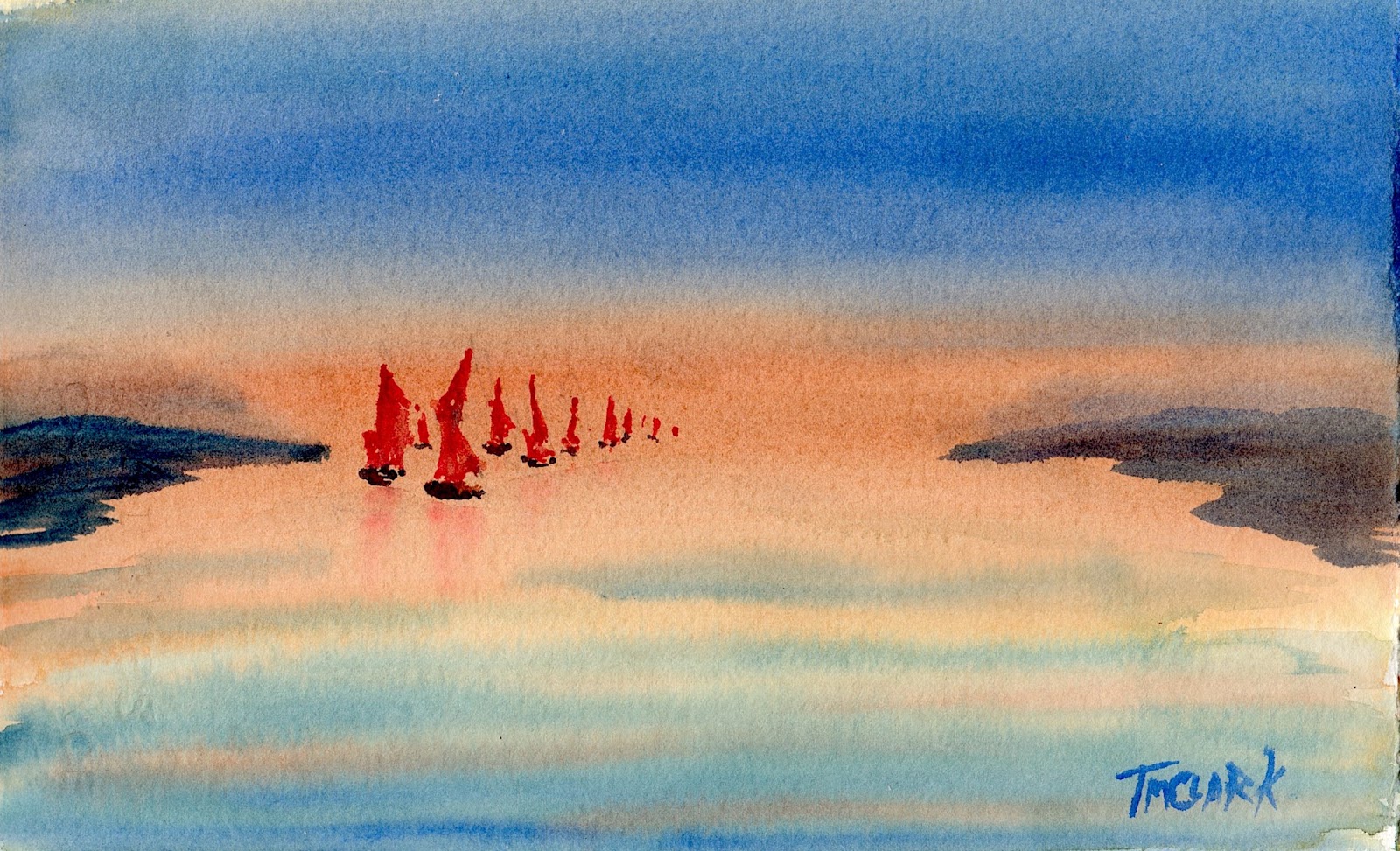
Conrad's Heart, 7 by 11 watercolor, 300 lb. d'Arches
“The sea-reach of the Thames stretched before us like the beginning of an interminable waterway. In the offing the sea and the sky were welded together without a joint, and in the luminous space the tanned sails of the barges drifting up with the tide seemed to stand still in red clusters of canvas sharply peaked, with gleams of varnished sprits. A haze rested on the low shores that ran out to sea in vanishing flatness. The air was dark above Gravesend, and farther back still seemed condensed into a mournful gloom, brooding motionless over the biggest, and the greatest, town on earth.”--Heart of Darkness, Joseph Conrad
Joseph Conrad is my favorite English author, and his short novel "Heart of Darkness" my favorite fiction.  
I first met Conrad in high school speech class, doing a dramatic reading from "Lord Jim." By the time I was an English major and teacher,  his description and storytelling enthralled me.  Not sure why, other than romantic notions of going to sea as a land bound idealist. It's no accident that my first born son's middle name is "Conrad."
Looking back as I read his words in a longtime copy of "Heart of Darkness, " perhaps some of the allure  was his strong description, imagery and dramatic narrative, all influences as I turned toward journalism.
At any rate, the second paragraph of the book has always been a favorite for imagination and the travel urge. Inspiration for  today's painting, from that second paragraph.
Day 27 of WorldWatercolorMonth daily challenge.
Palette--Ultamarine & Prussian blue, Alizirine crimson, quin gold & sienna, gamboge, Aureolin yellow.

Saturday, April 23, 2016

Revelations, perceptions, realities and New Mexico

Morning dreaming of the high road to Truchas, 5" by 6" journal watercolor on back porch
Quiet time revelations after a walk
 in Hafer Park this morning

"Since perception is reality, therefore all art is reality. There are no false views, wrong expressions, when artists put down what they perceive."  -Terry M. Clark

Think about it--yes, some are better at perceiving than others--Mozart, Michelangelo, Cezanne, Picasso, Whitman, Conrad, Twain, Parker, Ansel Adams, McPhee, Prince, Mish, Jake Harms, and millions more in all the arts. Perhaps a few times, Clark?

"Above all, I want to make you see,"--Joseph Conrad. "When I'm on stage, I don't think, I feel,"--Keith Richards.

As an uptight first born journalist I began painting by trying to get every detail photographically right. Some freedom eventually came with more practice, and especially watching my grandchildren paint, for who there are no rules. Looking at early work, or at work now when I'm in a dry spell, I see this morning, that every angle is different, every color is different, every shape is different, depending on how I look at things, and knowing you will see them differently. Why have I not had this insight before on my work--whether watercolor or writing? 

It helps to attend the Oklahoma City Festival of the Arts and be bombarded with a multitude of perceptions and realities.

Thus home from the walk to take out my leather bound watercolor journal--art and perceptions of reality in its own right--from Mind's Eye Journals--bought last year, but renewed with a visit at the art show with owner Teresa Merriman and her husband of Colorado. 

The high road to Taos, at Truchas, New Mexico, painted from memory, because that perception, that reality,  is so deep within.


Thursday, October 29, 2015

Great sentence search champion!

When I teach writing, I have my students go on what I call a  "Great Sentence Search" in the New York Times, which is our daily textbook.
Saturn's moon Enceladus
I firmly believe that in teaching writing, you have to expose students to good writing...it inspires, instructs, and also forces them to read and think. 
A great sentence is one you just know the journalist smiled and said "Yes!" in triumph when he/she wrote it--having had fun writing it. It makes you say "Wow, I wish I had written that."
Today, I found what may be the best ever, from the front page, headlined "With Worlds Visited, the Next Hunt Is for Life on Any of Them." 
Dennis Overbye wrote about NASA's exploration of Saturn's moon Enceladus, by the Cassini spacecraft. NASA is seeking extraterrestrial water, as a sign of life, and this moon spews icy jets of water.
Here is the great sentence:
"Enceladus is only 300 miles across and whiter than a Bing Crosby Christmas, reflecting virtually all the sunlight that hits it, which should make it colder and deader than Scrooge's heart."
Wow.
Here's the link to the entire story: Saturn's moon

Friday, September 26, 2014

Retracing "Blue" Highways --a journey of words

"The English language has the largest vocabulary on earth, so why should we live
 on dry, white toast when at hand is one fine smorgasbord?"
So asks William Least Heat Moon about some of his word choices in both "Blue Highways," and his new "Writing Blue Highways," and of his discussions with editors.
Which means when I'm reading his books, or any for that matter, you'll find me with pen in hand, circling words I like, or want to look up.
Here are the ones I noted in his recent book. They give you pause, but also spark curiosity.
  • purlieu-- the area near or surrounding a place.
  • ordinance-- the systematic or orderly arrangement of parts, especially in art and architecture.
  • unsnaggle.
  • soupçon--a very small quantity of something.
  • microcephalics (used disparagingly of critics)--people with microcephaly have a condition in which a person's head is significantly smaller than normal for their age and sex.
  • sententious--given to moralizing in a pompous or affected manner.
  • dispassion--about students.
  • fob--a medallion or ornament attached to a pocket watch to assist in handling
  • cognomen--an extra personal name given to an ancient Roman citizen, functioning rather like a nickname and typically passed down from father to son.
  • rebus--an allusional device that uses pictures to represent words or parts of words.
  • bifurcation--the division of something into two branches or parts.
  • gestalts--forms or shapes.
  • synonymicon--thesaurus.
  • escritoire--writing desk.
And here are are some phrases and sentences I underlined, marked or starred. 
  • "I was over-degreed and under-educated." He'd completed his Ph.D.
  • "Byways grant space and time to reevaluate what one should not have slighted, and they can stimulate ways to discover."
  • "To have a run at escaping the greatest cage of all--the interior of the human skull."
  • "Curiosity to a writer is as quadriceps to a weightlifter--the place hoisting begins."
  • "Drafts are strata, and they can be read like an archaeological record."
  • "To revise fewer than a half dozen or even a dozen times means either you're an unmatched genius or you're kidding yourself."
  • The opening paragraph had  91 words and he rewrote it two dozen times.
  • "Remember, rewriting is redemption."
  • "The biggest danger to a teacher is to be infected with student indifference."
  • "'Blue Highways' began not with a typewriter but with a camera. A photo can go where words cannot."


Retracing the "Blue" Highways--September's Pages


"'Blue Highways' began not with a typewriter, but with a camera.
 Photos go where words cannot."
As a backroad traveler, I've been a fan of William Least Heat Moon's 1982 "Blue Highways, A Journey Into America" since it came out. He did then what all of us vagabond spirits want to do...take time off and travel and write.  He covered 13,000 miles in three months of 1978 literally going "around" America--traveling the "blue" highways--the backroads that are in blue on maps. He photographed and told the stories of the people in the out-of-way places he stopped. 
Then this past year, he wrote "Writing Blue Highways, The Story of How a Book Happened." As a traveler and a writer and a student of writing and writers, fascinated by how writers write, I had to read it, finishing turning its 164 pages this month.
Good books provoke more stories, and there are many too tell here, for travelers, and writers, and readers.
This is not a book about how to write, though he tells how he agonized and labored to write it, and suffered innumerable rejections. It, like his other books, is really a story about journeys.
"Blue Highways" is the shortest of his several books in the past 30 years, and the only one I've read through is "Roads to Quoz," about more back roads and discoveries. His thick "PrairyErth--A Deep Map," about a rural county in Kansas, is the kind of book I'd like to write, but I only got have -way through it. Another thick one, "RiverHorse," about taking a boat across America,  just didn't click with me. He's written others, all about traveling.
Least Heat Moon showing one of his drafts.
I first learned of this new book when I saw something on Facebook where he was reading from it at a library in Columbia, Missouri, where he lives. The library was just two blocks from where my son Derrick, his wife Naomi and their children lived at the time. Wish I could have been there.
What impressed me much about his writing is that his first draft was written with pencil on paper, and his comments about that excruciating process fell in with many of my thoughts. And they give me ammunition  and information for when I teach non-fiction writing.
You will learn much here, including how the author went from William Trogden to his Osage name, Least Heat Moon.  
Then there's his robust vocabulary, not used to impress, but to use precisely the right word.  His comments on writing, editing and teaching add more stories.
He's extremely quotable, his writing full of fresh imagery, and the book also has photographs and philosophy throughout. "Blue Highways" began after a divorce and his being fired from a teaching job. Then after the three-month journey around the country, it took him another almost four years of writing and rejections to get published. So this new book was a must read, a story about stories and travels. To whet your appetite,  the next post will feature some of his words and phrases.


Friday, June 20, 2014

Finding the drama--taking a trip workshop--III

Here is a version of the finding the drama workshop page for my workshop session for the Oklahoma City Writers group at Full Circle Bookstore.


GOING FOR THE DRAMA
(Grabbing the Reader)
Your job—find the drama, organize it. Most written drama uses action words, short words, short paragraphs, to make the reader wonder what’s next, to think “Huh?”

How do I find drama? 
  • Sense of mystery
  • Mystery pronouns and nouns
  • Conflict
  • Raises questions
  • Contrasts
  • Twists
  • Missing facts
  • Specific details
  • Unexplained responses
  • Ominous detail


Organizing for drama--Storyboarding
Write this sentence before you write anything else:
“This is a story about ___________________________________________________
and it’s interesting because___________________________________________”

  • What makes it interesting? Is that not the drama?
  • Select the main scenes of your story (think of a TV commercial or movie)
  • Hinge your scenes on events (things that happen—verbs)
  • Scenes usually have action, characters and setting
  • List scenes in sequence
  • Choose most dramatic as first scene
  • What is last scene?
  • Always second guess

Tell me a story
  • Remember a trip you’ve taken
  • List, briefly, WWWWWH
  • Draw a map, where you started, where you ended
  • List three things that happened at separate places
  • Label them A,B,C and place on the map
  • What’s the most interesting scene?
  • Why? (This is a story about and it’s interesting because__________)
  • Describe the scene in one sentence.
  • What are key verbs?
  • Write one first sentence to grab my attention—20 words maximum

The writer’s first commandment
“Tell me a story; make it interesting.”


Going for the drama, in writing-- II

"Get to the point," I often irritate friends who get a little long-winded in telling a story.
What I'm really saying is, "Go for the drama."
Here is a version of the first  page of handouts for my workshop session for the Oklahoma City Writers group at Full Circle Bookstore.


Consider these first lines of novels:
  • It was the best of times; it was the worst of times.
  • Call me Ishmael.
  • It was a bright cold day, and the clocks were striking thirteen.
  • All children, except one, grow up.
  • Lolita, light of my life, fire of my loins.
  • It was inevitable; the scent of bitter almonds always reminded him of the fate of unrequited love.
  • Elmer Gantry was drunk.
  • A green hunting camp squeezed on top of a fleshy balloon of a head.
  • The last camel collapsed at noon. 

       They all grab your attention, and make you want to keep reading. Quiz--Do you know the authors? Answers at bottom.

In the beginning
“En el Principio, era el Verbo, y el Verbo era con Dios, y el Verbo era Dios.” San Juan 1:1
      “In the beginning was The Verb, and the Verb was with God and The Verb was God”
 “…le mot, c’est le Verb, et le Verb c’est Dios.” Victor Hugo
     “The word is the verb, and the verb is God.”
“No verb, no story, no drama.” Terry Clark
  • My students know I am a verb nut. Much of modern writing is guilty of "verbicide." If you want drama, you have to be a verbaholic.  
  • The most important words in a sentence are the verbs. Without verbs, nouns and adverbs and adjectives sit like empty boxcars on a siding, going nowhere, without a locomotive. Without them, nothing happens. They are action keys to getting to the point quickly, to grabbing and keeping readers’ attention.
  • Theology on John 1:1. The Word (English translation), is really Verb. The Verb is the incarnate Christ, but in the beginning was the force and the power of creation. In sentences and storytelling, the verb is the power and force of creation.

First sentences
The most important sentences you will write in a story?
The first ones.
Why?
What is the purpose of writing? To be read.
If you don’t catch your readers’ attention, you’re wasting your time.
Best test for effective first sentences: “Will I keep reading?”
It’s called, “Going for the drama.”
Examples
from my former students' stories and one I did for Oklahoma Today magazine on weekly newspapers:
  • “The sergeant fumbles with one hand to unbutton his fly.”
  • “Every Tuesday at one p.m., a silver-haired woman in her eighties centers the Sayre Record and plunks down seventy-five pennies for the latest news.”
  • “’I want to study people with the flesh on,’ she says.”
  • “The long, thin fingers of a frustrated pianist work the control board switches as her melodic voice interrupts the airwaves.
  • “The sergeant fumbles with one hand to unbutton his fly.”
In keeping with brevity, this is the end of this post. The second workshop handout follows.
  • Answers to authors--Charles Dickens-A Tale of Two Cities, Herman Melville-Moby Dick, George Orwell-1984, J.M. Barrie-Peter Pan,  VladmirNobokov-Lolita, Gabriel Garcia Marquez--Love in the Time of Cholera, Sinclair Lewis-Elmer Gantry, John Kennedy Toole--A Confederacy of Dunces, Ken Follett--The Key to Rebecca.