"When dawn spreads its paintbrush on the plain, spilling purple... ," Sons of the Pioneers theme for TV show "Wagon Train." Dawn on the mythic Santa Fe Trail, New Mexico, looking toward Raton from Cimarron. -- Clarkphoto. A curmudgeon artist's musings melding metaphors and journalism, for readers in more than 150 countries.
Showing posts with label English. Show all posts

Thursday, July 27, 2017

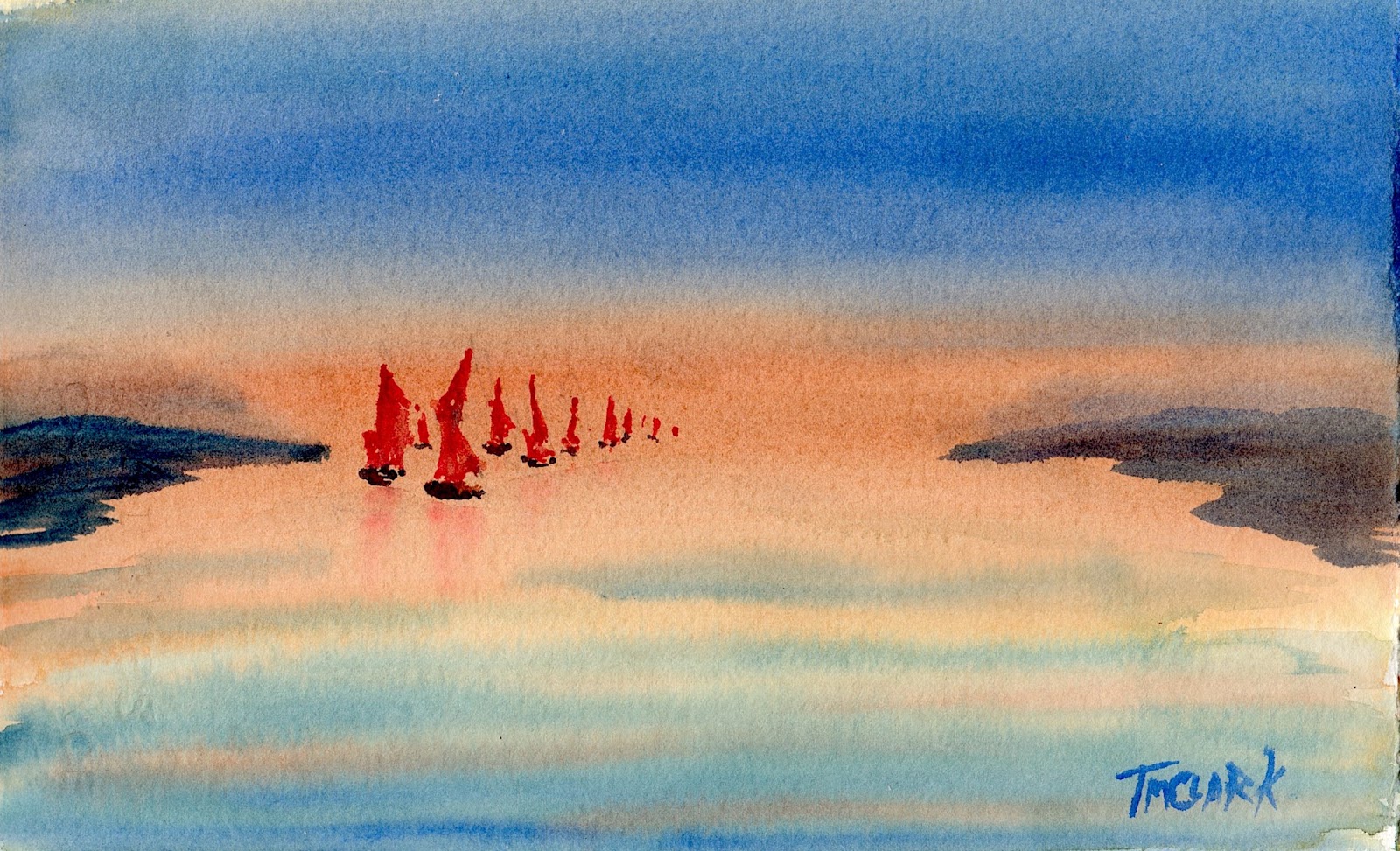
Heart of Darkness--watercolor


Conrad's Heart, 7 by 11 watercolor, 300 lb. d'Arches
“The sea-reach of the Thames stretched before us like the beginning of an interminable waterway. In the offing the sea and the sky were welded together without a joint, and in the luminous space the tanned sails of the barges drifting up with the tide seemed to stand still in red clusters of canvas sharply peaked, with gleams of varnished sprits. A haze rested on the low shores that ran out to sea in vanishing flatness. The air was dark above Gravesend, and farther back still seemed condensed into a mournful gloom, brooding motionless over the biggest, and the greatest, town on earth.”--Heart of Darkness, Joseph Conrad
Joseph Conrad is my favorite English author, and his short novel "Heart of Darkness" my favorite fiction.  
I first met Conrad in high school speech class, doing a dramatic reading from "Lord Jim." By the time I was an English major and teacher,  his description and storytelling enthralled me.  Not sure why, other than romantic notions of going to sea as a land bound idealist. It's no accident that my first born son's middle name is "Conrad."
Looking back as I read his words in a longtime copy of "Heart of Darkness, " perhaps some of the allure  was his strong description, imagery and dramatic narrative, all influences as I turned toward journalism.
At any rate, the second paragraph of the book has always been a favorite for imagination and the travel urge. Inspiration for  today's painting, from that second paragraph.
Day 27 of WorldWatercolorMonth daily challenge.
Palette--Ultamarine & Prussian blue, Alizirine crimson, quin gold & sienna, gamboge, Aureolin yellow.

Monday, May 27, 2013

Another Navy veteran who influenced me

Dr. Ray Tassin, who founded the journalism department at what is now UCO, was my reporting teacher years ago. He served for years as chair until health and retirement forced changes. Ironically, I returned to chair that same department, But that's another story.
Tassin, was well,"Tassin," as graduates and friends would say. A WWII Navy vet, he'd laugh about shooting Japanese ships out of the water. He always had change in his pocket which he constantly jangled, while lecturing. He wrote some fiction, which as an undergraduate I read. An English major at the time, before I repented, I was taking journalism to qualify my teaching certificate, but he and Reba Collins changed my direction in life, though it would take years to come into journalism as a career. (I earned only a "B" in Tassin's class.)
But Tassin had the guts and gumption not to care much about what others thought of him. Part of that came from having his son die before him. I think that teaches you what isn't important, and much of higher education's pretentiousness isn't important. Tassin had no patience with it, and managed to alienate a lot of people on campus. He didn't care. There was no political correctness in him. He was an unabashed conservative and constantly criticized and dug at liberals. One I remember, said in public, was something like, "I'm not a liberal. I know who my parents are." Still one of his best friends was colleague Dennie Hall, an unabashed liberal. I'm so glad there are still such characters as Tassin in this world. We need more of them.
All of it was punctuated with profanity. In fact, I think the saying," Cuss like a sailor," may have been invented because of Tassin. One of the last times  I saw him in his wood refinishing shop, I asked him how he was doing. "Too old to do almost anything but cuss," he said. 
The last time I saw him was at the 40th anniversary of the Oklahoma Journalism Hall of Fame, in April 2011 where we moved it into new quarters and rededicated it. I'm so pleased he could see how far it had come. He cut the ribbon.
 Ironically, I now direct the outfit. Forty years earlier he had founded it. Later that year, he died. His funeral  in Memorial Park Cemetery not far from here, was with military honors. The US Navy crest was on his casket.
  Home is the sailor, home from the sea. A Memorial Day salute, veteran!
Ray Tassin, in brown, cutting the ribbon at the Journalism Hall of Fame, with Dennie Hall in dark sport coat assisting, along
 with the other inductees , April 2011. shortly before his death


Thursday, February 14, 2013

An unholy gospel of punctuation, chapter 2

Nothing is sacred or holy about punctuation. Matter of fact, as my youngest son Derrick gigged on Facebook after yesterday's sermon, those  "other" gospels (and the rest of the New Testament), were written in Greek without any punctuation at all.
Makes you wonder who decided to put the punctuation in, doesn't it, since punctuation can change meaning? Obviously though, it wasn't God.
So punctuation is only a man-made tool to help clarify written language. Here are some more guidelines, generally accepted, for its use in American English, from this repentant old English major.

  • Period--Use lots of them. (Short sentences). And after abbreviations. But don't put a period after an abbreviation when it concludes a sentence, as He moved to Washington, D.C..
  • Question mark--Perhaps the easiest one, at the end of a question. Understand? Only difficulty is with quotation marks. See that item from yesterday, ok? And never use more than one. It’s immature.  Got it????????
  • Semi-colons--Avoid because they make for long sentences. Usually break something into shorter sentences for better readability. Use only in a series for clarity when commas are used: He went to Bugtussle, Oklahoma; Dimebox, Texas; and Hell, Michigan.
  • Ellipses--Avoid (…), even when cutting quotes, because people distrust them and think you're leaving out stuff you don't agree with, or are taking out of context. You can choose parts of quotes to use and as long as you don’t change context, there’s no harm: “I’m going to resign tomorrow,” said Superintendent Jones, at the end of a speech on embezzlement.
  • Dashes--Use with caution, when a comma or period won't do, or for emphasis. I am partial to these, for emphasis instead of an appositive, but still be careful. Also useful as I have done in this article—for lists.
  • The virgule (slash). My last mentor and friend Dr. Harry Heath hated this sign as in and/or, or his/her. Again, try to write around it.
  • Parentheses. Don't use them, unless you're William Faulkner (Or are Clark writing this sermon on punctuation and he’s already used them several times for clarity).  (See?)  They are stop signs for readers and interrupt the flow of reading. They make for long complicated reading. Make another sentence, or a compound sentence, linked with "and" or but." (But avoid most compound sentences, like parentheses). 
Revelation? I hope these sentences are. Again, always ask yourself if you have a question about punctuation, “Why do I need this?” or “Why am I using this?” 

Hear the word of Clark. Remember this mantra, religiously:
Most punctuation and grammatical problems can be cured with short sentences.

(Hey, if you enjoyed it, please tweet it in the space on the left sidebar. Help convert the masses.)

Monday, July 30, 2012

"Global-ization"--blogging around the world

Just over a month ago, I counted people in 73 different countries on six of the seven continents have been clicking on this blog. That is fascinating, and shows how the world has changed with digital media, and how widespread English is as a language. I still  wonder who and why people around the world read this.  My goal is now to get at least one reader, not a penguin, in Antarctica. http://clarkcoffee.blogspot.com/2012/06/internationally-speaking.html 
But since that time,  readers in 12 more countries have joined in. Here's a list of countries where they live:
  • Europe--Norway, Hungary, Czech Republic
  • Africa--Burundi, Mali, Morocco, South Africa
  • Caribbean-Trinidad and Tobago
  • Asia--Taiwan
  • Mideast--Jordan
  • Central America--Guatemala
  • Oceania--New Zealand