"When dawn spreads its paintbrush on the plain, spilling purple... ," Sons of the Pioneers theme for TV show "Wagon Train." Dawn on the mythic Santa Fe Trail, New Mexico, looking toward Raton from Cimarron. -- Clarkphoto. A curmudgeon artist's musings melding metaphors and journalism, for readers in more than 150 countries.
Showing posts with label Blue Highways. Show all posts

Saturday, December 18, 2021

Blue Highways


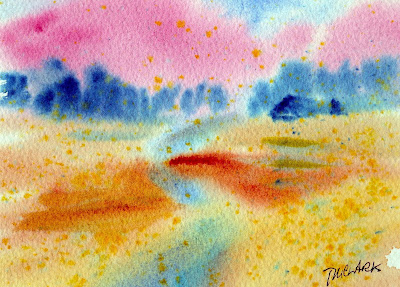
"Blue Highways," 5 x 7 watercolor, 300 lb d'Arches cold press

Among the Clarks' favorite books is "Blue Highways," by William Least Heat Moon.

It is now more than 50 years old, but to anyone who loves travel, and especially travel on the backroads, this personal journey is Gospel. I once found an inscribed hard cover first edition, and one son is now the proud owner. 

Note to those who haven't read it. The old maps of America had the main roads in red and the others in blue. He circumnavigated the U.S. in a van writing of the people and places he met.

A sampling:
  • “On the road, where change is continuous and visible, time is not; rather it is something the rider only infers. Time is not the traveler's fourth dimension - change is.”
  • "A true journey, no matter how long the travel takes, has no end."
  • "Life doesn't happen on the interstates. It's against the law."

Thus this little watercolor from yesterday, as the urge to travel deepens.

Friday, September 26, 2014

Retracing "Blue" Highways --a journey of words

"The English language has the largest vocabulary on earth, so why should we live
 on dry, white toast when at hand is one fine smorgasbord?"
So asks William Least Heat Moon about some of his word choices in both "Blue Highways," and his new "Writing Blue Highways," and of his discussions with editors.
Which means when I'm reading his books, or any for that matter, you'll find me with pen in hand, circling words I like, or want to look up.
Here are the ones I noted in his recent book. They give you pause, but also spark curiosity.
  • purlieu-- the area near or surrounding a place.
  • ordinance-- the systematic or orderly arrangement of parts, especially in art and architecture.
  • unsnaggle.
  • soupçon--a very small quantity of something.
  • microcephalics (used disparagingly of critics)--people with microcephaly have a condition in which a person's head is significantly smaller than normal for their age and sex.
  • sententious--given to moralizing in a pompous or affected manner.
  • dispassion--about students.
  • fob--a medallion or ornament attached to a pocket watch to assist in handling
  • cognomen--an extra personal name given to an ancient Roman citizen, functioning rather like a nickname and typically passed down from father to son.
  • rebus--an allusional device that uses pictures to represent words or parts of words.
  • bifurcation--the division of something into two branches or parts.
  • gestalts--forms or shapes.
  • synonymicon--thesaurus.
  • escritoire--writing desk.
And here are are some phrases and sentences I underlined, marked or starred. 
  • "I was over-degreed and under-educated." He'd completed his Ph.D.
  • "Byways grant space and time to reevaluate what one should not have slighted, and they can stimulate ways to discover."
  • "To have a run at escaping the greatest cage of all--the interior of the human skull."
  • "Curiosity to a writer is as quadriceps to a weightlifter--the place hoisting begins."
  • "Drafts are strata, and they can be read like an archaeological record."
  • "To revise fewer than a half dozen or even a dozen times means either you're an unmatched genius or you're kidding yourself."
  • The opening paragraph had  91 words and he rewrote it two dozen times.
  • "Remember, rewriting is redemption."
  • "The biggest danger to a teacher is to be infected with student indifference."
  • "'Blue Highways' began not with a typewriter but with a camera. A photo can go where words cannot."


Retracing the "Blue" Highways--September's Pages


"'Blue Highways' began not with a typewriter, but with a camera.
 Photos go where words cannot."
As a backroad traveler, I've been a fan of William Least Heat Moon's 1982 "Blue Highways, A Journey Into America" since it came out. He did then what all of us vagabond spirits want to do...take time off and travel and write.  He covered 13,000 miles in three months of 1978 literally going "around" America--traveling the "blue" highways--the backroads that are in blue on maps. He photographed and told the stories of the people in the out-of-way places he stopped. 
Then this past year, he wrote "Writing Blue Highways, The Story of How a Book Happened." As a traveler and a writer and a student of writing and writers, fascinated by how writers write, I had to read it, finishing turning its 164 pages this month.
Good books provoke more stories, and there are many too tell here, for travelers, and writers, and readers.
This is not a book about how to write, though he tells how he agonized and labored to write it, and suffered innumerable rejections. It, like his other books, is really a story about journeys.
"Blue Highways" is the shortest of his several books in the past 30 years, and the only one I've read through is "Roads to Quoz," about more back roads and discoveries. His thick "PrairyErth--A Deep Map," about a rural county in Kansas, is the kind of book I'd like to write, but I only got have -way through it. Another thick one, "RiverHorse," about taking a boat across America,  just didn't click with me. He's written others, all about traveling.
Least Heat Moon showing one of his drafts.
I first learned of this new book when I saw something on Facebook where he was reading from it at a library in Columbia, Missouri, where he lives. The library was just two blocks from where my son Derrick, his wife Naomi and their children lived at the time. Wish I could have been there.
What impressed me much about his writing is that his first draft was written with pencil on paper, and his comments about that excruciating process fell in with many of my thoughts. And they give me ammunition  and information for when I teach non-fiction writing.
You will learn much here, including how the author went from William Trogden to his Osage name, Least Heat Moon.  
Then there's his robust vocabulary, not used to impress, but to use precisely the right word.  His comments on writing, editing and teaching add more stories.
He's extremely quotable, his writing full of fresh imagery, and the book also has photographs and philosophy throughout. "Blue Highways" began after a divorce and his being fired from a teaching job. Then after the three-month journey around the country, it took him another almost four years of writing and rejections to get published. So this new book was a must read, a story about stories and travels. To whet your appetite,  the next post will feature some of his words and phrases.


Tuesday, January 21, 2014

"Jetting" along, Blue Highways Journal--IV

Oklahoma's small towns, while dwindling, are proud of their histories. Almost all of them have murals painted on old brick walls or signs, helping tell the stories of who the people are and were. No matter for these towns that the art work is in various stages of artistic ability. They represent dedication, hard work and pride by local rural artists and townsfolk.
Jet, population 213, on US 60-64, is no exception. On the eastern outskirts of town are four colorful murals on signs telling the story of the town. They're part of the town's veterans' memorial, etched in granite, behind  an old US Air Force jet trainer on stilts. That probably comes from nearby Vance AFB at Enid, where later that day I saw jets still zooming through skies in training.
In town were two more examples of brick buildings with finely crafted arches over windows and doors, typical of Oklahoma Territorial architecture. It was refreshing to see the local bank, Jet State Bank,  renovate one of the buildings for its operations, rather than building some ugly and modern box to do business in.
Also outside the town is a sign heralding it as the "goose hunting capital of the world." Now it may or may not be, but if they claim it, it is so. (This comes from someone who used to live in Waurika, "the parakeet capital of the world.") The town's location just south of the Great Salt Plains State Park and a federal wildlife refuge probably explains this.
Jet was established with a post office June 28, 1894, named for a local miller and the first postmaster, W.M. Jett.
Jet's school district for years was consolidated with Nash, seven miles east in Grant County. Nash's post office was established Feb. 14, 1894 as Nashville, and the named changed to Nash March 23, 1911. It was named for the first postmaster, Clark L. Nash.
(Information on town histories and names comes from Oklahoma Place Names, by George Shirk)

Monday, January 20, 2014

Back roads, no chain stores journal--Part III

Have you heard of Greasy Steve's restaurant or Ugly Fixer Liquor? If you get off the chain store main roads, and drive through Pond Creek, Oklahoma, population 856, you will.
I'm sorry I didn't stop and take a photo of those establishments, for they tell you a lot about the independence of living in rural Oklahoma. 
Straddling the center line of US 60 was a sign in front of the school announcing a bean and stew supper that night.  Everybody in rural Oklahoma knows of those Lions, Rotary, Kiwanis, volunteer fire departments and other clubs' pancake breakfasts and bean and cornbread suppers, raising funds for local events. 

I did turn around and snap photos of the water tower, an abandoned gas station, and two brick buildings with the distinctive arches of late Territorial and early statehood architecture. Such craftsmanship and care, instead of the plastic, all- look-alike facades of today's urban world.  No wonder we call them "Big Box Stores."
Distinctive arches of early Oklahoma archtecture
Pond Creek was originally named Round Pond, post office established in September 29, 1893. It was the county seat of Grant county from statehood till June 9, 1908 when it was moved to Medford. I bet there are all kinds of stories about those early day Oklahoma politics on the northern edge of Oklahoma, repeating a story about Waurika and Ryan in Jefferson County, at the  southern end of the same U.S. 81.
Oh, the stories to be told.
The original town site is now at Jefferson, four miles north, and Pond Creek is actually located closer to the Salt Fork River, on the intersection of US 60, 64 and US 81, which follows the old Chisholm Trail.
Oh, the stories to be told. There is a book, Trails to Old Pond Creek, by Jim Fulbright,  copyright 2006, that tells lots of stories about the Kansas connections.


(Information on Pond Creek from Oklahoma Place Names, by George Shirk)
  • Next:  the "goose hunting capital of the world."

Sunday, January 19, 2014

"Blue collar roads" Journal--Part II

Highway 60/64 west of Tonkawa may be red on our state map, but it is a blue collar highway these days, a testament to two Oklahomas--the urban affluent, and rural poverty. It is one of William Least Heat Moon's "blue highways" for me.
People who live in booming metro areas in medieval-thought gated communities or stuck like ants in rush hour traffic have no idea of the poverty in most of rural Oklahoma, and a trip down roads like this makes it clear.
Veterans' Memorial at Lamont
water tower and grain elevator in distance
I love roads like this, even though today there is increased oil-field truck traffic. There is some road construction on bridges, and wide open spaces, sparsely populated with cattle, old houses, vacant brick silos, barren fields and dwindling small towns, marked with water towers and grain elevators where railroads used to be.
First settled in the 1890s, and home to booming populations, the small towns every 10 miles are testaments to long gone prosperity and hope. Today, the highest paid people in town are probably school teachers--other than a few bank owners, probate lawyers, and retired large landowners. Everyone else is working in a garage, driving a truck, serving coffee at a cafe or cashiering at a convenience store, serving as a flagman on a road crew, all trying to make a living. You see this in the multitude of old frame houses and mobile homes, with a few brick homes interspersed.
There are two Oklahomas
There's usually a bank and a post office. Source of pride in every town, the last thing really holding it together, is the school, even if it is consolidated with another town.
At Lamont, population 417, 12 miles east of I-35, there's not much, but the street to the school is clearly marked. The Eagles roost here, and there are signs pointing the way, and eagle tracks painted on the pavement.
Urban folks and politicos who want all these small schools consolidated have no idea of the distances involved and the communities sustained with local tax dollars. They speak out of two sides of their mouths, fleeing intercity schools, but that is a different journey and subject, except that it illustrates the divide between urban and rural in this state in more than just economics and politics.
A testament to lost hopes...
Lamont, settled in 1893 was named for President Cleveland's secretary of war, Daniel Lamont. Today, there is a veterans memorial, with an aging armored military unit out front of the granite memorial, in the town park, with the slender water tower overhead. There are lots of boarded up buildings and houses, testaments to lost hopes and happy times. The most modern building in town is the Methodist church, a heritage of steadfast  faith that continues from settlement to now.
I could have spent more time here taking photos, and wish I had. In fact, as I kept driving west, I saw multiple grain elevators off on side roads, beacons or tombstones to other small towns, beckoning for a trip and more photos, more stories of the good people of rural Oklahoma.
First Methodist Church, Lamont, a heritage of steadfast faith
(Information on Lamont from Oklahoma Place Names, George Shirk)

  • Next, Greasy Steve's, and Pond Creek.


Saturday, January 18, 2014

Highway 60-64 "Blue Highway" journal-I

Did you know Oklahoma has a Nashville?
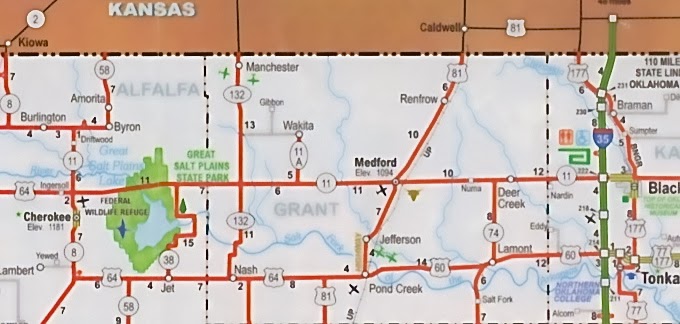
You get off I-35 at Tonkawa and head west on U.S. 60, through Lamont till it joins US 64 at Pond Creek, and slides through Nash and Jet and past the shimmering whiteness of the Great Salt Plains before turning north seven miles to Cherokee.
Welcome to the backroads, to William Least Heat Moon's "Blue Highways."It's not a coincidence I'm rereading that classic.
On my way to Steve Booher's retirement reception, I breathed at last, free of mind numbing stoplights and traffic in Edmond, and the incessant 70 mph+ trains of semis on I-35.
So there are stories to tell, photos to take. But first, I have to share this photo for friend Zach Nash.
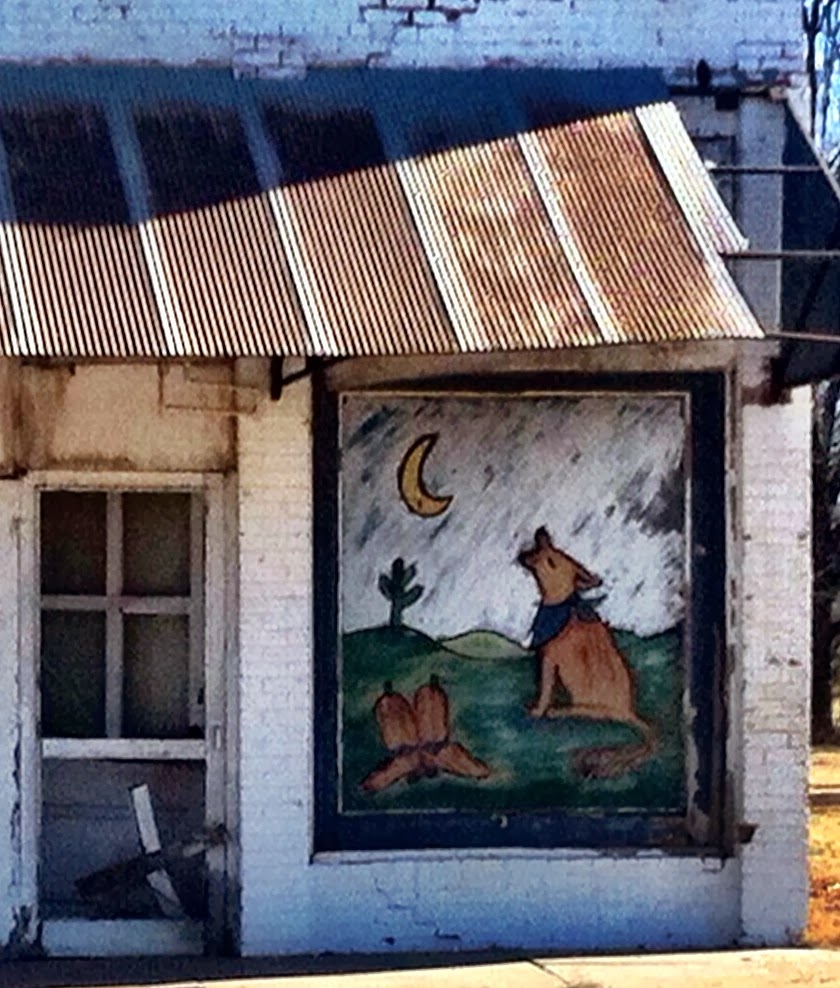
Nash, population 204, was not the first stop, but I couldn't pass up the photo, with a mural on the side commemorating John Dillinger's visit. So many memories on the backroads.

  • Next, Greasy Steve's and more

Tuesday, September 3, 2013

Back roads journal, New Mexico-I

NM 392--Eastern Quay County, north of Endee.
You find yourself on backroads, windows down, wide open spaces, scarce traffic and guardrails,  sometimes without centerlines, straight stretches to far horizons, or lots of curves, gravel, big skies, cattle guards, abandoned buildings, stacks of firewood. Small details. Quiet, except for the cry of magpies, ravens. Deer beside the road. Buzzards soaring on updrafts. Dramatic geology. Obscure state highways. 
Roads and journeys for solitude, for thinking, for imagination. Where you can see all the way from the past to the future. Take a trip with me, down William Least Heat Moon's "Blue Highways," or Walt Whitman's "Song of the Open Road." Shhh.
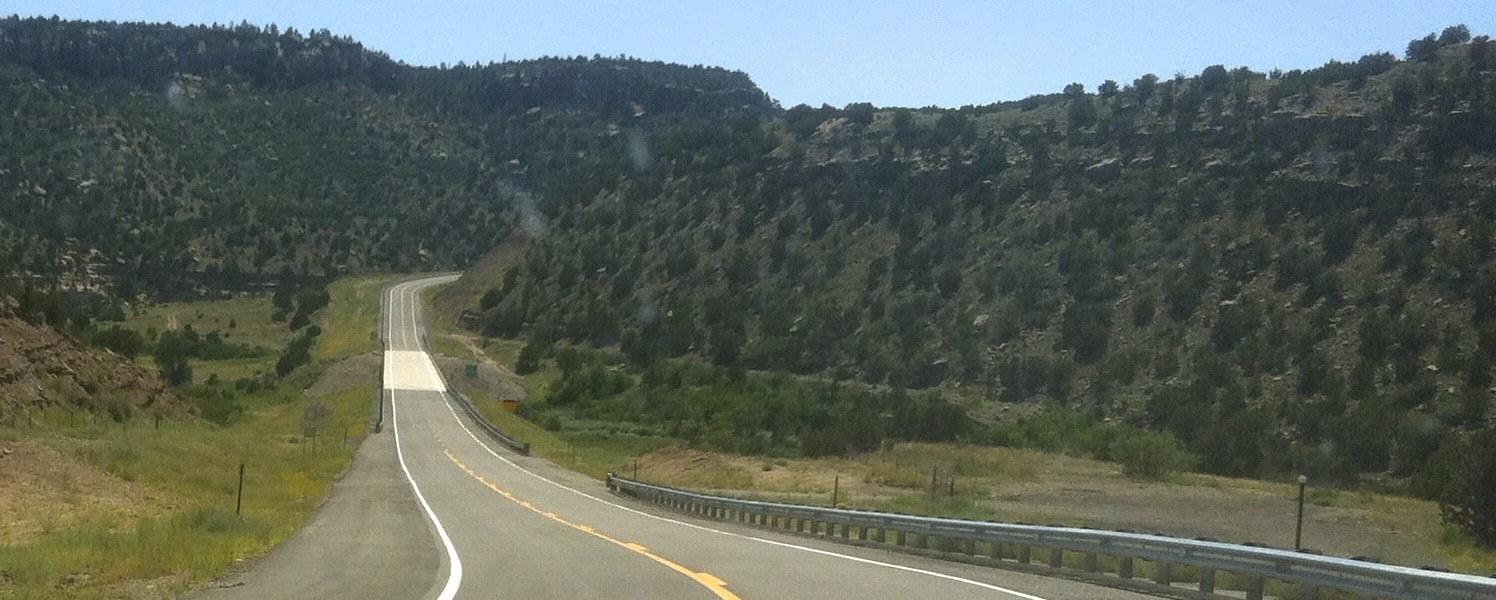
I love wide open spaces, but also the roads that twist and curve, like the sign on NM 120, coming up out of the Canadian River canyon in Mora County. Life is much more interesting, wondering what is ahead.
What's ahead? More to see, more to wonder.
Down the Canadian canyon east of Roy toward the NM 120 bridge  that separates Harding and Mora counties, as the river makes its way toward Oklahoma. Bug spots on the windshield.

Tuesday, March 20, 2012

My kind of roads

I hate lines of traffic, and stop lights, and Interstates, and straight, narrow subdivision streets and all city streets jammed with cars and trucks, and commuting. You almost can't breathe in Edmond and big cities. You forget nature and your senses and life, ruled by time and trivia.
     So my journey to the tip of the Oklahoma Panhandle this spring break was a journey to being alone, to hearing wind and meadowlarks, to hiking to the top of Black Mesa, to  open spaces and stories and imagination. It's a 350 + mile trip to Cimarron County, and the farther west you get, the better--fewer people, less traffic, wider skies, dryer landscapes and wider skies. County seat Boise City is closer to Santa Fe and Denver than OKC and Black Mesa and Kenton is another 40 miles. Some road signs out there made me realize I have some favorite kinds of roads. They match my personality, my temperament, my spirit.
     Probably the best are those with lots of curvy warning signs. They hint at adventure, something undiscovered, perhaps danger, and make you slow down to wonder what's ahead. And there's something around every bend, just like in life..something new, something interesting, something exciting, or boring or disappointing or who knows....
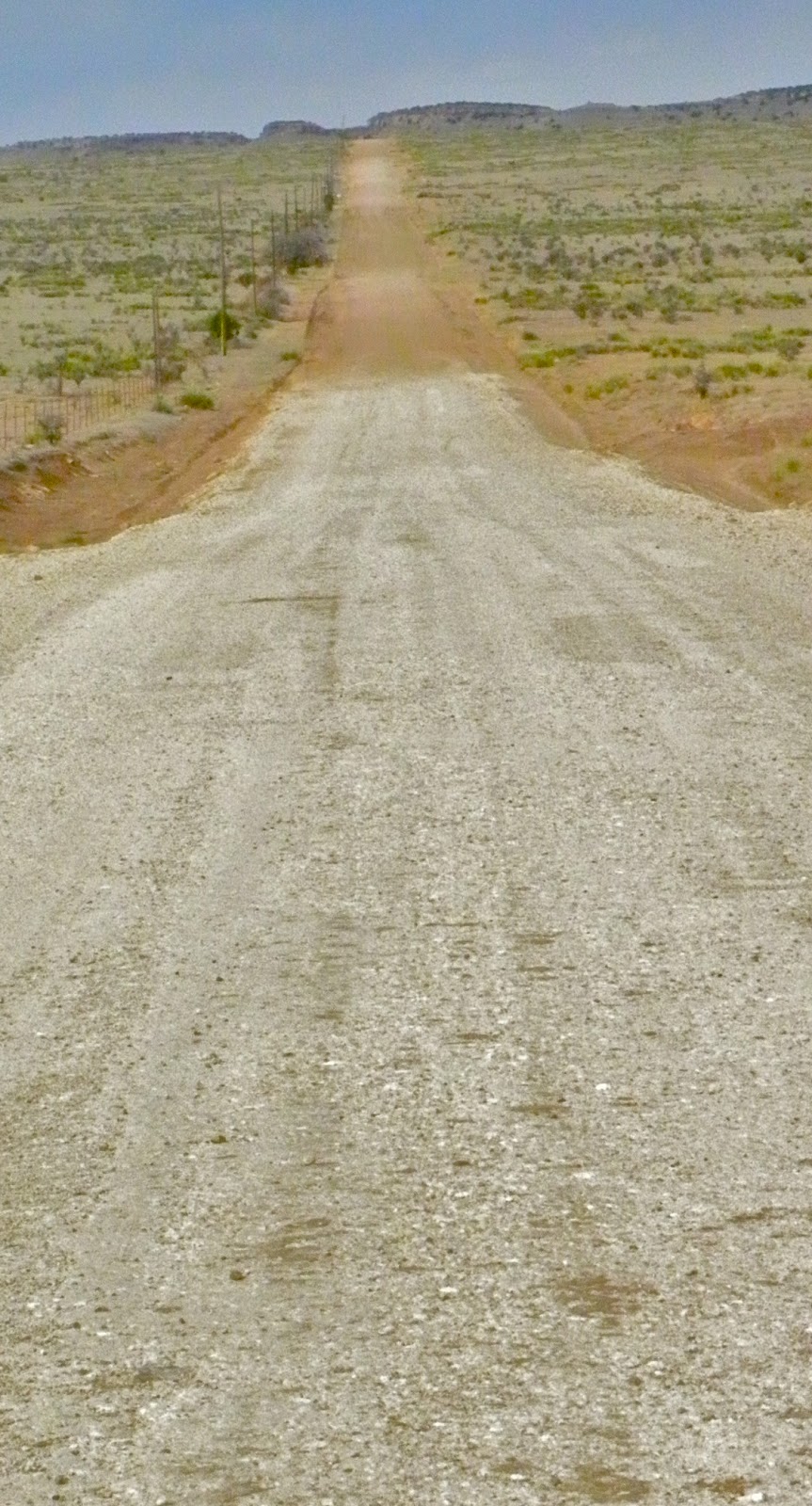
But there are straight roads I like too. Like those that remind me of the old song, "Look down, look down that lonesome road...." There are a lot of those out there, and I most like the dirt and gravel ones undulating over the hills. "What's ahead, what's ahead," I hear the whispers in my mind.
   What will I find, what will I see, who was here first, why is there a road here? Questions galore...and finally, my citified mind takes control and I think, "Turn around, you're wasting time." Such an obscenity, and affront to creativity, to discovery, to exploration, to change that breaks the rules of modern society.
   But it takes over, and I do, seeking other roads, other possibilities, rather than what is over the next hill. Wouldn't you really want to know?
   But I also like straight, paved roads--other than the one from Fort Sumpter to Vaughn, N.M., which is 70 plus mind-numbing straight miles that you dare not speed on, and which can hypnotize you. Instead, I like the ones where there is no traffic, no cops, no population--the "Blue Highways" of William Least Heat Moon. There are those out here in the Oklahoma Panhandle aptly named "No Man's Land." A car, or more likely, a pickup truck, in 40 miles is heavy traffic. The roads, like the one at the top of this blog title, or others, are where you look down in the early morning and for some reason the speedometer shows 80 or 90 or 100 mph--or slow down and stop in the middle of the road to take a photo of an old windmill, gate or abandoned house--and nobody cares or knows, as you speed along with your thoughts.
There are others, roads not taken. And you wonder where they lead.
But there's another road out here that fires my imagination also. This is where the Santa Fe Trail's (the 1800 international interstate from Missouri to Santa Fe) Cimarron Cutoff bypassed the Rocky Mountains at Raton Pass, and followed the mostly dry Cimarron River southwest, across what is now the tip end of the Oklahoma Panhandle, and entered what was then the Republic of Mexico, heading for the landmark Rabbit Ear Peak north of where Clayton N.M.is now.  It avoided the mountains but risked drought and the Comanches, from the 1830s for almost 50 years.   
A D.A. R. and historical marker marks the spot where it crossed  the current north-south pavement  showing the landscape heading southwest. I couldn't help but wonder if 150 years from now some historical marker would point out where our Interstates once were. No wonder I like the back roads.

Tuesday, February 21, 2012

Travel fever

The  latest issue of Oklahoma Today is out, and it makes you just want to get in the car and go. www.oklahomatoday.com

The first attention getter was a Shane Bevel photo of a lonely rural road and big skies accompanying Editor Steffie Cocoran's opening column. Deeper inside was the story, about the "Great Western Cattle Trail" by Jim Logan, with more  Bevel photos of vast lands and vaster skies. The magazine is fortunately featuring more large photography as it did in its early years.

I think we've all been down those highways.

Then to surprise me was friend-poet-publisher Jeanetta Calhoun Mish's "Remembering Number 9" about trips down a rural Oklahoma highway in her life.  In additon to other articles, there's veteran Oklahoma journalist-writer Sheila Bright's selection of the weird and wonderful places in Oklahoma. Yep, it's the travel issue, including articles by my former student and Associate Editor Megan Rossman, and Managing editor Nathan Gunter about the new Myriad Gardens.

I recommended William Least Heat Moon's Blue Highways to both Steffie and Jeanetta. My son Travis takes a copy with him when he travels on his motorcycle. I guess I should read it again, but I'm already cooped up. after reading this issue.

"Wrapped in ribbons of sky,
 the allure of the West is unmistakable."
--Blurb accompanying Steffie's column.

 Need to travel. Need to write. Need maps. Travel fever.

No wonder I had to change the photo at the top of my blog.