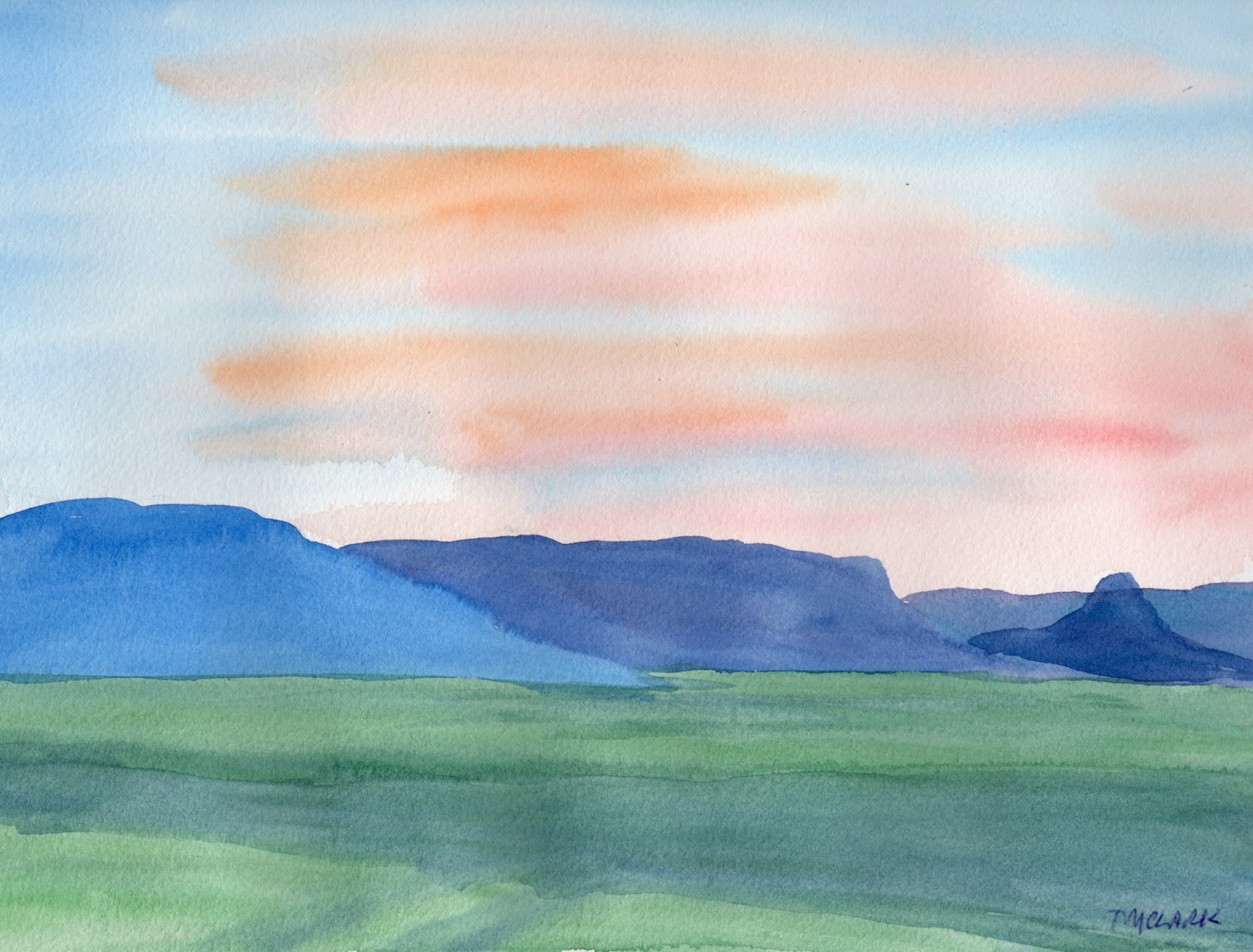
"When dawn spreads its paintbrush on the plain, spilling purple... ," Sons of the Pioneers theme for TV show "Wagon Train." Dawn on the mythic Santa Fe Trail, New Mexico, looking toward Raton from Cimarron. -- Clarkphoto. A curmudgeon artist's musings melding metaphors and journalism, for readers in more than 150 countries.
Showing posts with label Santa Fe Trail. Show all posts

Sunday, April 16, 2023

A week of emotional travel

"Dawn on the Santa Fe Trail,"  New Mexico, 10 x 20 acrylic on gallery-wrapped canvas


“Art is about emotion; if art needs to be explained it is no longer art." 

                                                                                                                         -Renoir

This was a week of emotional travel and rescue for me, thanks to fellow artists, paintings accomplished, a studio opening, compassionate advice, friends.

I don't think you can be an artist, of any type, and not have emotions. I love the quote by  Keith Richards when asked what he felt on stage. He replied, " I don't think, I feel."

A week ago, I was in the doldrums, working on a commission that was not going well, missing out on sales at Edmond Vibes. I was ready to quit, and be a greeter at Walmart. The downside of being open to emotion two-sided. You can't have positive without the other. 

"Sunset Road," loved by Ryan Day

Then,
on Friday  it changed. Friend, and wonderful multitalented artist Ryan Day, showed up at Paseo's First Friday at  In Your Eye Gallery for a great conversation. She then purchased my acrylic, "Sunset Road,"  and later bragged on it on social media.

Then her mother, Jennifer Lynn Farrar, a  Henry family friend and glass artist, bragged on it too, calling me a "hard-core artist" for painting in 105-degree heat last year during VIBES.

Stuck on the commission, and with the spark of attitude, and advice from my wife and a friend to "have fun," I revived it and finally finished it this weekend. Emotion.

And Friday, I got a call from Paseo Arts Association director Amanda Bleakley, offering me a studio space in the center. A dream, yes.

Then while studying another artist, I read this quote by Renoir. 

So this afternoon, painting from fun and a fav personal photo of New Mexico that is the header for my 14-year-old blog, I finished today's painting.   Emotion. Thankful.


Thursday, April 9, 2020

The colors of restless wanderlust

"Early Start, Dawn on the Santa Fe Trail," 8 x 10, 140 lb Fabriano Artistico cp
Every day of quarantine in this pandemic makes us more restless, especially those of us infected with wanderlust, the urge to travel.
It's even worse when you've grown up in the wide open spaces on the Great Plains, or in the West with big skies and far horizons.
I usually think of those restless adventures who risked their lives on the Old Santa Fe Trail, taking the even more chancy Cimarron Cutoff through what is now the arid Oklahoma Panhandle and northeast New Mexico..
It's no wonder that the photo at the top of this blog is from that area, one I took a few years ago heading east across the old trail, headed for home at early dawn.
Thus today's watercolor, my imagination at work, where you can still see the ruts of the trail, and in your mind's eye, the wagons headed southwest nearing Santa Fe--the colors of wanderlust, "Early Start, Dawn on the Cimarron Cutoff." 

Wednesday, January 15, 2020

Purple Dawn on the Great Plains

"Purple Dawn on the Great Plains," 8 x 10 watercolor, 140 lb. d'Arches cold press paper
The lure of open spaces, the far horizons beckon me to travel, in person, in memories and imagination.
The Great Plains have imprinted me with their spirit, enhancing the power and pull of distant mesas and mountains.
I love the silence, the lack of traffic and people, of wandering across them, wondering where back roads go, what's around the next bend or over the next rise.
They are not empty, but overflowing with stories. I'm currently reading the journals of Lewis and Clark and captivated by their wonder and experiences in America's undiscovered country just 215 years ago.
W. Swanwick's New Mexico photo
Today's watercolor was inspired by a recent photo on Instagram by William Swanwick of New Mexico, who captures the spirit of that state, and certainly the open country between, and before, mountains. I hope the painting also captures some of that unequalled aura.
It's also no accident that the painting is also in tune with the photo at the top of this blog, which I took a few years ago. I was crossing the ruts of the mythic Santa Fe Trail, east of Cimarron, very early one September morning.
And it's no accident that another inspiration, comes from the Sons of the Pioneers theme song for the 1960s TV Western, "Wagon Train":
"Dawn spreads its paint brush on the plains, spilling purple upon...."
Notice all the purple in this painting.
My blog photo, looking northeast on the old Santa Fe Trail


Monday, December 24, 2018

Pilgrimage-Christmas Eve

"Christmas Eve Pilgrimage," 5 x 7 #watercolor card
"These all died in faith, not having received the promises, but having seen them afar off, and were persuaded of them, and embraced them, and confessed that they were strangers and pilgrims on the earth." --Hebrews 11:13, King James version, others have "aliens, exiles, sojourners"

Where do you take or make pilgrimages to?
Isn't it interesting that in our sedentary lives where we think we own property, and indeed revel in it and are perhaps owned by it instead, forgetting that we're all pilgrims, we still make pilgrimages?
We see that especially at Christmas time, whether to family reunions or for religious purposes on Christmas eve. 
People of many different faiths make hundreds of pilgrimages a year to religious sites or down sacred trails. 
Why?
Maybe it is deep inside us that we know we are not permanent, in spite of our best attempts to hold on to time. Maybe it is because we are all seeking something better. Maybe it is because our spiritual ancestors--Abraham, Moses, Jesus, Mohammed, Buddist Kukai, and more made pilgrimages.
Pilgrimages have many different levels, not just a physical or spiritual journey, but a metaphor for life itself. They've fired the imagination of writers (Canterbury Tales, The Grapes of Wrath) and artists, influenced landscapes, been important in history, architecture, society.
Some pilgrimages are tainted with tragedy--The Crusades, The Trail of Tears, immigrants trying to escape poverty and tear gassed at our borders.  Others with exploration, The Mormon Trail, or with greed, The Gold Rushes, The Santa Fe Trail.
Pilgrimage is much alive today in repeated travels of all faiths and none, exploring the importance of place and journey, or merely traditional travels to specific places and times.
Perhaps we are less fortunate than Abraham, and his offspring, both by Sarah and by Hagar, who knew they were always aliens, strangers, because they lived in tents, and moved them a lot,
"By faith he lived as an alien in the land of promise, as in a foreign land, dwelling in tents with Isaac and Jacob...."--Hebrews 11:9
By the way, the reason the English settlers called themselves "Pilgrims" was because their early versions of the Bible used the word in Hebrews 11:13. If they'd had a modern version they'd used a different word.
One of my pilgrimages is through dictionaries looking for word origins. 
"Pilgrim" as made a long pilgrimage as a word.
"Pilgrim" was first used about 1200 A.D. as pilegrim, from Old French pelerin, peregrin-- "pilgrim, crusader; foreigner, stranger," from Late Latin pelegrinus, fromperegrinus, "foreigner" (source of Italian pellegrinoSpanish peregrino), from peregre, "from abroad," from per- "beyond" + agri,  "country, land," from the Proto-Indo-European root *agro  "field." The change of the "r" to "l"in most Romance languages  appears to be a Germanic modification. 
The English term "pilgrim" originally came from the Latin word peregrinus (per, through + ager, field, country, land), which means a foreigner, a stranger, someone on a journey, or a temporary resident. 
It can describe a traveller making a brief journey to a particular place or someone settling for a short or long period in a foreign land. Peregrinatio was the state of being or living abroad.

Peregrinus was also used in the Vulgate version of the Bible to translate the Hebrew gur (sojourner) and the Greek parepidemos (temporary resident). These terms undergirded a central image of the Christian life. Christians were identified as temporary residents in this world whose true home was in heaven. 
I know, more than you want to know. But as I've undertaken this annual journey of daily watercolor Christmas cards, the  trip has evolved into a pilgrimage of words.
My pilgrimages increasing head for New Mexico, where on Christmas eve, tonight, hundreds of devout parishioners will make their own pilgrimages to iconic adobe mission churches. 
These thoughts, these watercolors, help make me aware that I am a pilgrim, a stranger in a strange land.

Saturday, December 1, 2018

A season of beckoning trails

Snowfall in Santa Fe, today's #watercolor card
Holidays are seasons of traveling, in distances and memories, down old trails in our lives.
America, and Oklahoma, is a country of trails, and most of the old ones have been forgotten or paved over, but they still exist.
You can think of many...Trail of Tears, Chisholm Trail,  Santa Fe Trail, Route 66. Go to another section of the country and there will be others...The Natchez Trace, El Camino Real....
The Palace of the Governors at the end of the Santa Fe Trail in New Mexico, on the plaza, always beckons me. When there I have to walk down the long portico where Native Americans are selling their art. It seems always crowded with tourists.
But not at night. Then you can sense the almost haunting, definite magical 400-year-old history of Santa Fe. Especially after a snowstorm.
I took the photo below one Thanksgiving about 10 years ago, the inspiration for today's watercolor, though I painted from memory, what I feel, knowing it is not architecturally precise. That's not what matters when trails beckon emotionally.
For an earlier blog post and photos about the Santa Fe Trail from 2010, click "Santa Fe Trailings."


Tuesday, January 23, 2018

Landmarks on the horizon and in our lives

Dawn at Hermit's Peak, 5 by 7 watercolor card
There are landmarks on the horizon and in our lives--in our travels, in our languages, in our souls.
The word first described physical features that stood out to travelers before maps, but it's now a metaphor for so much more.
This really sunk in when I read Robert MacFarlane's book, "Landmarks," which explores the many words peculiar to specific geographic  locations.
But there are other landmarks in our lives, both positive and negative, but since I'm painting happy things this month, consider...falling in love, marriage, the births of children and grandchildren, certain trips, certain people...the list goes on.
And, out West where geographic landmarks stand out more, they also take on more than one level of importance, because they bring back memories and happiness.
Such is the hulk of rock at the eastern edge of the Great Plains, near Las Vegas, New Mexico...Hermit's Peak.
It juts out from the Sangre de Cristo mountain front, beckoning travelers since the days of the Santa Fe Trail.
Now it has become a landmark for the nearby church camp, Blue Haven, where we took our children years ago, and where some of my grandchildren have gone. I know memories will always flood their minds when they see that mountain, as they approach from West Texas. Even for me, when its silhouette rises over the horizon, I know I'm almost home to the mountains inside me.
It has become also a landmark for happy memories. So here is a birthday card for one of those kids.
(Daily #worldwatercolorgroup January paint happy things challenge)

Monday, July 17, 2017

Mythic morning watercolor--Santa Fe Trail

Dawn on the Santa Fe Trail, 9 by 12 watercolor, 140# d'Arches
Trails loom large in our history and culture, and especially mine.
The photo at the top of this blog I took a few years ago, as the first crack of dawn colored the landscape east of Cimarron, New Mexico, as I headed back to Oklahoma. I crossed the ruts of the old Santa Fe Trail, in this view looking north.
The end of the great Plains, the land of mesas and the Sangre De Cristo Rocky Mountain front.
It's a place for color, and history, and imagination. Other trails--Route 66, El Camino Real, the Mormon Trail, the Oregon Trail, Natchez Trace, Trail of Tears, Chisholm Trail, and so many more help define in spirit what we are as Americans.
So today's watercolor is a spiritual journey for me.
Day 17 of WorldWatercolorMonth challenge
Palette--Thalo Blue, Cobalt Blue, Alizerine Crimson, Cad orange, real green

Friday, December 23, 2016

Santa Fe Memories - watercolor


El Palacio do Los Gubanadores, La Villa Real de Santa Fe de San Francisco de Asis, Nuevo Mexico--9 x 12 watercolor, 140 # Fabriano
On days like this I dream of Santa Fe, where I've made many memories in the past 15 years, visiting and caring for my Uncle Mike, meeting new friends, and visiting  time and again.
I am always drawn to four icons of this oldest capital city in what is now the United States--the Cathedral Basilica of Saint Francis, La Fonda Hotel where my Dad drew portraits to make a living in the Depression, the National Cemetery where Mike is now buried five years, and of course, the Palace of the Governors, on the Plaza, at the end of the Santa Fe Trail.
I don't go as a tourist, but as an observer, a pilgrim almost. During the day, I walk the wide "portales" where the Indians of many tribes and pueblos are selling their wares to tourists.
But I especially like to go back after night fall, when the crowds are gone. And if you go after a snowfall, as I have on several occasions, there is the magic of the silence of more than four centuries.
Thus today's watercolor, and some of the photographs that helped inspire it.
Santa Fe-- "The Royal City of the Holy Faith of Saint Francis of Assisi" --memories and dreams.


Thursday, September 5, 2013

Back road journal--solitude at dawn

Dawn over the Old Santa Fe Trail, New Mexico
"Out here there's the sky," wrote Willa Cather in Death Comes for the Archbishop, capturing the essence of the wide open spaces in New Mexico. Out here, you can see forever, and the colors and light of dawn astound. Out here you can breathe in solitude and freedom. My best photo of the trip.
"Dawn spreads its paintbrush on the plains," were lyrics in the old Western, "Wagon Train. "Whoever wrote that, had to have taken the back roads out here.
Even the Interstates can be back roads...Sunday morning on I-25 heading for the Santa Fe Trail landmark, Wagon Mound--so named because it resembles a covered wagon led by oxen. Scarce traffic, wide open spaces, the solitude of traveling and thinking.
(Click on all photos to enlarge)
Wagon Mound, and I-25--even it is a "back road"

Tuesday, September 3, 2013

Back roads journal, New Mexico--II

Abandoned store at Ocate,  NM 120, at the end of the pavement. What a roof.  It breathes "weathered."What a painting to be.
Weathered adobe, wood and geography at Ocate.
Weathered. There's got to be some personal symbolism or identification for me to so love that word, and the many times I stop to take photos of weathered buildings and fence posts and more. 
So it was this trip. Rusting tin roofs. Drooping wooden rafters. Vacant windows. Peeling adobe.  Eroding granite and limestone in the mountains. But to really discover weathered, you have to get off the main roads, take the less traveled roads, slow down and look and feel.
Abandoned dugout in a nameless Texas Panhandle canyon.
Weathered...it makes you realize how small and impermanent mankind is...our monuments return slowly to dust, while the ancient earth also erodes, on a scale of size and time that dwarfs us. Those are lessons from the back roads, where there is time and space to think.


Abandoned church at San Isidro cemetery on NM 94, tin, adobe, wood, mountains, graves, weathering away.

More than man-made posts weathers...eroding Hermit's Peak, from dead end NM 266 near San Ignacio.

The "Tooth of Time" weathered landmark on old Santa Fe Trail, on NM 26, near Cimarron.

Monday, March 26, 2012

To the northwest tip of No Man's Land

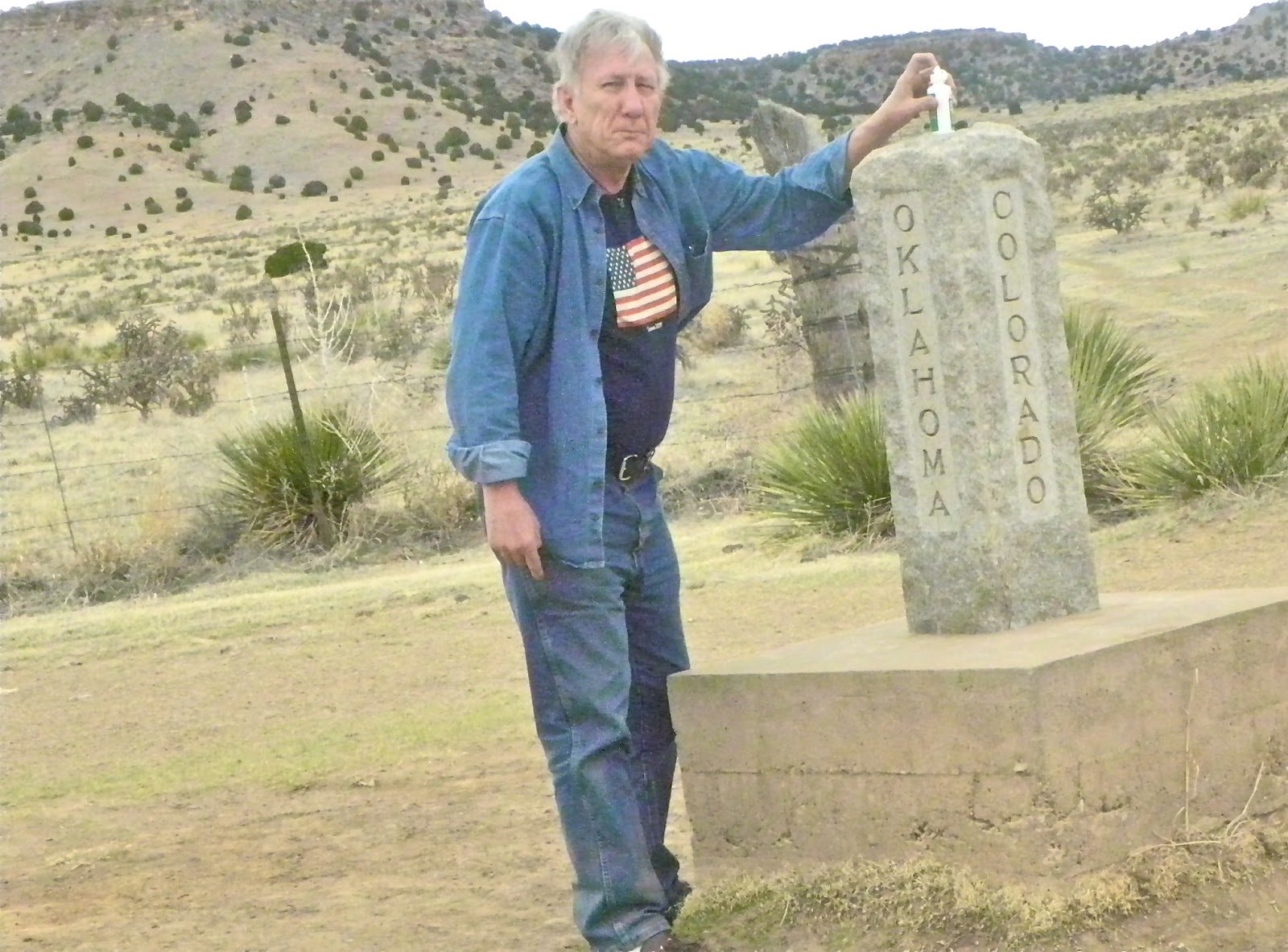
One foot in New Mexico, one foot in Oklahoma, with my finger on a little plastic bottle sitting in three states, looking straight west, camera on the hood of my car part in Colorado and part in Oklahoma.
If you travel to Cimarron County, to the tip of the panhandle of what was "No Man's Land," and get off on a dirt road, you can come to America's Three Corners--where New Mexico, Colorado and Oklahoma meet. An unassuming little monument marks the spot in a desolate land of few people and wide open spaces.

A few miles south the land opens up to the Great Plains where the Cimarron Cutoff of the Santa Fe Trail angled southwest out of what was the United States and into the Republic of Mexico. I found this marker on a gravel road, just across the line in New Mexico, looking southwest toward the landmark old volcano Rabbit Ear Peaks, just visible on the horizon between the sign and the tree, north of where Clayton, N.M. is now.
No, I'd never heard of this spot either. Here I am, car in Oklahoma, me in New Mexico. Nothing in Mexoma but a church, ruined houses,  and a cemetery. I covered many miles that day, and couldn't help but think about those wagons on the Santa Fe Trail where 10 miles would be a good day.


Tuesday, March 20, 2012

My kind of roads

I hate lines of traffic, and stop lights, and Interstates, and straight, narrow subdivision streets and all city streets jammed with cars and trucks, and commuting. You almost can't breathe in Edmond and big cities. You forget nature and your senses and life, ruled by time and trivia.
     So my journey to the tip of the Oklahoma Panhandle this spring break was a journey to being alone, to hearing wind and meadowlarks, to hiking to the top of Black Mesa, to  open spaces and stories and imagination. It's a 350 + mile trip to Cimarron County, and the farther west you get, the better--fewer people, less traffic, wider skies, dryer landscapes and wider skies. County seat Boise City is closer to Santa Fe and Denver than OKC and Black Mesa and Kenton is another 40 miles. Some road signs out there made me realize I have some favorite kinds of roads. They match my personality, my temperament, my spirit.
     Probably the best are those with lots of curvy warning signs. They hint at adventure, something undiscovered, perhaps danger, and make you slow down to wonder what's ahead. And there's something around every bend, just like in life..something new, something interesting, something exciting, or boring or disappointing or who knows....
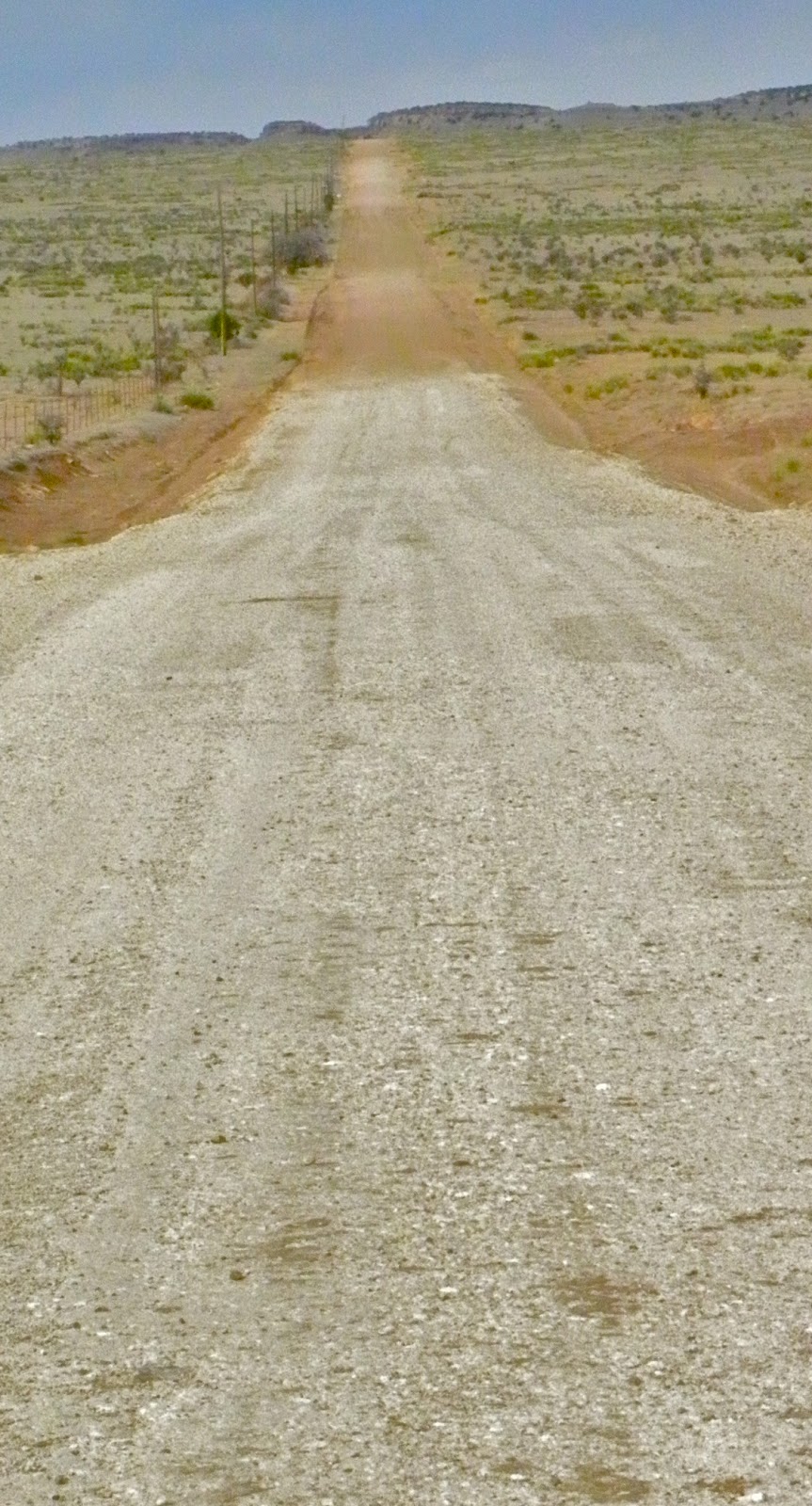
But there are straight roads I like too. Like those that remind me of the old song, "Look down, look down that lonesome road...." There are a lot of those out there, and I most like the dirt and gravel ones undulating over the hills. "What's ahead, what's ahead," I hear the whispers in my mind.
   What will I find, what will I see, who was here first, why is there a road here? Questions galore...and finally, my citified mind takes control and I think, "Turn around, you're wasting time." Such an obscenity, and affront to creativity, to discovery, to exploration, to change that breaks the rules of modern society.
   But it takes over, and I do, seeking other roads, other possibilities, rather than what is over the next hill. Wouldn't you really want to know?
   But I also like straight, paved roads--other than the one from Fort Sumpter to Vaughn, N.M., which is 70 plus mind-numbing straight miles that you dare not speed on, and which can hypnotize you. Instead, I like the ones where there is no traffic, no cops, no population--the "Blue Highways" of William Least Heat Moon. There are those out here in the Oklahoma Panhandle aptly named "No Man's Land." A car, or more likely, a pickup truck, in 40 miles is heavy traffic. The roads, like the one at the top of this blog title, or others, are where you look down in the early morning and for some reason the speedometer shows 80 or 90 or 100 mph--or slow down and stop in the middle of the road to take a photo of an old windmill, gate or abandoned house--and nobody cares or knows, as you speed along with your thoughts.
There are others, roads not taken. And you wonder where they lead.
But there's another road out here that fires my imagination also. This is where the Santa Fe Trail's (the 1800 international interstate from Missouri to Santa Fe) Cimarron Cutoff bypassed the Rocky Mountains at Raton Pass, and followed the mostly dry Cimarron River southwest, across what is now the tip end of the Oklahoma Panhandle, and entered what was then the Republic of Mexico, heading for the landmark Rabbit Ear Peak north of where Clayton N.M.is now.  It avoided the mountains but risked drought and the Comanches, from the 1830s for almost 50 years.   
A D.A. R. and historical marker marks the spot where it crossed  the current north-south pavement  showing the landscape heading southwest. I couldn't help but wonder if 150 years from now some historical marker would point out where our Interstates once were. No wonder I like the back roads.