"When dawn spreads its paintbrush on the plain, spilling purple... ," Sons of the Pioneers theme for TV show "Wagon Train." Dawn on the mythic Santa Fe Trail, New Mexico, looking toward Raton from Cimarron. -- Clarkphoto. A curmudgeon artist's musings melding metaphors and journalism, for readers in more than 150 countries.
Showing posts with label Abraham. Show all posts

Friday, December 24, 2021

Christmas Eve--pilgrims

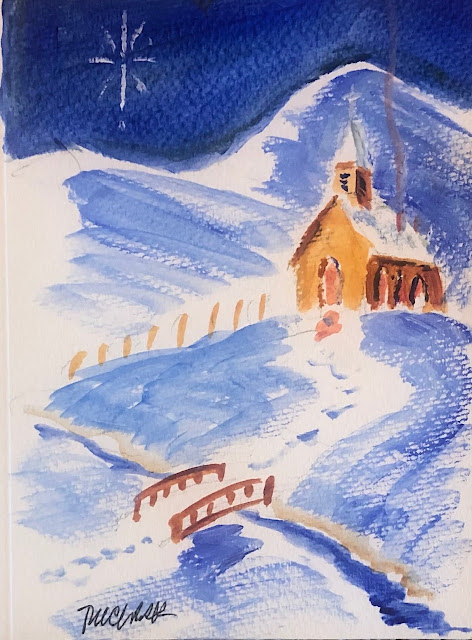
"Christmas Eve," 5 x 7 watercolor greeting card

                 
We are all pilgrims. 

For those who believe and attempt to follow the teachings of Jesus, this religion-ordained eve of his birth prompts a pilgrimage of sorts to church services throughout the world, perhaps reminding us that we, like Jesus and his Jewish parents on the night of his birth, were also pilgrims. 

We are not alone. "Next year in Jerusalem," is the closing wish and song of Jews the world over as they remember their pilgrimages at Passover in the Seder meal. As children of pilgrim Abraham, of exodus from Egypt, of exile and return, and of 4,000 years of existence, they too know they are pilgrims.

The other children of Abraham,  Muslims know they are pilgrims. Every year millions travel to worship in Mecca, the birthplace of Mohammed. One of the five pillars of Islam is this pilgrimage, the Haji, once in  life.

Many others make pilgrimages, whether for religious or personal reasons on this week or at other times of the year. Christmas is a time for family pilgrimages for reunions. "I'll be home for Christmas." My pilgrimages are to my mother's grave, once a year or to New Mexico. Many others who return to home country for family and other special occasions.

 Consider the English term "pilgrim" originally comes from the Latin word peregrinus (per, through + ager, field, country, land), which means a foreigner, a stranger, someone on a journey, or a temporary resident. We even have a falcon from that name, though given the migration of birds and animals....

What should that remind us of, especially in these uncertain times--that there are always uncertain times, that we are on a journey?

Are we are not all children of Abraham, pilgrims?

Monday, December 24, 2018

Pilgrimage-Christmas Eve

"Christmas Eve Pilgrimage," 5 x 7 #watercolor card
"These all died in faith, not having received the promises, but having seen them afar off, and were persuaded of them, and embraced them, and confessed that they were strangers and pilgrims on the earth." --Hebrews 11:13, King James version, others have "aliens, exiles, sojourners"

Where do you take or make pilgrimages to?
Isn't it interesting that in our sedentary lives where we think we own property, and indeed revel in it and are perhaps owned by it instead, forgetting that we're all pilgrims, we still make pilgrimages?
We see that especially at Christmas time, whether to family reunions or for religious purposes on Christmas eve. 
People of many different faiths make hundreds of pilgrimages a year to religious sites or down sacred trails. 
Why?
Maybe it is deep inside us that we know we are not permanent, in spite of our best attempts to hold on to time. Maybe it is because we are all seeking something better. Maybe it is because our spiritual ancestors--Abraham, Moses, Jesus, Mohammed, Buddist Kukai, and more made pilgrimages.
Pilgrimages have many different levels, not just a physical or spiritual journey, but a metaphor for life itself. They've fired the imagination of writers (Canterbury Tales, The Grapes of Wrath) and artists, influenced landscapes, been important in history, architecture, society.
Some pilgrimages are tainted with tragedy--The Crusades, The Trail of Tears, immigrants trying to escape poverty and tear gassed at our borders.  Others with exploration, The Mormon Trail, or with greed, The Gold Rushes, The Santa Fe Trail.
Pilgrimage is much alive today in repeated travels of all faiths and none, exploring the importance of place and journey, or merely traditional travels to specific places and times.
Perhaps we are less fortunate than Abraham, and his offspring, both by Sarah and by Hagar, who knew they were always aliens, strangers, because they lived in tents, and moved them a lot,
"By faith he lived as an alien in the land of promise, as in a foreign land, dwelling in tents with Isaac and Jacob...."--Hebrews 11:9
By the way, the reason the English settlers called themselves "Pilgrims" was because their early versions of the Bible used the word in Hebrews 11:13. If they'd had a modern version they'd used a different word.
One of my pilgrimages is through dictionaries looking for word origins. 
"Pilgrim" as made a long pilgrimage as a word.
"Pilgrim" was first used about 1200 A.D. as pilegrim, from Old French pelerin, peregrin-- "pilgrim, crusader; foreigner, stranger," from Late Latin pelegrinus, fromperegrinus, "foreigner" (source of Italian pellegrinoSpanish peregrino), from peregre, "from abroad," from per- "beyond" + agri,  "country, land," from the Proto-Indo-European root *agro  "field." The change of the "r" to "l"in most Romance languages  appears to be a Germanic modification. 
The English term "pilgrim" originally came from the Latin word peregrinus (per, through + ager, field, country, land), which means a foreigner, a stranger, someone on a journey, or a temporary resident. 
It can describe a traveller making a brief journey to a particular place or someone settling for a short or long period in a foreign land. Peregrinatio was the state of being or living abroad.

Peregrinus was also used in the Vulgate version of the Bible to translate the Hebrew gur (sojourner) and the Greek parepidemos (temporary resident). These terms undergirded a central image of the Christian life. Christians were identified as temporary residents in this world whose true home was in heaven. 
I know, more than you want to know. But as I've undertaken this annual journey of daily watercolor Christmas cards, the  trip has evolved into a pilgrimage of words.
My pilgrimages increasing head for New Mexico, where on Christmas eve, tonight, hundreds of devout parishioners will make their own pilgrimages to iconic adobe mission churches. 
These thoughts, these watercolors, help make me aware that I am a pilgrim, a stranger in a strange land.

Monday, December 17, 2018

Child of the desert--8 days 'til Christmas

"Life, in the deserts," 5 x 7 watercolor
He was a child of the desert, spending more of his life there than in the cities or towns.
Three of the world's major religions began and grew from people and gods of the desert--children of Abraham, a child of the desert--Judaism, Christianity, Islam.  Why? How?
Are deserts where people find God, or does God find people in the deserts?
 Ignore the stereotype image of shifting sands of the desert. Those of us who have grown up in arid areas know the desert is more varied than that...places of stark landscapes, little water, vast skies, withering daytime heat, stunning nighttime starscapes.
People find solitude in deserts, and humility from finding how small they are in vast landscapes.
It's no wonder Islam, home on the largest deserts, including those dunes we all imagine,  in the world, have brought us must astronomy and mathematics. Out here you have time to think and observe and create.
It's no wonder that the children of Israel, exiled in Egypt and Babylon, and wandering 40 years in the desert, give us poetry and another religion.
"I cared for you in the desert, in the land of drought."--Hosea 13:5
It's no wonder that Jesus and his teaching come with insights about truth and humility.
The King James Bible did us no favor by referring to the desert as wilderness. I suppose that's because those English translators had never seen a desert.
Jesus had. Born and growing up in an arid town. 
"And the child continued to grow and become strong in spirit and he lived in the deserts until the day of his public appearance to Israel."--Luke 1:80
Walking and working in the dusty landscapes where wells were landmarks, he sought followers there, but also sought solitude, spending 40 days fasting and being tempted in deserts.
"Jesus, full of the Holy Spirit, returned from the Jordan and was led by the Spirit in the desert, where for forty days he was tempted by the devil."--Luke 4:1
He knew about the deserts in people's lives, in regimented religion that preached rules and complications and ignored the freedom and spirit of living in deserts.
In the deserts, the child of the desert found not death, but life.