"When dawn spreads its paintbrush on the plain, spilling purple... ," Sons of the Pioneers theme for TV show "Wagon Train." Dawn on the mythic Santa Fe Trail, New Mexico, looking toward Raton from Cimarron. -- Clarkphoto. A curmudgeon artist's musings melding metaphors and journalism, for readers in more than 150 countries.
Showing posts with label higher education. Show all posts

Friday, January 12, 2018

An opinionated journal and photos of UCO changes- part I

Paved parking lots...an unappreciated symbol of vast changes at UCO

"...it looks and acts and breathes like a university."

This week marks the first spring semester in more than three decades that I've not prepared for new university classes, and the first in 28 at the University of Central Oklahoma. While I have no regrets or sadness about that, this week has reminded me of the passing of time, and the changes over the years. This will be the first of two or three posts about the changes I witnessed, beginning with the earliest. 
Caveat: (I've always wanted to use that word) This is not a UCO-sanctioned official blog, history or comments. I'm retired, and the opinions and perspective are all my own. I am thankful for and proud of UCO, especially my students and colleagues, and the progress that has been made. So these comments should be taken as good- natured, but with the understanding that some of them are tinged with a journalist's humor and faculty member's viewpoint, punctuated with a few barbs. Most of the photos have no students in them, but that's when I walked around--early one morning in late May, or in December break.
Before retirement from the UCO last spring, I took a walk around campus, thinking about the passing years and the changes.
I started taking photos of all the buildings that were not there when I arrived in 1990. I couldn't take photos of the now absent gravel parking lots, or the demolished Industrial Arts Building, the old president's house, or the East dorm.
Lots of physical plant changes have happened  under the three most recent presidents. Before then, the newest buildings were 1960s era, there were gravel parking lots, no uniformity in signage, no landscaping, no maintenance budget for aging buildings. The only changes were when faculty died, or the college changed its name again. It was sometimes, justifiable called, Broncho High. 
Not now--the academic quality of faculty, programs, students  and leadership is the highest it's ever been, and instead of a commuter school, it looks and acts and breathes like a university.
Perhaps the most changes were the result of former Oklahoma Governor George Nigh, who took over when Bill Lillard retired. Through Nigh's  political connections and bond issues, the campus began a transformation that continues today. Lots of academics didn't like Nigh being president but he was exactly what UCO needed to wake up from its long lethargic status quo. If you haven't been on campus in a few years, you won't recognize it. 
Understand the ruling principle of all higher education. 
"Turf"--At UCO   and elsewhere--space is limited, dollars are scarce, faculty positions  almost sacred, and you have to have student enrollment to justify anything. Campus politics to hold onto and increase turf--obtain space, get faculty, hold onto enrollment--has lead to cutthroat competition between departments in the past. As a new chair, I had to fight and wheedle for years for equitable resources for our students and faculty. Improvement in administration over the years has  ameliorated (another word I've always wanted to use) that quite a bit--there is much more cooperation now than when I started. But as state support shrinks as the GOP legislature deliberately works to castrate education  (What else would you call cutting UCO's state support 27 percent in the past three years?), the scramble for dollars and enrollment is still about turf--especially between different universities.
Perspective: which means that faculty and staff are indeed thankful for any new space that comes along.
Here are those improvements from the Nigh era. Most obvious to the public is the conference center and additions to the student center.
You come in off second street on Garland Godfrey Blvd, and this greets you:


East view, the joining of the old and the new

On the north side is the idyllic Broncho Lake, and the center, where landscaping is most obvious
I have neglected to get photos of the business building additon, which provided an auditorium and elevators to the second story. I'll post that next. I remember when Nigh was explaining his grand plan in an upstairs classroom, we had to carry our student newspaper Vista reporter Roy Howe confined to a wheelchair, up stairs so he could cover it. Roy has died since then. The memory hasn't.
The education building was the first completely new building on campus in years, housing the original departments from the school's teacher college days. It looks pretty good from here, but the hodge podge of haphazard architecture with fake Greek columns and more may make it the ugliest building in Oklahoma. But inside, it looks better, and has wonderful people and students there, who are thankful for new facilities after years of neglect.


Chambers Library had space almost doubled, but the real change was inside. When I first came to UCO, we got a few dollars each year to buy books for the department. They went into dusty shelves. The addition, in spite of more fake Greek columns,  helped fuel a transformation to digital technology, modern data bases and much more. The glass atrium joins the new and old.

The science building was another addition, to existing Howell Hall, and provided lots of needed space, but the money spent on fake Greek columns and unfinished labs irritated faculty for years.  Notice also the up-to date signage--a product of the last few years that has made a huge difference on campus.


A rear view from the university center.
The art building had the addition of the Melton Art Gallery.
Sidewalks--To me, the most exciting time of the year is when students crowd the sidewalks during the beginning of the fall semester. There's energy and excitement and so much more. 
Don't take them for granted. They bind the campus together, cover utility lines, and didn't exist 25 years ago.

This building goes unnoticed, but provides cooling to many buildings, through those under-sidewalk arteries.
Something that hasn't improved since those early years, is obviously the fading chipped sign on Edmond's water tower.

Two of the most neglected buildings on campus have been the music building and the communications building.
Communications received a token connection between two buildings. We also got an unappreciated Land Run mural on the side, which draws derision and controversy. But I don't want to end this negatively.
  
This plaque was also not there when I started, honoring my friend Terry L. May, who was an assistant vice president in Academic Affairs when I started. He was the one person in administration I learned I could completely trust. You could stand on his word, and even if you didn't agree, it never affected professional action and decisions. This plaque is outside the ROTC department which he, a Vietnam vet,  helped organize. I walked by this every morning for years heading for our building from the parking lot.
Snap a salute to Lt. Col. May, an officer and gentleman.
(Next, More changes you can see, and can't see)


Saturday, December 16, 2017

December Departures - Old North

"Old North at UCO," 5 by 7 watercolor card
Graduation days are departures as well as beginnings, and this marks the first December in more than two decades that I won't be attending at UCO,  congratulating favorite students receiving their degrees. It's why we teach.
Retirement has been departure, and they so are students, beginning new phases of our lives, leaving behind the iconic Old North, oldest higher education building in Oklahoma, dating from 1893. 
2016
For years I've painted snow scene watercolor cards for several friends on campus, but not this year. However I've photographed it a lot this year, watching its construction, and through the years. 
Old North was often the first thing I saw early in the morning as I arrived on campus, lit by the rising sun, or in the evening, silhouetted by the setting sun. Departures.
But  this year has been important for it as well. After sitting vacant since 2001 because it was unsafe, it reopened this fall, rebuilt inside, and added on to as well, the result of lot s of fundraising and committed administrative leadership. It is once again a showcase of the promise of education, including excellent art and photographs, the latest technology, and classrooms full of students. 
Anybody who has attended UCO in its various name changes through the years probably has stories to tell, because there are literally thousands of people who have had classes inside this former teacher's college--including me.
Here is last year's painting, and some photos I took walking around  campus in May, and some from earlier years. Departures.
(Day 16 of 31 December paintings)

Icon  of education

The new and old, and Chickasaw Plaza

Sunrise 

Sunset

Campus beauty

From UCO archives

From UCO archives


Sunday, April 23, 2017

The booth, chapter 1, the story retold

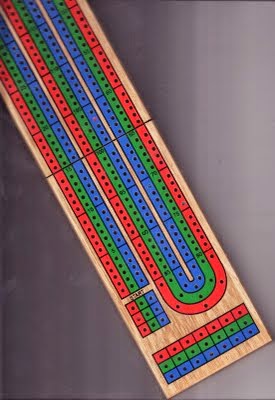
Ye olde, and actual, cribbage board of "The Booth"

"…cribbage...a game of cards and counting and moving pegs in holes endlessly around a board…somewhat like teaching in college, and certainly like being an administrator, other than it was fun." 

From 2009, on the blog, The Booth, chapter 1, because these words have high import

Chapter 1

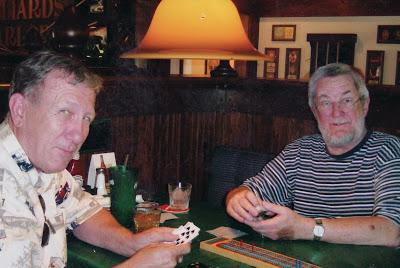
And on the first day of the booth, commencing at 4 p.m. one sunny fall day, which was unremarkable and unmemorable to the profs as the years passed, they joked and the Illidge taught the Clark how to play cribbage…a game of cards and counting and moving pegs in holes endlessly around a board…somewhat like teaching in college, and certainly like being an administrator, other than it was fun. As the afternoon unfolded, with only grading to be done for tomorrow, the two shared war stories. Under the watchful eye of the bosmy student-bartender however, they would not share their preferred refreshments of vodka on one hand, and rum and coke on the other, which helped them forget the frustrations and stresses of higher education.


Lo, the Illidge, since he knew the rules, soundly thrashed the Clark in the card games, though the cards, dealt repeatedly for two hours, perchance did get sticky from their glasses’ condensation circles.. And in spite of several games and matching drinks, after generous tips, it is well reported that both were able to drive home safely, vowing to return. 


Henceforth, though they knew it not, the one-sided results of the card games, as well as their exclusive occupation of the booth, would not always be so.

On the morrow, as was their habit, they arrived early in the less-than-august halls of the university, yea, before most academics and administrators had even heard alarm clocks. It was, as it were, an unsaid competition between them, to see who would be first to start the coffee. Whoever was second, even at 7 a.m.,  would be greeted with insults, as in “It’s nice you came to work this afternoon.
"

Then they would sit, in the pre-dawn darkness of the day, office lights not turned on, sipping coffee, dozing, sighing, thinking, occasionally exchanging words, but not constantly yammering as women, about issues and events of the day, but mainly enjoying the silence, the quiet. Until of course, the sun slowly came up, illuminating the aging clock tower of the university with its hands slowly, if ever ticking, as time slid by. Then the Queen bee of the department arrived, early as was her habit, unlocked the department office door, flipped on the lights, to the dismay of the optical pupils of the professors, and their outcry.


Lo, then the Illidge exclaimed to the fair Queen, even boasting, about his previous afternoon’s conquest of the Clark in cribbage. And the Clark could only cower that first day. And the Queen, with the exalted reputation of Dr. Sump, did nothing to assuage the stories, nor mitigate, nor even lessen them, much less deny them. So then the word of the Illidge spread, abetted by the Queen's royal reputation and humor, that there was this spot, this time when there was respite from campus control, from inane dithering, from the Clark’s type-A attitude—a veritable air-conditioned, and thoughtful oasis in the midst of Oklahoma aridity.


To be continued…

Saturday, April 22, 2017

Yea verily--Tis time to retale the tale of "The Booth"--Prologue

End of another semester, and of a career for me, but not of "The Booth," now immortalized in the caricature of me in "my" retirement paper. 
Booth?
'Tis surely time, yea verily,  to retell the tale, for the benefit of the "young-uns" who do not know how "booth" became a verb, and while we still, every time we meet to imbibe, toast "To Bob," not with saddness but with much revelry and great memories and sayings.
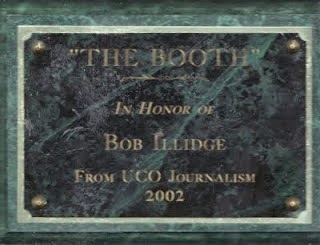
Henceforth and forsooth, here is the beginning of 16 chapters telling that sacred tale, last retold told in 2014. (Note--the booth location twas once Bennigans and now is Old Chicago's--alas the booth plaque, which once hung on the wall of the original booth is no more.)

"Booth" is a verb, a story and reverie

"We need to booth," said a colleague the other day, and we knew what she meant. End of semester. Time to get together for a little adult beverage and toasts and stories and jokes and release from  higher education's tensions, rules and nonsense. 
Boothing, The Illidge, The Clark, cribbage and spirits
But "Booth" has a long history for us in our department, I'd guess about 14 years. I've told this story before on this blog, but realized it has been a decade since my friend Bob Illidge retired, and nine years since he died, most of us attending his funeral in Wichita, Kansas.
After all these years, at this week's booth, here was the first toast: "To Bob." Such is the power of a friendship and a gathering.
So, in his honor, here is the first of about 16 chapters in the story of "The Booth," first written in 2009. I'll post one each day.

From Aug. 9, 2009

"Booth is a verb...a love story, prologue"

Once upon a time long ago in a university department, two friends needed to get off campus one afternoon, to get away from the inanity of higher ed, from students who didn’t care, from stupid rules and useless meetings and endless paperwork, from administrators who didn’t care about teaching.
Major universities worth their salt have neighborhood pubs around them for the students, and select ones for the faculty. But not so for where they labored against ignorance, a commuter-oriented university in the midst of a rich religious-right Republican suburb of a government-welfare capital city in a somewhat backward, if friendly, state. And this was grievous indeed for the Irish Catholic, veteran advertising professor whose sense of humor offset the injustices of life. He knew he needed a “little something” to wash away another day. Forsooth, the younger professor and chairman, a recovering tee-totaling fundamentalist, had become an expert over the years in the nonsense of administration, and knew he also needed respite of a liquid kind to keep his sanity.
 

Yea verily, they escaped the halls of mediocrity one day, a cribbage board and cards in hand, and ventured down to a franchise bar and restaurant no more than a half-mile from the austere campus, and found in the back, a booth paneled in dark-stained wood, cushioned with fake green leather, and set off from the rest of the restaurant by fake dark greenery. Then they saw the bartender, a cheerful, bosomy young woman who both knew because she was a student, as with most of theirs, paying her way through college by working long hours in fooderies and drinkeries for cheap pay in hope of good tips.

"To be continued…  "

Saturday, February 13, 2016

"I want my country back"--so much is wrong here

"I want my country back." I'm mad and want to make America great again. All this anger and yelling in this campaign makes me think America is in the toilet. I may even switch and register Republican.
"...makes me think America is in the toilet."
Just think of all the things wrong here.
A school bus just went by, on paved streets, full of students on the way to public school, with well trained certified teachers.
My electricity is on 24 hours a day and my tap water is drinkable.
The  prescription medicines I take with that water is government certified, as is my breakfast food, and all other food, is  certified safe.
I can go safely down the street, patrolled by police cars and regulated by stoplights, to the grocery store packed with that food.
I have regulated insurance on my house, and firetrucks are not far away. I have a working sewer, not an outhouse, and zoning prevents someone putting up a trailer house or factory next door.
My car meets safety regulations, and the big trucks on the efficient highways and Interstates are licensed and inspected by the government. Gasoline also meets required standards.
Overhead a jet airliner, certified safe and piloted by trained  and certified pilots, heads for the airport under direction of government air traffic controllers.
"I attended four different kinds of religious groups..."
In my house I own firearms, without fear of seizure, and this past month I attended four different kinds of religious groups without fear or being forced.
I recently went for an annual physical and was attended by a licensed doctor and nurses. I paid for this with funds from my secure account in a bank, where my money is safe. On the way home I stopped and bought a cup of coffee and my money was accepted. We went out to eat last night, and never worried about the safety of the food. 
Overhead, another U.S. Air Force AWACs jet just slid across the sky, reminding me of our country's military, the most powerful in the world, protecting us from invasion, trying to deter war so our service people don't have to die. 
Refugees and immigrants from those trouble spots and poorer countries are desperately trying to come here, oblivious to the sorry condition of America.
I've seen bumper stickers criticizing Obama, and others praising him. I read newspapers that are not censored by the government. 
Citizens can safely go vote, for whoever they want, in a multitude of elections, and know that whoever gets the most votes will win
I work at the University of Central Oklahoma that must meet certain safety and fire regulations, and my benefits include retirement.
"a young man in a wheel chair with a service dog,"
On that campus yesterday I saw a young man in a wheelchair with a service dog, able to go to college, which would never have happened when I was that age.
And there are a multitude of races and  citizens on that campus. In my classes I've had students from around the world and across the country--no segregation. I've had public schooled, private schooled, home-schooled, foreign schooled. All are welcome, and treated equally.
 "All are welcome and treated equally".
In one day I saw a booth for Christians on campus and another by Muslim students informing others. Outside, a small group was strumming a guitar, singing a religious song, with some hands reaching for the sky. There's also a skeptics club on campus, a bass fishing club, and a multitude of others.
I've seen anti-abortion displays, and pro-choice displays, across the sidewalk from each other.
A friend and favorite former student spoke to one of my classes this week. During her presentation, she essentially criticized the president. Some in class agreed, and some didn't, but her comments  were welcome. 
Are there things wrong with my country? Of course--crime and poverty and injustice and inequality and racism and hatred and prejudice and unfounded fear, corruption in buying politicians ... the list goes on. It is indeed maddening...has it ever been different?
Oh, I forgot about how mad I am and wanting to make America great again. My garbage is picked up every week, not strewn around or left to stink on the roadside.
"You take the outhouse"
Speaking of garbage...you take the outhouse if you want it back...it fits.
I'll take my country the way it is, not the way it never was.


Thursday, December 24, 2015

125 years ago today

Old North, from a Christmas card this year
Today, 125 years ago, what is now the University of Central Oklahoma began as the first teacher's college in Oklahoma Territory.
This is my 26th year as a professor at the University of Central Oklahoma, formerly Central State University, Central State College, Central Normal School. There's much to-do, as there should be this year about this milestone.
Prairie icon years ago
Within two years, what is now "Old North" was erected on the prairie. Many years later I actually attended my first journalism classes in the building. It was a strange circular journey in life that brought me back here to teach. The building has been closed for years now because of structural decay, and refurbishing and additions have been underway, as budgets and fund-raising allows. 
Today, except there's construction fence around her
Still, though, it is an icon for many Oklahomans. Almost anywhere you go in this state, when people hear you teach at UCO,   someone will say they went there, or a relative or friend did. They, and we, joke about the name changes, with "Central State" the most common, and usually, we just settle on "Central."
It's a good school, with many great programs, respected around the state, having grown from those small beginnings to about 17,000 students.
An earlier watercolor
All of this is, as my faculty colleagues joke, "In spite of," not being treated equally in budget allocations with other colleges in the state, and in the face of less and less state support.
But I'm proud of the place...we have great students and great alumni, and judging by their successes, I think we do great work.
I've painted "Old North" many times. Happy Birthday, UCO.


Saturday, February 21, 2015

I'm "published"--an inside look at tenure and academia

Publication is a big thing in academia. Professors are supposed to do research, write about it, and submit articles to "scholarly journals." That means they're "peer reviewed"--several professors in the field will review the submission to see if it acceptable.
Major universities require it as part of your career--"adding to the academy" as one prof at the Indiana University School of Journalism told me a long time ago. Most major universities (called "R1" for research, doctoral-granting institutions like OSU and OU), and those that are not so major like UCO (MA- and BA-granting schools)--require publication for promotion and tenure. For the record, those universities put as much emphasis, or more, on research than they do teaching, and profs usually only teach one or two classes a semester to allow for it. At UCO we require it, even though we're a teaching university, and profs teach four classes a semester. (By the way, as a former newspaperman, I am not complaining--this is a great job.)
Fortunately, I'm at a school, and in one of those fields where creative work, or publication within my discipline, also matters. The doctoral degree is my union card, and yes, I've earned tenure, but those of us in journalism, and the arts, are often looked down on because we may not be published in the journals. And we shoot back that we publish writing that people want to read, not in snooty journals full of bloated academic language that nobody reads. And I contend, anybody who can meet my editors' demands is more than "peer reviewed."
We're both a little full of ourselves, and also defensive.
Tenured curmudgeon
By way of explanation, most people are hired as assistant professors, and depending on the school, have a certain number of years, about six, to be granted tenure and promotion to assistant professor. That's where the publication comes in. If you don't get tenure, you have one year before you're gone. If you get tenure, you have a certain number of additional years, and publication, service (You're supposed to serve on committees, etc. As someone who abhors meetings and committees, this has also been difficult for me), teaching and whatnot, to be promoted to assistant professor. The step is repeated till you get promoted to full professor. Then you're a "silverback" or "old dog" like me, and are still supposed to keep producing.
Tenure is terrific, but it's not complete protection against being let go. I suspect that in Oklahoma, at least, if the president of a university and other higher ups want you gone, you'll be gone. Obviously sexual harassment and other factors can affect it.  I know the system has protected poor teachers, but remember, those people are expected to do more than teach. There's also an increased fear of lawsuits.
I've said before that  I don't need tenure, because I can make a living doing other things,  unlike some professors who have done nothing else but straight academics. But I'm happy to have it. Among other things, it helps me speak my mind more freely--which somehow I've developed a reputation for as a curmudgeon.
I do have journalism professor friends who have published in journals, but alas, I have not. My research and writing has been much more practical through the years. I have "presented papers," and attended conferences, but I haven't written a book (which I do regret), nor been cited by others' research, nor  used a footnote in my writing (I don't think that I can remember).
But I know the power of a byline, for my students, and myself. For a young student, seeing your name in print is a huge boost, a validation of your writing skill and importance. It doesn't change with age. And publication and creative results, of some sort, are important for professors--how can you teach if you're not setting an example.
That's probably why I have written this blog for more than five years, and have written a monthly column for The Oklahoma Publisher, trade newspaper for the Oklahoma Press Association for 19 years. I'm still excited to see my byline in Oklahoma Today and Persimmon Hill magazines.
That's only one reason it was great to see my byline this week under "A letter home," the personal column "Coffee with Clark," in the new Waurika newspaper, the Waurika News Journal.
I'm published.

Thursday, May 8, 2014

Booth love story saddens, chapter 6 redux


From August, 2009
 
A gospel story full of "higher" education's injustice


Chapter 6

"Yea, though much of this tale is enlivened with levity and laughter, and will continue to be, the circumstances of The Illidge coming to UCO, and his presence there enriching students and faculty, were blemished with injustices that would anger his colleagues and mystify anyone not drugged by the inanity of so-called 'higher education.' This is a melancholy tale that is difficult to relate for the scribe, The Clark, so readers should be suspect of his detachment and aware of his anger, but not his heart and his truthfulness.

"The Illidge, after more than three decades of successful advertising experience, completed his master’s degree at The Wichita State University, and became chair of the Elliott School of Journalism there. Even though he 'only' had a master’s degree from the institution, the faculty elected him to lead them, because of his excellence teaching and skill and experience in media. Assured by his superiors that he was secure, even without research into meaningless subjects and publications in arcane 'academic' journals that nobody could or would read, he continued. 


 "does the symbol of a forked tongue come to mind?"
"But administrators' words are like America’s treaties with Indians…does the symbol of a forked tongue cometh to mind? So with a change in administration, The Illidge found himself, at age 60, out of a job, because he didn’t have a 'terminal' degree to add to the academic status of said so-called institution of higher learning. What The Illidge did have, was a terminal degree of a different sort, a long-term form of Leukemia.

"He sent out about 100 resumes, seeking a teaching position, and though they would deny it, no one called because of his age—except one. It was then, in the early 1990s, that The Clark called, from a university journalism program two and a half-hours south of The Illidge’s comfortable Wichita home. What The Clark and his faculty knew was that they needed an advertising professor who knew hands-on advertising. A doctoral degree was useless if the holder had no experience in the area he was teaching, or at least so his faculty believed, despite protestations by their administration.

"inferior universities are ... great pretenders"
"Unfortunately, The Clark could only get The Illidge hired at the low level of lecturer, instead of as associate professor as he would be ordained at any 'real' university. But lower level inferior universities are, perforce, great pretenders when it comes to trying to delude themselves that they are equal to their superiors. Hence they add more and more academic nonsense to their rules and regulations, and anyone without a' terminal degree' cannot be accorded the status they deserve. This myopia is particularly damaging to journalism programs, where experience in the fields in which you teach is worth more than a mere academic degree. The Clark was trying to build an advertising program beneficial to students, not academics, and his faculty agreed. The Illidge was grateful for the job, but the low ranking and pay was grievous to him till his death, and still is to The Clark, who now is almost inured to academic nonsense.

"Thus The Illidge came to UCO, and his demanding standards soon lifted the advertising program to new heights, and led to the discovery of The Booth. There were more tears to follow."

To be continued…

Sunday, May 4, 2014

Booth is a verb, Chapter 2, redux

From August, 2009

Hear Ye, hear ye...

Booth is a verb...a love story, chapter 2

Chapter 2

"And on the second day, after enduring students who couldn’t spell, fuming about students who thought assignments were optional, and ruminating about students who thought average work was excellent, the duo gathered in the afternoon near the hive of the Queen bee to recuperate. They dropped into their chairs, with greatest of sighs and moans, seeking to wash away the greasy taste of the lunch and mediocre students with the bitter dregs of that morning’s coffee.

"Alas, even after much commiserating, and exchanging understanding jocularity with the Queen, still persisted the sourness in their mouths. Whereupon, the Clark, because as chair he was supposed to have great ideas, suggested another trip to the booth, even though he knew he would probably again lose the battle of the cribbage board, but he knew the frivolity and ferment of the drinks would offset it. Up perked the ears of other equally frustrated faculty members—especially the German complainer, the public relations princess, and Friar John, the photographic monk--who happened to come into the office to kill time and postpone grading papers or avoid attending meaningless committee meetings.

“'Booth?' they asked—because they had already heard intimations of immortality from the Illidge’s boasting, and the Queen’s complicity--and when once explained and located, they affirmed that such an pedagogical concept had transformational possibilities, because, lo, all were as thirsty as the Ancient Mariner for more than the dregs of everyday life. Whereas, it was only 3 p.m., and early perhaps for liquid refreshment, the Clark, because he was chair and was experienced in scheduling meetings and wished atonement for his sins, proposed a 4 p.m. rendezvous with reality, and the bosomy bartender. The frustrated trio immediately departed the hive, heading to their offices to finish grading, turn off computers, clear desks, or otherwise waste time.

"Then it was that the Illidge said, in his great and superior wisdom, “It’s five o’clock somewhere. Let’s go.” And with much insult, he did challenge the Clark to another embarrassing loss on the higher ed metaphorical circular cribbage board. And lo, forth they did sally to the booth, and the evening’s debauchery began.

"To be continued…."

Saturday, May 3, 2014

The booth, chapter 1, the story retold


Ye olde, and actual, cribbage board of "The Booth"


From five years ago, on the blog, The Booth, chapter 1, because these words have high import


Chapter 1

"And on the first day of the booth, commencing at 4 p.m. one sunny fall day, which was unremarkable and unmemorable to the profs as the years passed, they joked and the Illidge taught the Clark how to play cribbage…a game of cards and counting and moving pegs in holes endlessly around a board…somewhat like teaching in college, and certainly like being an administrator, other than it was fun. As the afternoon unfolded, with only grading to be done for tomorrow, the two shared war stories. Under the watchful eye of the bosmy student-bartender however, they would not share their preferred refreshments of vodka on one hand, and rum and coke on the other, which helped them forget the frustrations and stresses of higher education.

"Lo, the Illidge, since he knew the rules, soundly thrashed the Clark in the card games, though the cards, dealt repeatedly for two hours, perchance did get sticky from their glasses’ condensation circles.. And in spite of several games and matching drinks, after generous tips, it is well reported that both were able to drive home safely, vowing to return. Henceforth, though they knew it not, the one-sided results of the card games, as well as their exclusive occupation of the booth, would not always be so.

"On the morrow, as was their habit, they arrived early in the less-than-august halls of the university, yea, before most academics and administrators had even heard alarm clocks. It was, as it were, an unsaid competition between them, to see who would be first to start the coffee. Whoever was second would be greeted with insults, as in “It’s nice you came to work this afternoon.”

"Then they would sit, in the pre-dawn darkness of the day, office lights not turned on, sipping coffee, dozing, sighing, thinking, occasionally exchanging words, but not constantly yammering as women, about issues and events of the day, but mainly enjoying the silence, the quiet. Until of course, the sun slowly came up, illuminating the aging clock tower of the university with its hands slowly, if ever ticking, as time slid by. Then the Queen bee of the department arrived, early as was her habit, unlocked the department office door, flipped on the lights, to the dismay of the optical pupils of the professors, and their outcry.

"Lo, then the Illidge exclaimed to the fair Queen, even boasting, about his previous afternoon’s conquest of the Clark in cribbage. And the Clark could only cower that first day. And the Queen, with the exalted reputation of Dr. Sump, did nothing to assuage the stories, nor mitigate, nor even lessen them, much less deny them. So then the word of the Illidge spread, abetted by the Queen's royal reputation and humor, that there was this spot, this time when there was respite from campus control, from inane dithering, from the Clark’s type-A attitude—a veritable air-conditioned, and thoughtful oasis in the midst of Oklahoma aridity.

"To be continued…"

"Booth" is a verb, a story and reverie

"We need to booth," said a colleague the other day, and we knew what she meant. End of semester. Time to get together for a little adult beverage and toasts and stories and jokes and release from  higher education's tensions, rules and nonsense.
But "Booth" has a long history for us in our department, I'd guess about 14 years. I've told this story before on this blog, but realized it has been a decade since my friend Bob Illidge retired, and nine years since he died, most of us attending his funeral in Wichita, Kansas.
After all these years, at this week's booth, here was the first toast: "To Bob." Such is the power of a friendship and a gathering.
So, in his honor, here is the first of about 16 chapters in the story of "The Booth," first written in 2009. I'll post one each day.

From Aug. 9, 2009

"Booth is a verb...a love story, prologue"

"Once upon a time long ago in a university department, two friends needed to get off campus one afternoon, to get away from the inanity of higher ed, from students who didn’t care, from stupid rules and useless meetings and endless paperwork, from administrators who didn’t care about teaching.

"Major universities worth their salt have neighborhood pubs around them for the students, and select ones for the faculty. But not so for where they labored against ignorance, a commuter-oriented university in the midst of a rich religious-right Republican suburb of a government-welfare capital city in a somewhat backward, if friendly, state. And this was grievous indeed for the Irish Catholic, veteran advertising professor whose sense of humor offset the injustices of life. He knew he needed a “little something” to wash away another day. Forsooth, the younger professor and chairman, a recovering tee-totaling fundamentalist, had become an expert over the years in the nonsense of administration, and knew he also needed respite of a liquid kind to keep his sanity.

"Yeah verily, they escaped the halls of mediocrity one day, a cribbage board and cards in hand, and ventured down to a franchise bar and restaurant no more than a half-mile from the austere campus, and found in the back, a booth paneled in dark-stained wood, cushioned with fake green leather, and set off from the rest of the restaurant by fake dark greenery. Then they saw the bartender, a cheerful, bosomy young woman who both knew because she was a student, as with most of theirs, paying her way through college by working long hours in fooderies and drinkeries for cheap pay in hope of good tips.

"To be continued…  "

Wednesday, November 20, 2013

Micro-managers' manifesto & guide, chapter 1

(Based on experience, observation, and stories of victims of micro-managers)
  • You must be in charge of every aspect of your subordinates' jobs
  • Trust no one
  • Boost your own ego and importance
  • Act like you're an expert in fields you have no experience in
  • Lie about directives coming from higher up
  • Demand complete agreement
  • Surround yourself with "Yes" people--sycophants who have no backbone
  • Increase your staff with such people, so you have more time to micromanage others
  • Overrule, and get even, with anyone who disagrees with you
  • Be vengeful; double talk and fear rules
  • Only give credit to others when it increases your stature
  • No independent thought or actions allowed
  • Master all the acronyms of your organization, so that nobody knows what you're talking about
  • Keep plenty of slogans handy, about being good for the students, or customers, or whoever
  • Always demand recognition for what you do from your subordinates
  • Always demand they recognize how great you are
  • Never allow independent thoughts or ideas without your prior approval
  • Insist on multiple, frequent, long meetings, without agendas
  • Use the code  words for control:  "We want to help you" 
  • Insist on uniform rules and forms for everyone
  • Lavish praise and big words on those above you
  • Always defend those above you
  • Always act like you're really on the side of the others
  • Always come up with "new" initiatives and paperwork, to keep your underlings occupied with busy work and away from meaningful, creative work
  • Always smile 


Tuesday, May 28, 2013

Lessons from out the "cat box," and a rap

Sophie and Snoops
Cats teach you a lot of things "unfeline," and as we've adopted two in the past couple of months, I'm discovering new metaphors for life, thanks to Snoops and Sophie. They're really my first cats, others having belonged to my children when they were growing up or Susan. The kids' cats seemed to meet untimely deaths, and Susan's died over the past two years, and while I was sort of tangential, they were never mine. I have been a dog person up until just a few years ago.
This new intimacy of having cats rather than dogs has introduced me to their habits, and while they're fun and cute and interesting and adoptive in their own ways, some of the main lessons have come from
... cleaning out the "cat box."
So far, these are indoor cats, not that I'm opposed to bi-habitual cats--in fact, I prefer that, as I do with dogs, but I've been outvoted. (If you're married, you understand)
Which makes the "cat box" a matter of daily worship, of bowing down to it with the appropriate genuflections of holding your nose, or your squeamishness.
These young cats are very active, bowel-wise, which surprises me because I'm very familiar with being more bowel-active as I age.
The cat box
Which means the "cat box" has to be emptied twice a day. Susan and I are supposed to split it, and we usually do. Hold your temptation to write a headline. I can outdo you since there are so many key words you can play off of, starting with poop, litter, sift, shit, couples, dump...the list goes on.
But that is not the purpose of this erudite exercise in evacuation. 
We use a box with a cover, in  the laundry room, which adds new meaning to the need for fabric softener, and the aroma of clean clothes. Susan insists in kitty litter that is fragrance free...yeah right.

We use a small sized spade-shovel with slots in it to drag through the kitty litter and scoop up the clotted colon processed remains, while the rest of the "kitty litter" sifts back into the "cat box." The awful offal--I love that play on words--goes into a plastic sack for disposal. It is literally, full of ... .
My thoughts while bowing over the "cat box," sifting through the poop....
I think first of all of my work and experiences that has qualified me to clean out the "cat box."

  •  I continually sift through statements from politicians, national, state and local, separating their poop from where it is amply deposited, noting that it's always presented positively, but still smells;
  • I am continually showered by TV weather people with their bloated language, seeking to find just the pertinent news:
  • I'm continually dumped on by TV cable channels with their self promotion and egos and protestations of being "fair and balanced." Poop is not fair and balanced, and it comes in all sizes, regardless of source, though some are more excremental than others;
  • I'm continually sniffing at TV and Internet advertising with their intrusive special effects odor --having sold advertising, I know how to shovel such stuff.
  • I'm continually barraged with PR poop in higher education, with its slogans and acronyms and flavors of the month, knowing that the messages are runny, without much substance;
  • I was continually soaked as department chair for years with edicts from on high for forms, new reports, some administrator's latest brainchild project, more cookie-cutter paperwork. None of it ever sifted through to help students and better teaching.
  • I 'm also continually having to sift through Politically Correct language from my government, interest groups, and more. Don't believe me? Why do we call it "kitty litter"?
Susan calls cleaning out the "cat box" as "farm chores." But at least when you're doing that, you know what you're doing, and it'll prevent a mess in the near future.
So do the cats. Go to the "cat box," and they sit nearby, waiting for you to finish so they can enjoy the freshness.
The cats and Susan are calling. My only rule is that I don't do it just before eating. I'm headed back to the "cat box."


Cat box blues rap
I don't know about youse
I got the cat box blues
Plenty of poop
to fit in the scoop
Sounds like life
I ain't being trite
I ain't bitter
I hate kitty litter
Sophie and Snoops
Lots of poops
It's just the pits
with lots of shits
I know what I knows
Hold your nose.

(Note--if you have other lessons from the cat box, comment below, I'll be glad to add them)