"When dawn spreads its paintbrush on the plain, spilling purple... ," Sons of the Pioneers theme for TV show "Wagon Train." Dawn on the mythic Santa Fe Trail, New Mexico, looking toward Raton from Cimarron. -- Clarkphoto. A curmudgeon artist's musings melding metaphors and journalism, for readers in more than 150 countries.
Showing posts with label wheat. Show all posts

Tuesday, December 14, 2021

Back road stories

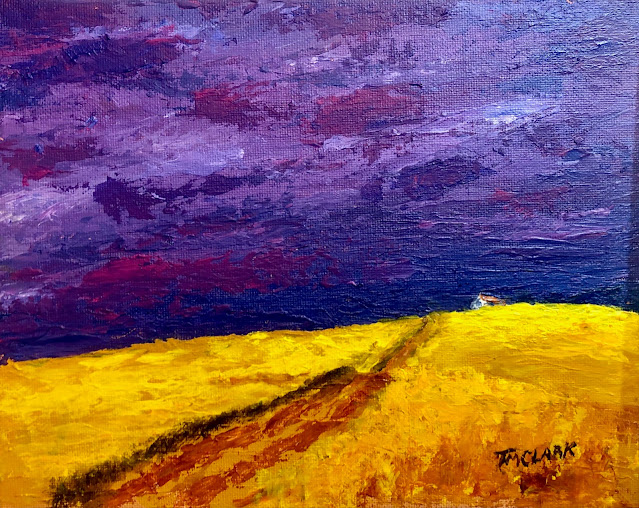
"After the Storm," 8 x 10 acrylic on canvas panel

Back roads in rural areas captivate my imagination, and beckon traveling, even when stuck at home.

They speak silently of stories told, of stories to tell, of stories to come.

This painting has several stories, and I'm not sure of a title, yet...back roads, stormy skies, wheat, home.

Another story is in painting it, deciding on complementary colors for contrast, and using  palette knives for challenge, texture, and learning.


Saturday, May 16, 2020

Misty Magic

"Morning Mist, Oklahoma Spring," 11 x 14 300 lb. d'Arches cold press paper
Driving through the countryside this week,  on a damp day, I was search for subjects for paintings. I  could see the mist settling in over the hillsides, fuzzing the edges of the landscape, of the fences, of the green trees and the ripening wheat.
Yet there was color and drama, perhaps increased by the enchantment of the mist in the distance. I didn't find anything specific, but in spite of the gray, cloudy day, in gray cloudy pandemic pandemonium, I wanted to paint the mist.
Thus today's watercolor, on the edge of a spring Oklahoma wheat field, before the rising sun burns off the magic of the mist.
Color? There is color where you find it, where you imagine it, because we need it.
Misty Magic, the largest I've painting in a while, and one I'm happy enough with to frame. 

Tuesday, February 5, 2019

White is valuable real estate, story of a painting

 Finishing touches, Green wheat and red dirt, 8 b y 10, matted for 11 x 14.
Watercolor demands patience and planning, thus my tutor in humility.
"White is valuable real estate, don't squander it," said one teacher of watercolor.
There's only the paper, no white paint. 
In this record, I should have started just showing how I didn't paint the house, but started moving to quickly. 
Center of interest, the white house, positioned from value sketch, and rough outline on paper, but only a hint of it, outlined by trees. Then the back porch. Then the "windows." The the roof of the barn, more trees plus shadows on the house and barn. Then the road.
Next wheat, background, shadows, spaces for poles.

 Then more wheat, more shadows.
Finishing touches at top, sky, fences, poles, more shadows. Notice how roof of house and barn is lighter...not really, it's the contrast in the sky. Add the mat to make the house snap.

Sunday, July 2, 2017

West Texas canvas challenge

West Texas canvas, 5 x 7, 300 Lb. d'Arches
Llano Estacado, West Texas Panhandle...those who drive through it at 75 mph think it desolate. Yet is is alive with color and history drama and people...if you slow down and look.
Day two of the July #WorldWatercolorMonth daily challenge, inspired by by daughter Dallas' photo near Canyon, "West Texas Canvas," big skies, wheat, far horizons.
West Texas Canvas, photo by Dallas Bell
 

Saturday, April 28, 2012

The waving wheat

It's not white yet, but it's turning...wheat in a field near Union City today. Looks like a bumper crop.

 “Behold, the fields are white unto harvest.”
I think He must have been talking about the prettiest crop I know--wheat.
You don’t have to be in Oklahoma long to realize how wheat graces the landscape for three seasons of the year.
It’s not by accident that the state song poetically sums up the crop’s impact on Oklahoma: “The waving wheat sure smells sweet when the wind comes right behind the rain.....”
I don’t know of another crop that compares. I’ve lived in Iowa, and the tasseled ears of corn undulating over the hills is beautiful--for one season. Some crops are occasionally pleasing to the eye--peanuts, soybeans,  alfalfa. 
Wheat is different.
In late fall and winter, it provides a green lawn accent to much of Oklahoma--standing bright and fresh and rich against the bare branches of the trees.
A favorite place of mine is a wheat field along Interstate 35 just north of the Cimarron River. In the early mornings in late winter and early spring, mist rises and envelops the highway and scenery, except for the bluffs along the south bank. But in between the trees, cut by creek banks and the river, is this wheat field that often draws a herd of deer, peacefully grazing just before the sun comes up.
In those first few months of the crop, up through early spring, you’ll also see the fields punctuated with grazing cattle, and the red and white Herefords sprinkled over the green pastures are especially picturesque.
Then as spring deepens into summer, the wheat heads out, and becomes a waving grain, rippled by the Oklahoma wind. The green softens a little, but as the crop blankets our rolling countryside, it seems to flow across the terraces and fields, pushed by breezes. It gives texture to the land, even as the nearby trees bud out and take on a brighter green.
With summer at hand, and the rest of the foliage turning verdant, the wheat changes, gradually, sporadically, unevenly, to light green, golden brown, yellow, almost white. 
As the Oklahoma wind brushes over the tops of the rich grain, it seems to move like the surface of the ocean. From a hilltop, you can trace the path of the air across the fields. 
In winter, it gave beauty to the drab landscape with its pastoral green accent, emphasized by the backdrop of dark branches. In spring and summer, those same branches, now deep green themselves, accent the rich, honey blond and gold of the adjacent wheat fields.
With harvest, the giant bugs of combines and trucks, often working late into moonlit nights, cut swaths through the crop that has defined much of Oklahoma’s year. The crop provides much more than just economic sustenance to our people. Its beauty sustains our spirit.
“Oh beautiful for spacious skies, for amber waves of grain.” 


Near Tuttle


Saturday sightings

The back roads, wind generators on the rural horizon.
What stories are behind this sign on an old building
in Union City?
You just have to get out of the city as often as possible, and today's trip was southwest of Oklahoma City.
I call it going to Front Porch country, where older frame houses in the towns being swallowed by urban commuter sprawl still have porches and knickknacks and flowers galore in their yards, the opposites of the cookie-cutter subdivision house surrounding them.
Alas, I didn't take a photo of a front porch, but in visiting Mustang, Union City, Minco and Tuttle, you don't have to travel far before the city is behind you.

Three other photos I didn't take: Just outside suburban Mustang I saw a rooster and hens out in a green yard. And in Union City, a guy was sitting on his porch in a swing, enjoying the morning. In Tuttle, there was an old swing hanging from a big tree.

Outside Minco
Most of the trip was up and down the Old Chisholm Trail.

Flowers and flags
In Minco, there's an impressive veterans memorial I'll post about later. And flowers on Main Street and lots of flags.


I'm fascinated by old bank buildings which used to be the most substantial and first brick buildings in the new towns. 


Union City

Tuttle

Out in the country you see all kinds of things, including the divided boulevard west of Tuttle in the middle of a prairie leading to Braum's Dairy main plant. And lots of new wind generators on the horizon. Plus an old windmill that I just had to stop and take a photo of. Talk about school spirit.

These are the kind of roads and places where you can drive at 45 or 55 mph with the window town, enjoying the spring air, hearing the meadowlarks, looking at the changing wheat, and new hay bales, the red roses and other flowers booming in profusion. Too soon, it is time to turn back toward the city, rolling up the windows, speeding up for the Interstate madness of everyone in a hurry. 


At least, so far away is so close to get there, to breathe deep the open spaces.

Tuesday, March 15, 2011

Back road interlude

Spring break means distance, not of traveling thousands of miles, but distance from "to do" lists, from self.

I took a short drive today, into eastern Oklahoma County, past new and old houses,through woods and pastures, over creeks and rivers, on back roads and not Interstates. Radio off. Bird sound when you pull up to a stop sign every mile. Soaring hawks, greening wheat. Room and time for imagination and thoughts and photos about how quickly life changes just a few minutes away from traffic. Don't ask what I do on spring break. I just am.
On a gate post to a house in a wooded area.


Barn door
North Canadian River, downstream from OKC, looking south,  at Hefner Road
Looking northeast
Where it loops back east and south, at Hiwassee Road
I love wheat in the spring, bringing bright color to our landscapes, the promise of life to come.
You can feel the distance.
Deep Fork Creek, east of Arcadia, into which Coffee Creek-pictured in my blog title above-- flows.
Man has been here a long time.
The historic round barn at Arcadia, 10 miles east and a century from Edmond, on old U.S. 66. Back to traffic. I grew up within a few miles of  US 66 in Albuquerque, and have spent a lot of my later life within a few blocks of it in Oklahoma City and Edmond. We now live less than a a mile south of its old route through Edmond.

Another reminder of slower traffic and life, visible from old US 66, a few miles east of our house.
 That's why it's good to slow down, think, and take a break from today.