"When dawn spreads its paintbrush on the plain, spilling purple... ," Sons of the Pioneers theme for TV show "Wagon Train." Dawn on the mythic Santa Fe Trail, New Mexico, looking toward Raton from Cimarron. -- Clarkphoto. A curmudgeon artist's musings melding metaphors and journalism, for readers in more than 150 countries.
Showing posts with label questions. Show all posts

Friday, June 25, 2021

Because, Color

"Because," 5 x 7 watercolor, 140 Lb. fabriano Artistico rough press paper

The
answer?

"Because, that's why." You've heard that as a child from your parents. Sometimes simple answers are the best, and you learned to accept them.

In our complicated world, there seem to be no simple answers, and that's normal. Very little in our lives is an either/or situation. Those who think  so become fanatics and extremists, as we can see repeatedly these days. 

But there is an honesty in a direct answer, not mincing words, or evading direct answers as politicians do when a simple "Yes" or "No" would do.

One of today's watercolors, in response to the previous one, "Why Not." 

Because. Color can speak directly. 

Monday, September 9, 2013

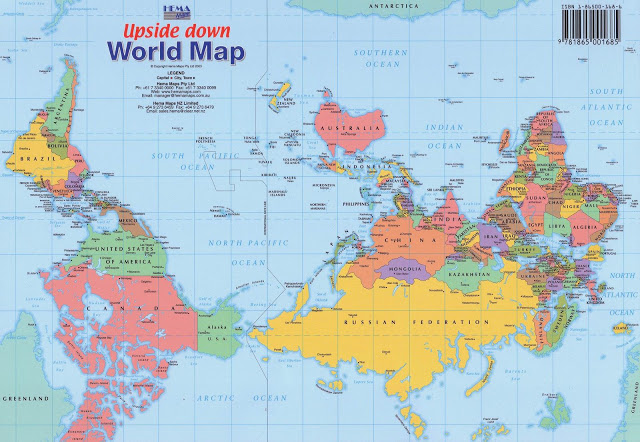
Turning the world upside down, questions on media

One of the joys of teaching upper level students is being able cause them to think, to be aware of the differences in the world, by asking questions centered around what we used to call "current events." So it is with my International Media class, where 24 students have to adopt a country and present to the rest of the class how its media reflects the culture and government.
Before then we concentrate on how press systems differ, and the only textbook is the New York Times, which we get free every day. It's full of items that show the interaction of media and every day international life.
This map of the world turned "upside down," (which is ridiculous since there is no up or down in space, but only how we're trained to look at it) formed questions for discussions about Eurocentric, ethnocentric, xenophobic," etc. last week. 
I've created a blog for the class, Clarkinternational where assignments are made, and students respond. Tomorrow's assignments  are all questions about two events--the U.S. security leaks, and the Syria crisis.
One post is "Authoritarian government in the U.S? and it asks this question: "Why is this American journalist, Barrett Brown,  in jail? Jailed Texas journalist Is it justified? Does this make the U.S. government authoritarian in spite of the First Amendment? Comment today."
The other post, "Syria and international media"  asks three questions: Find two sources today about the impact of international media on the crisis in Syria, and post below.  Why is President Obama using TV?TV and foreign policy . Why are journalists being kidnapped in Syria? Kidnapped journalists .
By the way, I think you'd be interested in some of the countries we'll hear presentations on, in addition to all the English-speaking countries, there will be Japan, Hong Kong, China, Taiwan, Mozambique, Bhutan, Kenya, and others.
Oh, I give in to old-fashioned learning too. Students have to identify most of the countries in the world, continent by content, on blank maps I give them. It's called "geography." We can't have "globalization," if we don't know where England is.
So what do you think?

Sunday, April 14, 2013

A brand of hope in wet concrete, and questions

I've seen this symbol many times in my life but this one caught my eye this weekend on a decaying sidewalk in Norman. I wondered about the people working on that Depression era crew long ago  in Oklahoma in the residential neighborhood of small frame houses. How hot was it? How long had they been working that day? Where were they all from? Which hands were assigned to place this symbol, this brand, of hope and three meals a day in hard times, in this concrete? They're all dead now, but still I wonder.
Then it occurred to me that I've never seen the tool that was used to imprint this brand of hope in the still wet concrete. Was it like a cattle brand? Was it a badge of honor and experience to be selected to place the mark of a long day's work in something that would last? Who designed the tool? Where were they made? What were they called? Have they all rusted away, or been melted down for metal in the war years? So many questions, unanswered in the years.