"When dawn spreads its paintbrush on the plain, spilling purple... ," Sons of the Pioneers theme for TV show "Wagon Train." Dawn on the mythic Santa Fe Trail, New Mexico, looking toward Raton from Cimarron. -- Clarkphoto. A curmudgeon artist's musings melding metaphors and journalism, for readers in more than 150 countries.
Showing posts with label trees. Show all posts

Tuesday, December 28, 2021

The Old Ones

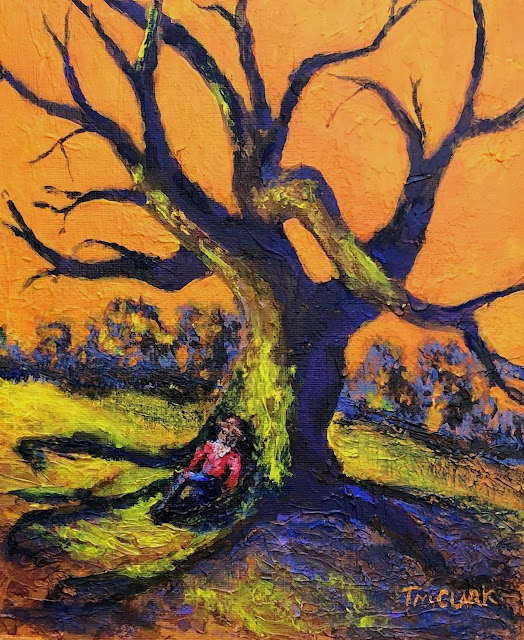
"The Old Ones at Sunset," 8 x 10 acrylic on canvas panel

Aging.
That's been on my mind more than I realized, as another year nears end and another birthday looms.

Looking back last night after I finished the last of the seven books I've read in the past two months, it dawned on me that three of them were in some ways about that theme.

I finished rereading Larry McMurtry's "Walter Benjamin at the Dairy Queen," one signed by him that I bought 22 years ago. He died this past year, and that book is about his thoughts on aging.

Before that, I picked up our copy of Norman Maclean's "A River Runs Through It," and reread that for the first time in years. "I am haunted by the waters," the old man closes the book.

The other book was by a doctor, on helping people as they age, "Being Mortal," recommended by my son-in-law Todd Bell, himself a doctor.

Yesterday, after a walk in Hafer Park and talking with my favorite old tree, I picked up my acrylic paints, palette knives and brushes headed to the back porch, obviously thinking about aging.

The result is pretty rough, but that seems fitting texture for the bark and wrinkles, as I tried something new, palette knives first, then brushes. 

 I call it "The Old Ones at Sunset. I suppose  if you're being snarky, thinking about me, you could call it "Portrait of the Old Tree Hugger." If you were sarcastic, you could simply call it, "The Golden Years."

Monday, December 28, 2020

Tree wisdom and art

"Trees," 8 x 10 watercolor, 8 x 10 300 lb. d'Arches cold press paper

"Emerson,
has beautifully named trees, 'rooted men.' In many ways they excel man. A tree seldom, or never encroaches upon the liberty of another tree, if it can be avoided. Usually 'both parties' settle equitably and without 'process.' A tree recognizes that its liberty ends where the next tree's liberty begins. a tree never wastes its growth in unnecessary cavortings of display, nor in frivolous waste of energy. If a tree is seen to twist and turn, it does so by reason of choice, tempered by necessity. These turns and twists are intimately connected or in rapport with, the turnings and twistings of some equally charitable neighbor. This it is that engenders that certain rhythm of flow of related lines in a wood." 

Those words, written 97 years ago in a chapter of painting trees Elementary Principles of Landscape Painting by John F. Carlson, are eerily of today's science, learning that trees talk to each other and support each other--see The Hidden Life of Trees, for instance.

He keeps going: "Every tree is a personality, and possesses within its specie a tremendous latitude of expression...A tree is a highlight of organized entity, which, when functioning in its realm, becomes beautiful."

"It is curious how one's feelings about trees change, in proportion to one's appreciation of their importance and dignity as living beings. We discover trees to be of royal blood, rather and apologetic parasites!" (Even Tolkien knew this, as in The Lord of the Rings.

Then he writes about trees in art:

"A tree reaches for light with its every leaf, ....."

"Trees are the most personal objects in a landscape. We feel distinctly related to them."

"To the artist, the woods is an asylum of peace; ...an eloquent silence made up of a myriad of pleasant sounds seems to hang on the air."

I read these words this weekend, after a walk in Hafer park, thinking  that's why I don't listen to music or anything else when walking in the woods.


Thursday, November 19, 2020

Brushing up, or branching out


Our front yard

The ice storm was probably my fault. 

A few weeks before it hit, wreaking havoc with our trees, our properties, our power, I bought Wendell Berry's new book, "The Art of Loading Brush, New Agrarian Writings," from our local bookstore Best of Books.

There is non-fiction, fiction and poetry in this book. The last chapters are a short story about rural life, where the book gets its name.

In the two weeks since the ice storm, we've been doing a lot of loading brush. In fact, every day, some splinter branch falls to the ground in our wonderful Oklahoma winds. I get up in the mornings, go cut it up into no more than six-foot lengths, and drag it to the curb. Brush piles line streets all over the city. 

The city is working its way here in cleanup, but my guess is that it'll be another month before ours, along with our many neighbors' brush piles are gone.

The irony is that we bought this house because we liked the trees. We still do--less in fallen leaves season, and certainly less now.

And there's more damage in the trees that needs professional work; tree guys are so swamped  that they're not taking new customers and that ours has just shown up.

In the meantime, I'm getting good at loading--well piling--brush.

Our curb appeal


Thursday, February 6, 2020

If winter comes, can spring...

"Old one," 5 x 7 watercolor, 140 lb. d'Arches cold press paper

The more we fast-paced, self-centered humans learn about trees, the more ignorant we discover we are.
Thinking that homo sapiens is the climax of evolution, of life on earth, Western "civilized" humans arrogantly ignore science and history, leading to our eventual suicidal extinction.
Bleak? Only from a human point of view, because every indication is that life, in its many forms, will survive our aggressive  exploitation of this planet--if we don't exterminate everything off first. 
But that is a narrow view as well, because of the billions of life forms under our feet, in the depths of oceans, in caves, and in forests.
Which brings me to today's watercolor--a "dead" tree I've admired in Hafer Park for a long time. 
It is in the winter of its existence, but it is not dead--it is a necessary host that teems with other life forms we probably can't even see.
If you read about trees--having a "heartbeat," having a community, communicating and caring for each other, you have to cope with what Eastern thought has long known.
All life is connected. 
Western mankind is systematically committing genocide in the oceans and forests, and eventually, us. Homo sapiens is the most dangerous predator ever.
Think about it. Deforestation of the Amazon, the lungs of the planet, is nothing more than suicide...essentially infecting our lungs with emphysema--depriving us of oxygen.
This painting began as a challenge for beauty, not negativity...the older I get, the more beauty I see in aging creations, organic and non-organic. I've tried this before, but my challenge has been to give an impression, an abstraction, almost an Eastern thought process.
Abstract brush strokes lead to abstract ideas....
"If winter comes, can spring be far behind?" asks Shelley. 
"No man is an island," wrote Donne, words more apropos than ever.
Winter is coming. In the long life of trees, and creation, homo sapiens is a recent organism that may not see another spring, but may become host for other unknown life forms.
"No man is an island," wrote Donne, words more apropos than ever.
Sources:
Trees have "heartbeats"


Wednesday, February 5, 2020

Dimp's life and society, chapter 3.

Dimp doesn't like cold weather, but he prefers snow to rain, because he's insulated inside Sol, his tree, and not getting wet which is a miserable as wet wood.
Dimp peering out from inside his tree on a snowy day
He, like other Emps, is used to moving slowly, because his pulse often comes close to that of his tree. 
That's not to say he can't scurry back into his sanctuary or up a tree if need be if one of his few predators approaches when he's outside at night gathering bark and acorns for food. 
Other wildlife, especially owls or coyotes,  as with a few humans who happen to see him after a late night trysting and drinking in Hafer Park, probably consider him some form of mutant squirrel or prairie dog, but he's smarter and more patient that them, as are most emps. 
Most emps are only about four to six inches long, and seem to be that way most of their lives, evolved to move through the interior of the roots and cavities of trees. 
In terms of procreation, there is a little evidence that they are spawned perhaps by spores or fertilized molecules  left on acorns outside on the ground, which are then brought into a tree by another emp. This is an unsolved mystery, and emps seem never to talk about it, but fits in with the possibility that they may be a link between the plant and animal kingdoms. 
Each emp apparently recognizes other emps by name, and the trees were they live. There is some evidence that they help name each other, but since nobody has ever managed to capture and figure out the age of emps, that also remains a mystery, as does their gender differences.
Dimp is obviously short for his dimples. Other names I picked up on from the vibrations I felt around Sol were Gimp,  for an emp who tended to limp and Timp, short for temporary,  one of the few who are impatient.
I found it refreshing that emps have no use for political correctness or politics.  Thus one who seems to lack courage is named Wimp, and another who isn't the brightest, Simp. I heard of one named Pimp, but since emps also have no use for exploitation or sin--apparently not being bothered by differences of gender or social status, I am at a lost to explain that one. 
Their social gatherings on special days like Arbor Day and Earth Day are rare and brief. It would be a mistake to call them religious rites, because emps believe all life is connected and therefore equally important. Perhaps the gatherings are more for just celebrating life as such, or to share news they can't gather from their network of tree roots, or to help acculturate the younger ones.
It's obvious that they're very peaceful and open-minded creatures since they're not burdened with politics, gender and social inequality, and religion. 
That leads to the next chapter, chapter four, about their roles and influence on their trees, and the benefits to humans.


Tuesday, February 4, 2020

Green eyes? What you need to know about Empus Arboli Haferae, the new species--Chapter 2

Dimp the Emp, looking out from his Emp tunnel in his tree
Having met Dimp the Emp, you ask, "What exactly is an Emp?" I'll tell you what I've learned from listening to trees about this new species.
In fact, it may be difficult to distinguish between plant and animal with Emps, because they are so closely intertwined with trees.
But, by trying to feel the pulse of trees, and thus being rewarded for my patience and open senses in walks in Hafer Park, Emps shouldn't surprise us.
We know that trees talk to each other--scientific fact. We know that their pulse is much slower than humans. Yes it quickens in the spring and summer and then slows late in the year--much like hibernating bears and other creatures.
An Emp tunnel in Hafer Park
Emps, each one living inside a tree near the ground have evolved to the same slow pulse. Other creatures have slow pulses too...just this week a salamander was found in Europe that didn't even move in an entire year. 
Emps' close relationship with the inside of trees affects more than just their pulse. Notice the green color of their eye balls. Those eyes are very large because they primarily live in the dark, and come out only at night. But they're green. Yes green.
Why? Because of their long  lives--nobody knows exactly how old they are,  and their food--acorns and diseased bark--their eyeballs are green. Why? The chlorophyll that comes from the trees breathing.
Notice that their ears and  tail are stubby, unlike those rodent squirrels they are mistaken for at night in brief sightings. When you're small and need to navigate cramped spaces inside trees, you don't need long ears or tails to become obstacles.
Their teeth are all molars, perfect for cracking open acorns on the ground, or decaying wood inside the tree trunk (ever wonder why you see so many hollow logs on the ground?), or from aging bark on the outside or the ground.
And speaking of bark, guess what kind of noise they make? They're hard to hear, but yes, they sound like faint barks, like those you'd hear from an old dog with tonsillitis.
Do they talk to each other? I think so--probably the way trees talk to each other through the roots in the ground. Emps are so in tune (key word) with their trees that they probably use that same network to communicate. 
They also have a few tunnels you can find that may be used for gathering at their religious rites, especially on Arbor Day and Earth Day. Those ceremonies are very sacred and private. I hope to learn more.
That's enough science for today. Since I've discovered the Emps, I get to name the species in the tradition of discovery, after where I found them and their important life roles. They are Empus Arboli Haferae.
Chapter three will explore their behavior and importance to trees, and to us!

Sunday, February 2, 2020

Meet "Dimp" the Emp discovered in his tree home--chapter 1

"Dimp" the emp
Have you heard about  Emps?
Probably not, unless you walk in forests or around a lot of trees and pay close attention.
On a recent walk in Hafer Park I noticed some holes in trees very need the ground. Pausing and breathing and listening, I picked up on some unusual vibes.
Then I put my hand on the tree I've named "Sol" for Solitude, trying to feel the pulse of whatever it was.
The more relaxed I became, the more I learned, finding out why being around trees helps spur imagination.
Demp's home in Hafter Park
Looking inside one of the little holes, I found evidence of habitation, so while connecting pulses with the tree, I learned, almost by osmosis,  about an important new species on the planet.
Humans never really see these nocturnal little creatures, but I learned they're called Emps, adopting and caring for individual trees in a mutual relationship.
The longer I stood there, the more of an image I had of an Emp, learning they even have individual names and are not dangerous, unless you're an acorn.
This tree, Sol,  was the home of Dimp, because he has dimples. And today, I was finally able to get a firm image of Dimp, so I could translate it to watercolor, which Sol wanted me to share because trees and emps are so important to all of us.
In future chapters, I'll spend more time talking about why and how Emps have evolved like they have, what they eat, what they do, their names, etc. 
But first here is my portrait of Dimp the Emp, and a photo of his tree home in Hafer Park.

Wednesday, January 10, 2018

A walk in the woods

"A walk in the woods," 5 1/2 by 7 watercolor, 300 lb. d'Arches cold press paper
Trees. Woods. Forests. Havens for  life and thought and creativity. For being happy.
I walked yesterday in Hafer Park, savoring the sunshine and a relatively mild day before another cold front hits. I don't wear ear phones, but just walk, enjoying the sounds of birds and wildlife in the underbrush of this "urban forest" that is adjacent to our subdivision.
There is also peace there, watching parents with children, adults   and lovers walking and talking, a few joggers, people walking their dogs, the ducks and geese.
It's a happy place in all seasons, even now with the bare branches. I have a favorite tree and especially enjoy watching the trees in various stages of life and death, and by the time I've completed just over a mile and walked back home, my blood pressure has dropped, and I'm happy.
Trees. No trees, no life on earth. But they are more than just engines of oxygen. A walk in the woods is also an engine of creativity.
Although I'd watched a video yesterday of another artist painting trees, I sat here in Current Coop Studio stumped (forgive the pun), without an idea of what to paint for today's happy challenge from WorldWatercolorGroup.com happy challenge.
Ray Bradbury writes that everything that happens to you is compost, and from all that compost, this painting came to life.

Monday, January 19, 2015

An "old one, watercolor

An "old one," in Martin Park, 5 by 8 watercolor

Saturday, January 17, 2015

A walk in the park, sanctuary with the "old ones"

One of the "old ones"
A beautiful, unseasonable January day...the kind that makes you glad you live in Oklahoma.  
Yes winter weather can be bitter with north winds and ice and more, but....
It never lasts long, and almost forces you outside. Such was today, sunny, temps in the 60s. A north breeze, but still, only a windbreaker or sweatshirt needed.
So I turned off my phone, social media and all, heading to Martin Park  (see the web page for lots of photos) (for this Facebook link) in northern Oklahoma City. It has been a while, and I found the expanded parking lot packed, with the 144-acre park attracting lots of people of all ages--from babies in strollers with parents, to kids, teens, and to us "old timers." 
The city is making huge improvements to the park, from a playground, new trails and more. And in spite of the crowd, you can still find a few trails less traveled, and drink in the scenery, think, and enjoy nature...the only distraction the constant noise of the nearby turnpike, but at least you  can't see the traffic, and there is quiet. I passed one fellow who called the place "healing." It is.
Where aging isn't ugly, but beautiful
Another old one
The park--a wildlife sanctuary, and a sanctuary for humans too-- has always been an important treasure for urban livers, but as more and more  development surrounds it, it is even more important to our sanity and life, and the crowds show it. Along the way I took a few photos, and then realized I was photographing either the oldest trees, or quiet water, or of quiet places in Spring Creek which flows through the park, abundant in turtles, fish and waterfowl.
I guess I identify with the old ones, gnarled and wrinkled with age, but distinct individuals, weathering time and still living. Where aging isn't ugly, but beautiful. And the hope and peace of still water.
They're also testaments to how beautiful this country was before man covered it with concrete and traffic.

And out of death, comes life

Thursday, July 24, 2014

Old one

Old one, 5 by 7 watercolor, 300 # deArches
This painting, comes from this photograph, and I don't remember where I saw it...got me to thinking about old ones, old people, old tires, old trees. Thus the watercolor.

Saturday, January 25, 2014

Captain and Tennille tree

What a difference a day makes, or in Oklahoma, an hour for that matter.
Yesterday the high was in the low 40s and the wind chill probably cut it to 20 degrees less than that. My layered coats and sweater from the Alaska trip--which worked there--weren't enough.
Bitter. From Beast to Beauty.
Today it's in the mid 60s, no wind, beautiful sunshine. Time for my neglected walks in Hafer Park, and sure enough, the kids and dogs and parents and lovers and old folks were out, walking the trails, most in short sleeves. I was one of few with a sweater, and worked up a sweat.
Almost at the end of the walk I though it was strange I hadn't stopped to take a photo. Then I saw this tree I hadn't noticed before. "Captain and Tennille, " I thought as I walked by. I stopped and turned around to take a photo.
I post it here, not to make fun of, or mock, or judge the divorce this week of the long-married couple famous for the song "Love will keep us together" in the 1970s. I think it's sad, but a story many people are familiar with on a personal level these days.
The tree said to me, "Life goes on." So I added some special effects, beyond usual old-time darkroom burning and dodging, just to emphasize the subject, and the emotions involved.
Every trip, every walk, every tree, every marriage, is a journey.

Saturday, April 17, 2010

From one branch to another

In the backyard,
worrying about the future,
out of the corner of my eye
a movement in the oak tree--
a gray squirrel moves
confidently along a limb
until it becomes a branch
then almost a twig
swaying from the weight
of the traveler.
He pauses before
considering which branch
in a neighboring tree
will be the new road
for his aerial journey
above man-made obstacles below
to whereever he is going.
Then he leaps,
his tail keeping his balance,
onto a slender branch
which sags from his arrival
but his sure claws grasp it,
and he moves on to firmer wood
until it becomes limbs and trunk,
the momentary interruption
and uncertainty forgotten
as just another part of the journey.