"When dawn spreads its paintbrush on the plain, spilling purple... ," Sons of the Pioneers theme for TV show "Wagon Train." Dawn on the mythic Santa Fe Trail, New Mexico, looking toward Raton from Cimarron. -- Clarkphoto. A curmudgeon artist's musings melding metaphors and journalism, for readers in more than 150 countries.
Showing posts with label Scotland. Show all posts

Saturday, April 8, 2017

Words you have to look up, and mountains

Mountain journey, 9 by 12 watercolor, 140# d'Arches
Books
that you have to circle words in--I love it, and go back and look them up. Reminds me of mountains--no matter what you see, there's always the unknown, more to learn.

It's mountain mood today, reading  The Living Mountain by the late Nan Shepherd about the Cairngorms of northeast England, another place I'd never heard of.
I found the book in another I'm reading, Landmarks, By Robert MacFarland of Cambridge University, about the deep place names of local places in England and Scotland, complete with partial  glossaries of the old names.  Names as landmarks...so powerful for any country, and any reader or writer and seer.
I first found him about a year ago in his book The Old Ways, about walking the ancient paths in England.
In this recent book, he devotes most of a chapter to Shepherd's book, and writes the forward to her most recent edition. It's a book of a lifetime of discovering mountains up close, not from a distance.
Other than English and Scottish terms I don't know, there are words throughout that I've circled, going back at the end of each chapter to look them up in the OED.
Discovery.
Thus today's watercolor, Mountain Journey, exploring and risking new paths in watercolor.

Monday, December 26, 2016

Dreams of Scotland

Dreams of Scotland, 9 by 12 watercolor, 140# Fabriano
Inspiration--Yesterday's unsettled skies, and following Scottish sites on Instagram.
Our brief time time in Scotland two summers ago captivated me...the wild, picturesque landscapes, the wonderful people, proud history and language, and powerful whisky.

Sunday, August 16, 2015

Never on the rocks--from the "Whisky Correspondent"

Here's the story that appeared in the July 29 issue of the Journal Record, the daily business newspaper in Oklahoma City. After a dram of Ardbeg's last night, I wanted to share with you what I wrote. I think I earned the appellation "Whisky Correspondent" at the paper, so I'm looking for new assignments.  Headlined, "Never on the Rocks," which was the title of my previous post too. This was the most fun I've had on an article in a long time, especially in the "research" before writing it. 


Oklahomans who gather after work with  their blended scotch on the rocks cocktails would discover an entirely different whisky world in Scotland.
While Dewars and Famous Grouse top the Scotch whiskies sales charts here, they're weak in that and taste too in the home of more distilleries and whiskies than anywhere else in the world. Single malts are king, and not just on the Royal Mile of Edinburgh.
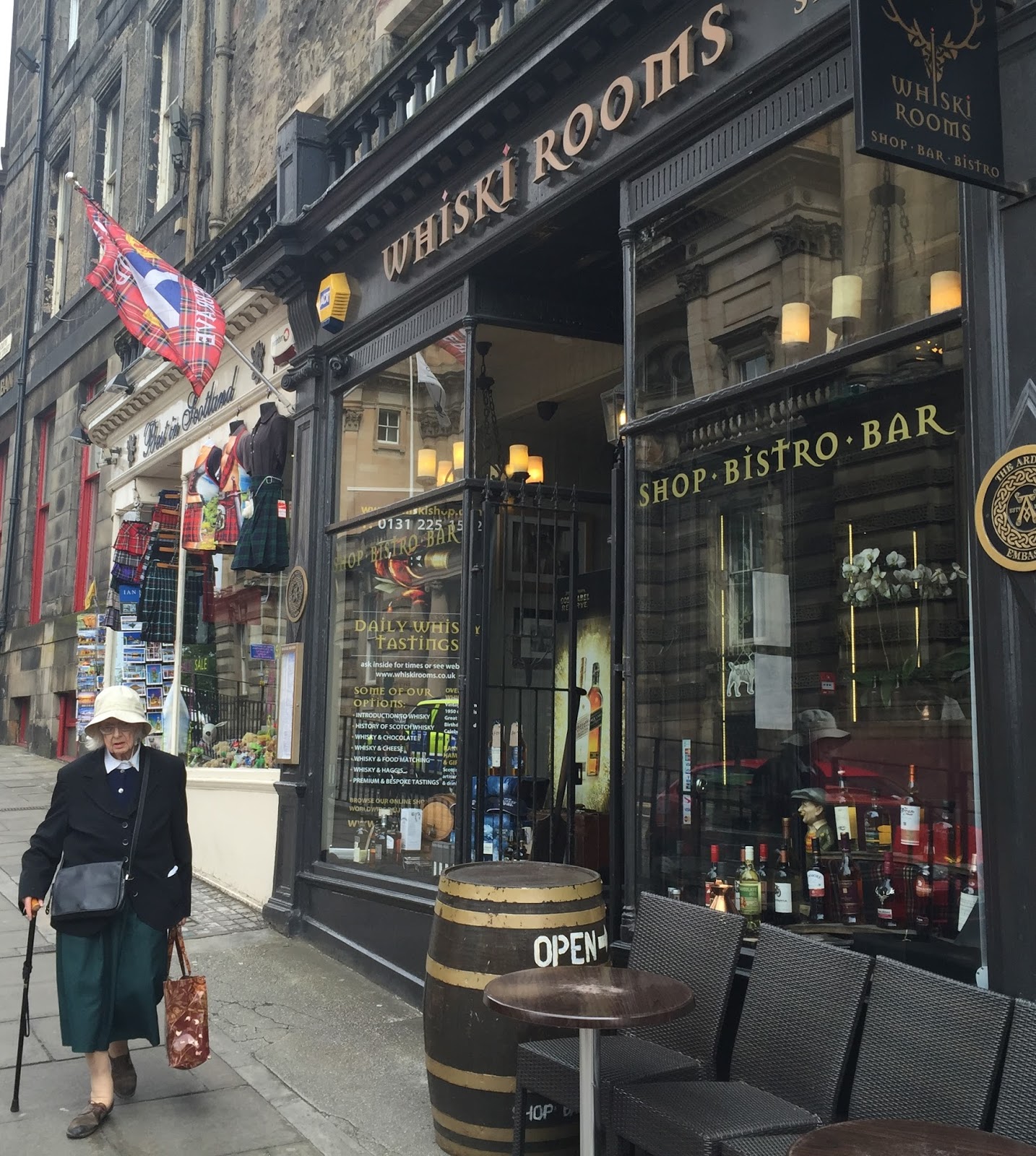
"You can buy Dewars at the airport," said Alan Rogerson, assistant manager at at one of the Whisky Trail stores in Edinburgh, a city that seems to have more whisky stores than Oklahoma City has convenience stores. The shelves are lined with hundreds of bottles of single malts. About the only similarity with America is that Famous Grouse is the best selling blend in Scotland.

Amie Hendrickson, manager and sommelier at the Edmond Wine Shop, agreed.
"Blends are the favorites and best sellers," she said. Her main distributors report Dewars as the best selling scotch in the state, and it and Famous Grouse are among the top sellers at the Edmond store.
But in Oklahoma, the best selling single malt usually includes The Glenlivet, Hendrickson's suppliers report, though several other brands  are also favorites, while the best selling scotch in the world is Glenfiddich, Rogerson said.
Hendrickson's not surprised at the variety.
"Single  malt drinkers tend to be more adventurous and try more, but they all have their favorites,"  she said.
And scotch isn't as popular in Oklahoma as other liquors, said Randa Warren, of Warren Wine and Spirits in Tulsa. Warren is the only master sommelier in Oklahoma, and said that vodka and others outsell Scotch here.

Drinking and buying scotch in Scotland is an adventure as different as the blends and single malts.
Hendrickson said the blends are designed to be refreshing and delicious, for use in cocktails.
"They're not complex. Many blended drinkers don't even like single malts, the flavor is so different. There's as much complexity in scotches as there is in wine,"  she said.
It's no wonder. Scotland, with more than 100  whisky distilleries, produces single malts by the hundreds, in an area a little smaller than the state of Maine. America is second in the world, with just 15.
To experience the full range of adventure, visitors should put The Scotch Whisky Experience (http://www.scotchwhiskyexperience.co.uk/) on their travel itinerary. Located at the foot of Edinburgh castle, it offers an hour-long tour explaining the distilling process. Or visitors can just go to the store….lined with hundreds of bottles of scotch from all of the country's six producing regions.

A visit to the bar offers single drams, or "tastings" (what Americans would call "flights")  of four different whiskies. Prices start at about 23 pounds (current exchange rate is about $1.60). That first flight offers four drams from four of the  distillery regions, culminating in a smokey, peaty Ardbeg malt from the isle of Islay. For the more adventurous, and richer, there are other tastings, ranging up to more than 100 pounds in price.
Staff members at any of the  stores--regardless of age-- all seem to be whisky experts and the word "adventurous" is a word that keeps coming up in reference to scotch.
Caleb Jaffray of The Scotch Whisky Experience said that the Ardbeg Uigeadail scotch  is "dark and mysterious," and at 50 percent alcohol might need just a little water to "open it up" in flavor.

Water perhaps, but never on the rocks as in Oklahoma on a hot August day. Scotland's cold enough, but drinking Scotch there is a ritual of swirling, sniffing, and slowing sipping, perhaps while dreaming of sitting by a blazing fire after a cold day in the highlands.
Those sampling at the Whiskey Experience tastings take at least 30 minutes to sample those malts. It also helps them to be able to walk out afterward.
 Henderson said that scotch sales in Oklahoma increase in the winter, between January and March.
In most of the English speaking world, it's spelled "whiskey." But  in Scotland, it's "whisky" and the tastes and sales are as different as the spelling.
Scotch is serious business in Scotland, where its production must meet specific standards. Single malts must be aged at least 10 years in barrels--some up to 30 years, and must be at least 40 percent alcohol. But blends make up a majority of the production because of worldwide sales demands in places like Oklahoma.
Your whisky correspondent at work
 

Hendrickson and her husband vacationed on the isle of Islay this past year, visiting distilleries.
For the adventurous who want to try really expensive scotch, she recommends going to a "high-end" steakhouse, and ordering one dram at the bar. 

"If you want to know what a really expensive  Scotch tastes like, order one $100 dram and share  who you're with. Those many varieties cater to many different tastes," she said.

Wednesday, July 29, 2015

"Never on the Rocks"--investigating Scotch whisky

A whisky tasting  is an experience in Scotland
My story in today's Journal Record
Investigative journalism at its best...that's what I thought when I asked for a travel assignment from the Journal Record daily business newspaper in Oklahoma City this summer. 
"Sure," said Editor Ted Streuli, when he learned we were going to Scotland. "Report on the business of scotch"
So in our trip to the UK, Susan and I had to experience Edinburgh, and I made sure to investigate Scotch whisky. That meant multiple "interviews" of the subject--because a "one source" story is shallow.
(Note--AP style--scotch is capitalized only when preceding "whisky." "Whisky" is the spelling in Scotland--elsewhere it's spelled "whiskey" if produced elsewhere.)
Alan Rogerson in Edinburgh
It was a tough assignment, but someone has to cover this beat. I also interviewed friend Amie Hendrickson, manager and certified sommelier at Edmond Wine Shop, who provided important local information.
So today, my story appeared in the Journal Record. Ah, the power of a byline, it tastes almost as good as...well, maybe not.
Whisky stores are everywhere in Scotland
I'll share the written story in a few days, but if you want to read it first, buy a Journal Record.
For perspective, there are more than 100 whisky distilleries in Scotland, which in land area is smaller than Maine. The next largest number of whiskey distilleries is in the U.S. with 15.
In the meantime, here are some of the photos I took.
Your investigative reporter at work

Sunday, July 12, 2015

Haunting windows of UK itinerary discoveries

The Benedictine abbey, destroyed when the Protestants revolted.
We worked almost a year on putting together an itinerary for the trip to England and Scotland.
Susan did most of the work, using travel books, and then we turned to Vickie Nichols of Nichols Travel for more help.
We made some of the arrangements ourselves, including a stay in Cambridge, and bed in breakfasts in York and Keswick, driving through the moors, Lake district and into Scotland. 
Someone still decorates the graves of monks.
Still we rented a car in York, and braved me learning how to drive and sit on the opposite side of the car and road than here. 
And behind the wheel of this new Mercedes, thankfully with a gps system we named "Maggie," we discovered countryside and people we never dream of, nor planned on our large itinerary. 
Discoveries included the ruins of this haunting, historic  Benedictine Abbey on a high, windy bluff overlooking Whitby, a fishing village on the coast of the North Sea.
For some reason I'm having trouble writing and organizing these trip stories, but the them of windows helps keep be going. Susan's priority were the moors and mine was Cambridge. We missed much and changed schedules. More about that later.
So for the record, here's the official itinerary--we neglected to plan for all the walking--anywhere from five to nine miles a day, so we lost weight!
  • London--five nights. parliament, Westminster Abbey, Churchill's War Rooms, Buckingham Palace, Tower bridge and the Tower of London, Trafalgar Square, Picadilly circus, British Museum, Harrods department store, Dickens' house and museum, side train trip to Canterbury Cathedral, and various pubs, using the Tube (subway, cabs, double-decker bus, and walking..
  • Brit rail to Cambridge--one night. My pilgrimage to a real university. Punting (not the Stoops' kind) on the River cam. Painted one watercolor.
Haunting windows on the past

  • Brit rail to York--three nights. touring York Minster, largest cathedral north of the Alps. Toured the National Railway Museum, a little boy's dream of real locomotives. Visiting Viking center, visiting pubs, walking the medieval walls. Car trip to Scarborough and discovering Anne Bronte's grave. North through the most beautiful country I've ever seen. Whitby and the Abbey. The Yorkshire Moors. Whitby was a religious site from the mid 600s. The Abbey was built about 1225, after the Catholic Normans had conquered England.  Henry VIII disestablished the monasteries in 1540 and destroyed it. The windows are haunted, in more than one way. Bram Stoker lived in Whitby and the abbey  may have been an inspiration for "Dracula."
  • Keswick--Lake district, two nights in a country house. Drove through beautiful North York Dales. Drove to Grasmere, toured Wordsworth's Dove Cottage and grave. Hiked in the mist alongside on of the lakes. Painted one watercolor.
  • Scotland and Edinburgh--three nights. Drove up through Scotland on the rural roads, Turned in car at Edinburgh after nightmare traffic.  Took 12-hour small bus tour to Loch Ness and through the highlands. Shopped Edinburgh. Toured Edinburgh castle, and sampled great Scotch. At and drank in pubs.
  • Took tram in front of hotel for 30 minute ride to airport, five pounds each. Home.

Monday, July 6, 2015

Windows into a wonderful world--2

Old window at Canterbury Cathedral
Windows tell you a lot about a place, a people, a time, a civilization, We take ours for granted, though I wish our 1970s house had bigger ones. Many of the newer ones do, but they're not distinctive, just cookie-cutter pre-fab ones.  
Go back in time and you'll find American windows smaller, especially on the frontier, or in pre-white man days when there was no glass. We're spoiled today with storm windows, screens, air conditioning and more. 
Parliament, Union Jack, from Westminster cloisters
Over time, windows reflect a civilization and culture, and that tells you something about the shallowness of America. Only in some aging neighborhoods in the city and elsewhere do you find windows with character, grace and style.
Windows draw me, my imagination--so many stories, histories, ghosts, hopes, fears--demanding to be photographed, to be encountered.
In England and Scotland I found different stories, growing out of centuries of habitation.
Too many words--I was overwhelmed everywhere I went, and it's hard to write about, to organize. The windows help. 


Canterbury Cathedral, from its cloisters
Earls Court Tube station--our window to the rest of London

A sea of red buses outside the 18th Century pub, The Clarence


Parliament...windows on freedom
Westminster, windows on the past

Windows on Wordsworth's world-1


I'm drawn to windows, especially old ones. To me, they beckon to be photographed, hinting at ghosts and stories and imagination. Of memories and lives once lived. Of beliefs and hopes.
It's no wonder that windows in our trip to England and Scotland grabbed my attention.
This first window and pitcher  in Grasmere near William Wordsworth's home begged to be photographed. There's a novel here, or, more fittingly, a poem.
You don't have to be in England or Scotland long before you understand how the landscape imbues the work of their artists and writers. Impossibly green. It was a cold, misty day in the Lake district, and absolutely wonderful. Clouds obscured the tops of the mountains, but not the spirit of a poet who is one of the founders of the Romantic movement. No wonder. 
Dove Cottage, where Wordsworth wrote


Susan photographing at the rear of the cottage

Looking out at Wordsworth's garden

Wordsworth's graves at St. Oswald's, Grasmere

Stained glass inside the church, with ropes to ring the bell


Wednesday, July 1, 2015

A journal of journaling in England

Every time we take a trip, this old newspaper man can't keep from taking notes, finding time at the end of the day to comment, to record impressions, to give a brief summary of the day's events. That, by the way, is where the first meaning of "journalism" came from, a record, or log, of the day's travel--using the Latin and now French word for "day," which is "jour."
Painting in Cambridge
So yes, I'm a journalist in many ways, and our trip to the England and Scotland was no exception, but with a couple of twists.
First, I went off and left the specific journal I'd bought for the trip. Fortunately, I had an Associated Press reporter's notebook in my bag.
And I did take another kind of journal, the handmade leather bound watercolour (in deference to my British heritage) from Mind's Eye Journals that I bought at the Paseo arts festival this year. And I brought my traveling watercolor kit, plus one other brush.
St. John's chapel
I had no idea if I'd have time to paint on our two week trip, but I was going to try. Fortunately, I did three paintings, and while they're not very good, they are mementos for me of specific days and times I will remember forever. I remember the seller of the journal telling me the journals are artifacts, and indeed they are--but then so have all my trip journals become.
Another reason the painting isn't great is that painting in England is far different that the desert southwest, where there is little moisture and lots of harsh landscapes. It's a slow transition for me to different painting.

My watercolours, and painting journal
Having been to England, Susan and I now understand how that landscape has so influenced English painting...it is moist and green. I wrote this in my AP notebook on the train on the way to Canterbury: "The English atmosphere cries out for watercolor. It's humid, fluid skies, green. It's idyllic, pastoral. The landscape drips with watercolour."
Here's the second of my three watercolours...St. John's College chapel at Cambridge University, done on the rooftop of the Varsity Hotel, virtually on the banks of the river Cam. It's late in the evening, we're getting a little sunburned, and there are lots of clouds in this distance. We've eaten, had some wine, and are listening to some Cambridge students at the next table celebrating the end of the semester. 
Yes, it's done in plein air, drying quickly, and painted quickly. I'd like to do it over, but that's later, and won't have as much meaning.
My AP notebook and transcribed notes
But at least, my doldrums of writing since we've returned seem to have ended. Here's hoping for a fresh breeze to gather and write all the thoughts and stories we encountered and experienced, recorded on those 81 pages of notes in the AP notebook and three watercolors. 

Some of my previous trip journals--the thick one is from Paris, 11 years ago,


Wednesday, January 1, 2014

Bucket list for 2014

2014 Buckets...5 by 6 watercolor

For 2014--

England and Scotland--this summer;
Open cockpit biplane ride;
Sail on a sailboat in the Caribbean;
Take more backroads;
More New Mexico;
Family history;
Take up oil painting;
Cousin reunion;
Retire ?;
Surprise myself!

Standard resolutions:
More time with children and grandchildren, family and friends;
Health and exercise;
Improve blog;
Paint more;
Write  a book?


Sunday, February 24, 2013

Flags of historic friends--Canada and the UK

 Of the number of readers of this blog over the years, Canadians and the Brits rank in the top 10. It's good to have friends, even when familiarity leads to jokes about the other, on both sides of the border and "The Pond." Of course there are differences and sometimes tensions, but like loved ones, you tolerate each other, forgive and know how important friendship is.
The flags of Canada and the United Kingdom are among the most recognizable to most Americans, because of so much shared history and culture.
The Canadian flag is relatively new, only officially adopted on Feb. 15, 1965 to replace the British Union Flag. That date is now the National Flag of Canada Day. It's also know as the Maple Leaf flag, and in bi-lingual Canada, the I'Unifolli', "the one-leafed," in French.

"The Union Jack" of the United Kingdom, composed of England, Scotland, Wales and Northern Ireland is deeply a part of American history too. It's the flag of  our "Mother Country, of many of our ancestors, and the flag we fought against, and then alongside, over the centuries.
 It was first adopted in 1606 by order of King James IV--the one who commissioned the King James Bible. It consists of the red cross of England's Saint George, patron saint of England, and the white cross of St. Andrew, patron saint of Scotland. The current design dates from 1801 when Northern Ireland became part of the UK, with the added  red cross, for the cross of St. Patrick, Ireland's patron saint. Wales' patron saint, David, is not included.