"When dawn spreads its paintbrush on the plain, spilling purple... ," Sons of the Pioneers theme for TV show "Wagon Train." Dawn on the mythic Santa Fe Trail, New Mexico, looking toward Raton from Cimarron. -- Clarkphoto. A curmudgeon artist's musings melding metaphors and journalism, for readers in more than 150 countries.
Showing posts with label Journal Record. Show all posts

Friday, January 8, 2016

Back to the future in OKC with a beautiful lady, the Tower Theater

A beautiful lady
I drove back 50 years in time on 23rd Street in OKC today, and into the future.
Coincidences--one of the speakers in my UCO Twitter for Media class (#clarkclass on twitter)this week is Jenny Grigsby, a self-employed social media manager for a number of cool clients. (See the class blog #clarkclassUCO.blogspot.com for more on her.)
Following her on twitter, I had learned they were going to relight the marquee on the historic Tower Theater at 5:30 tonight. The classic and architecturally beautiful theater was built in the 1930s, and closed in the late 1980s.We're fortunate it hasn't been torn down.
For months, I've been reading about public-spirited developers who have invested in it and are bringing it back to life, both from Steve Lackmeyer (who covers OKC like a wool blanket) in The Oklahoman and in the Journal Record. The once decaying area is now  part of OKC's Renaissance, especially in the Uptown district. Then meeting Jenny, I found out this week that the Tower is one of her clients.
So why did I go down there?
There was a crowd, of all ages, including people my age, young hipsters and even kids, all attracted by social media. For me, it was personal.
I walked through those doors
Fifty years ago, I and my first wife went and saw "Sound of Music" there during its 82-week run. We walked a few blocks from the garage apartment near there where we lived, when I was a student at Central state College (now UCO). I think we also saw one of the early James Bond movies there, probably "Goldfinger." The theater even hosted the debut of "Cleopatra"  for 26 weeks in 1963. 
1963, and my kind of car, Studebaker!
And today, I took photos, and walked inside where they're restoring the original look, including paint. The first floor will now be standing room, for live music concerts, and the balcony will have seating. 
This time, I was tweeting about it to my #clarkclass twitter students--who now can figure out how really old I am. 
The place was, and is, huge
I was taking photos, meeting people I knew, having a good time as I looked into the future, seeing construction everywhere--bars and offices in the adjacent buildings, and more on rush hour traffic on 23rd Street, a few blocks west of the state capitol.
Then I was an English major, and a budding journalist. I am still a journalist!
More photos, from tonight:
The event drew a huge crowd. Lackmeyere at right, Periscoping it.

The state, still under construction

Lackmeyer and Clark  after last night's #twitterbeef
Before the lighting


Sunday, August 16, 2015

Never on the rocks--from the "Whisky Correspondent"

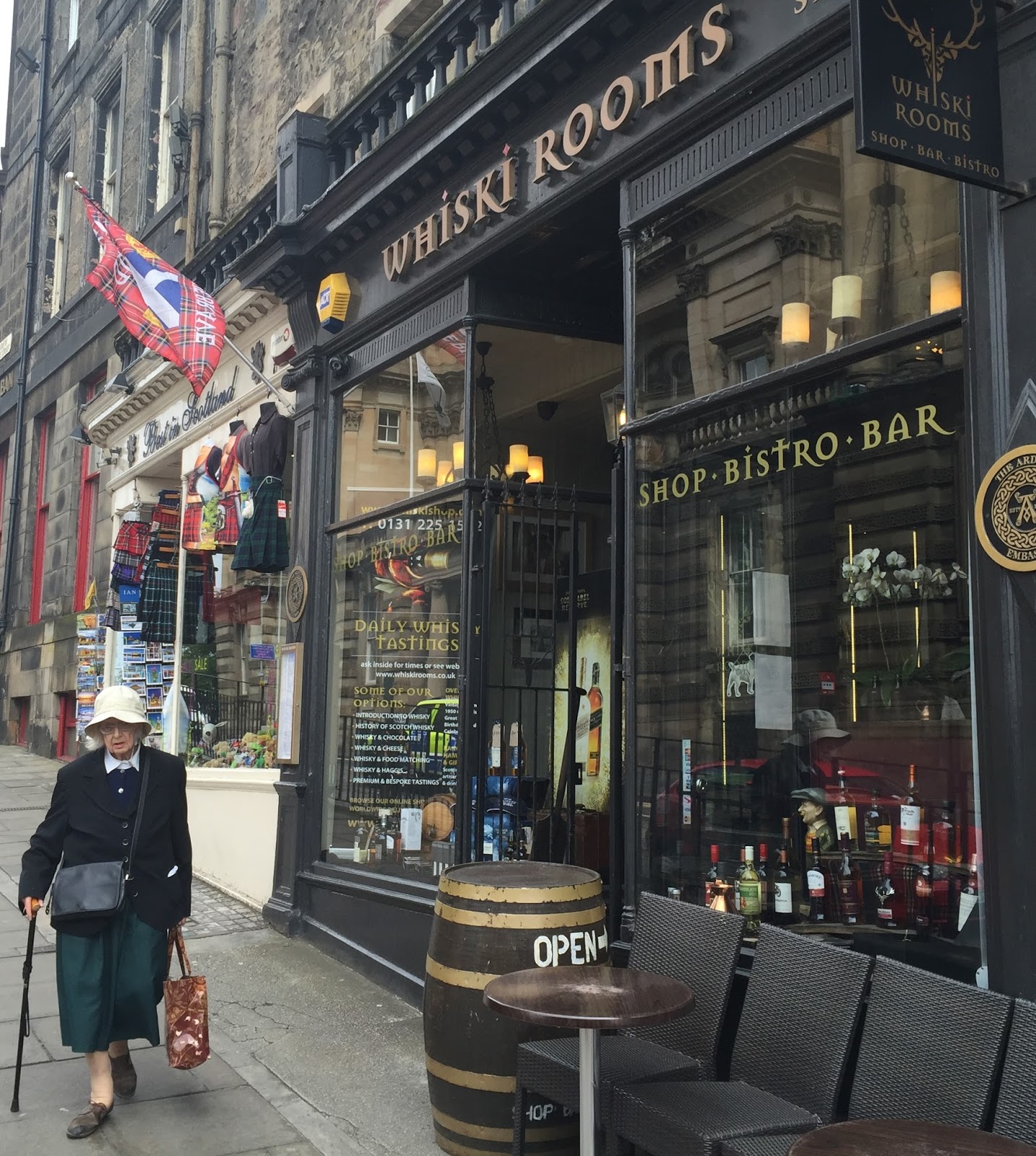
Here's the story that appeared in the July 29 issue of the Journal Record, the daily business newspaper in Oklahoma City. After a dram of Ardbeg's last night, I wanted to share with you what I wrote. I think I earned the appellation "Whisky Correspondent" at the paper, so I'm looking for new assignments.  Headlined, "Never on the Rocks," which was the title of my previous post too. This was the most fun I've had on an article in a long time, especially in the "research" before writing it. 


Oklahomans who gather after work with  their blended scotch on the rocks cocktails would discover an entirely different whisky world in Scotland.
While Dewars and Famous Grouse top the Scotch whiskies sales charts here, they're weak in that and taste too in the home of more distilleries and whiskies than anywhere else in the world. Single malts are king, and not just on the Royal Mile of Edinburgh.
"You can buy Dewars at the airport," said Alan Rogerson, assistant manager at at one of the Whisky Trail stores in Edinburgh, a city that seems to have more whisky stores than Oklahoma City has convenience stores. The shelves are lined with hundreds of bottles of single malts. About the only similarity with America is that Famous Grouse is the best selling blend in Scotland.

Amie Hendrickson, manager and sommelier at the Edmond Wine Shop, agreed.
"Blends are the favorites and best sellers," she said. Her main distributors report Dewars as the best selling scotch in the state, and it and Famous Grouse are among the top sellers at the Edmond store.
But in Oklahoma, the best selling single malt usually includes The Glenlivet, Hendrickson's suppliers report, though several other brands  are also favorites, while the best selling scotch in the world is Glenfiddich, Rogerson said.
Hendrickson's not surprised at the variety.
"Single  malt drinkers tend to be more adventurous and try more, but they all have their favorites,"  she said.
And scotch isn't as popular in Oklahoma as other liquors, said Randa Warren, of Warren Wine and Spirits in Tulsa. Warren is the only master sommelier in Oklahoma, and said that vodka and others outsell Scotch here.

Drinking and buying scotch in Scotland is an adventure as different as the blends and single malts.
Hendrickson said the blends are designed to be refreshing and delicious, for use in cocktails.
"They're not complex. Many blended drinkers don't even like single malts, the flavor is so different. There's as much complexity in scotches as there is in wine,"  she said.
It's no wonder. Scotland, with more than 100  whisky distilleries, produces single malts by the hundreds, in an area a little smaller than the state of Maine. America is second in the world, with just 15.
To experience the full range of adventure, visitors should put The Scotch Whisky Experience (http://www.scotchwhiskyexperience.co.uk/) on their travel itinerary. Located at the foot of Edinburgh castle, it offers an hour-long tour explaining the distilling process. Or visitors can just go to the store….lined with hundreds of bottles of scotch from all of the country's six producing regions.

A visit to the bar offers single drams, or "tastings" (what Americans would call "flights")  of four different whiskies. Prices start at about 23 pounds (current exchange rate is about $1.60). That first flight offers four drams from four of the  distillery regions, culminating in a smokey, peaty Ardbeg malt from the isle of Islay. For the more adventurous, and richer, there are other tastings, ranging up to more than 100 pounds in price.
Staff members at any of the  stores--regardless of age-- all seem to be whisky experts and the word "adventurous" is a word that keeps coming up in reference to scotch.
Caleb Jaffray of The Scotch Whisky Experience said that the Ardbeg Uigeadail scotch  is "dark and mysterious," and at 50 percent alcohol might need just a little water to "open it up" in flavor.

Water perhaps, but never on the rocks as in Oklahoma on a hot August day. Scotland's cold enough, but drinking Scotch there is a ritual of swirling, sniffing, and slowing sipping, perhaps while dreaming of sitting by a blazing fire after a cold day in the highlands.
Those sampling at the Whiskey Experience tastings take at least 30 minutes to sample those malts. It also helps them to be able to walk out afterward.
 Henderson said that scotch sales in Oklahoma increase in the winter, between January and March.
In most of the English speaking world, it's spelled "whiskey." But  in Scotland, it's "whisky" and the tastes and sales are as different as the spelling.
Scotch is serious business in Scotland, where its production must meet specific standards. Single malts must be aged at least 10 years in barrels--some up to 30 years, and must be at least 40 percent alcohol. But blends make up a majority of the production because of worldwide sales demands in places like Oklahoma.
Your whisky correspondent at work
 

Hendrickson and her husband vacationed on the isle of Islay this past year, visiting distilleries.
For the adventurous who want to try really expensive scotch, she recommends going to a "high-end" steakhouse, and ordering one dram at the bar. 

"If you want to know what a really expensive  Scotch tastes like, order one $100 dram and share  who you're with. Those many varieties cater to many different tastes," she said.

Wednesday, July 29, 2015

"Never on the Rocks"--investigating Scotch whisky

A whisky tasting  is an experience in Scotland
My story in today's Journal Record
Investigative journalism at its best...that's what I thought when I asked for a travel assignment from the Journal Record daily business newspaper in Oklahoma City this summer. 
"Sure," said Editor Ted Streuli, when he learned we were going to Scotland. "Report on the business of scotch"
So in our trip to the UK, Susan and I had to experience Edinburgh, and I made sure to investigate Scotch whisky. That meant multiple "interviews" of the subject--because a "one source" story is shallow.
(Note--AP style--scotch is capitalized only when preceding "whisky." "Whisky" is the spelling in Scotland--elsewhere it's spelled "whiskey" if produced elsewhere.)
Alan Rogerson in Edinburgh
It was a tough assignment, but someone has to cover this beat. I also interviewed friend Amie Hendrickson, manager and certified sommelier at Edmond Wine Shop, who provided important local information.
So today, my story appeared in the Journal Record. Ah, the power of a byline, it tastes almost as good as...well, maybe not.
Whisky stores are everywhere in Scotland
I'll share the written story in a few days, but if you want to read it first, buy a Journal Record.
For perspective, there are more than 100 whisky distilleries in Scotland, which in land area is smaller than Maine. The next largest number of whiskey distilleries is in the U.S. with 15.
In the meantime, here are some of the photos I took.
Your investigative reporter at work

Saturday, April 18, 2015

The journalism of April 19, 20 years ago--part 2

Front page of The Daily Oklahoman, April 19, 1995
 The Oklahoma City Murrah Federal Building bombing on April 19, 20 years ago, affected the entire state. I think it is the only news story since statehood getting almost universal coverage in Oklahoma's almost 200 daily and weekly papers. Pearl Harbor, or 9-11 since then, may be close.
At the time of the bombing, there were 47 dailies and 136 weeklies in Oklahoma. From Boise City to Idabell and Pitcher to Eldorado, I found only four newspapers that didn't have stories about the bombing. My content analysis was for The Oklahoma Press Association newspaper, The Oklahoma Publisher.
The newspaper most affected by the bombing was the daily business newspaper, the Journal-Record, located across the street north from the federal building. Its building now houses the Bombing Memorial museum.
Several staff members, including one of our UCO grads, were injured and were lucky they weren't standing in front of their south windows when the blast occurred. After missing the next day's issue, in an amazing feat of journalism, those journalists used our computers in the UCO Vista to produce the remarkable next issue.
It was "only" a two-page paper--front and back--headlined "Eyewitness Accounts of the Tragedy," were first person stories by each staff member. 
  •  
Oklahoma's two largest newspapers, The Daily Oklahoman and the Tulsa World, starred in their coverage, not just the day after but for weeks and months to come. The World's photo coverage was stunning.
For Oklahoma City's hometown The  Oklahoman, it was the paper's finest hour.  The building, a few miles north of the bombing and built to withstand a tornado, shook. The reporters and photographers were downtown almost immediately, some in their heels scrambling through rubble.
The entire news staff showed up, putting in long hours, day after day. I wasn't supposed to work that night, but went in, and got a "Yes" nod from my editor and helped edit stories and write headlines for the next day's paper. As reports of dead children came in later that day, in the break room, I saw an assistant editor looking out the window and crying.
As the weeks went by, the paper started  "Those Who Died" vignettes, little stories about each of the victims, written by several members of the staff, making the story intensely personal. Those became the model for what the New York Times did after 9-11. 

I believe the paper did more than just cover the news and humanity--it became a tangible psychological force in the survival and healing of the city and state. Every morning, people could pick up something solid, something that said the world is still normal, there is still goodness among all the bad news, something you can count on, even when your foundation of security has been blasted away. The coverage was continual; it was months before a bombing related story didn't appear on the front page.
It was also the source for news by others--it in many ways "owned" the story. Rick Bragg, Pulitizer winner for the New York Times said The Oklahoman was the paper of record--he had to pick it up every day to see what was going on.
The  Oklahoman should have won a Pulitizer Prize for its exceptional work. A tradition is the award goes to  local newspapers for excellence in responding to local crises. But it didn't, to the consternation of those hard-working journalists. My opinion is that the Pulitzer judges snubbed the paper because they so strongly disagreed with the paper's very conservative editorial page.  That was a crime, because the news staff more than earned it.


"Oklahoma City tragedy affects everyone" 
cried the headline in the Ringling Eagle in far southern Oklahoma a week later, telling the story of the state.
As an old weekly newspaper man, I was proud of how those all local news papers responded around the state--reflecting the hardiness and goodness of Okies.
"The bombing washed over Oklahoma like a harshly dropped stone in a serene pool," wrote the Wynnewood Gazette, summarizing the impact as well as any.
In my content analysis of those papers in the next two weeks I found--
  • 84 staff stories about local activities and local impressions of the bombing
  • 57 staff photos of local activities related to bombing
  • 44 staff photos about people who took part in the rescue and other efforts
  • 28 photos of the bombing site
  • 25 stories about the bombing
  • 21 stories about victims with local connections
  • 12 editorials

For  non-journalists, understand that headlines are measured by how tall they are in points--a printer's measure. There are 72 points to an inch. Many headlines today are rarely more than 36 points (a half inch) or 48 points.
The Daily Oklahoman's "Morning of Terror" in all caps was a 144 point headline.

Largest headline in the state was at the Edmond Sun, which came out with the story the afternoon of April 19, "Explosion" in all caps, 268 point
Tulsa World, "Bombing Terror," 186 point

Largest of the weeklies
Meeker News, "Act of Terrorism," 144 point.
  •  
By the way, The Daily Oklahoman became a national leader in helping train journalists on how to deal with victims of trauma and for helping journalists deal with their own trauma. It won the Dart Center for Journalism and Trauma's  Excellence in Covering Trauma
Award that year and used the funds to conduct a national workshop on the UCO campus for journalists.
And the printing plate that produced their April 20  front page hangs in the National Press Club in Washington, D.C.

Sunday, May 18, 2014

#clarkclass--the "Bat Belt" returns

Tomorrow's #clarkclass  Twitter for Journalists is Dave Rhea, one cool guy, former musician and now general manager of The Oklahoma Gazette, @okgazette, returning perhaps for the fourth time. He first spoke when he worked in online media for The Journal Record, @journalrecord, the daily business newspaper, and has since changed jobs. But his message to students, about being versatile and serious, hasn't changed, though it keeps evolving. Here's the article he wrote for his blog, about the "Bat Belt" analogy. He'll talk about "disruptive technology."

Wednesday, January 8, 2014

Disruptive technology, twitter & an ex-rock star

@okieprof #clarkclass 
Speaker in the twitter for Journalists class today was friend and multi-talented journalist Dave Rhea, @jdaverhea, now general manager of the Oklahoma Gazette.
Dave Rhea and @okieprof
He spoke about still having to write, even though he's now in management--formerly with the Oklahoma City Journal Record business newspaper. 
"If I didn't write, I wouldn't be a journalist," he said. (He writes for Blade Magazine, about knives.)
A former rock band star and musician with a record contract, he related the changes journalism is going through to the changes in the music industry where making money off records collapsed, talking about the Internet as "disruptive technology." He urged students to always adapt to the new technology, or to better yet, invent the "disruptive technology."
I, and my students, were really impressed with how many people he knows in many different fields , and his wide range of reading. He's always learning. My students are amazed at how many really cool people this old prof knows.
So after he left, here's what the students commented on in our debriefing. Thanks again to student Lacey Rhodes @laceymrhodes for the note-taking. More student comments by searching #clarkclass on @okieprof.
  • Twitter is just a tool in the toolbox.
  • Don’t worry about the outcome, focus on the work to be happy.
  • Do something for a half hour a day that you thoroughly enjoy.
  • Don’t do your writing for the outcome but remember what pays the bills.
  • Disruptive innovators create new ways to do old things.
  • At the end of the day publication credibility is the most important thing.
  • The bat belt of many different skills is to create story-telling abilities.
  • Twitter distributes power.
  • Be here now, live in the moment.
  • Story telling is always going to be there.
  • Be a Renaissance man, have a big skill set.
  • Classic forms of networking aren’t always as important anymore.
  • How he uses his personality type to do his job to the best ability.
  • Pay attention to the creative flow.
  • Journalism isn’t stiff and old school anymore.
  • The more ways you can tell a story the more ways you can sell that story.
  • Be authentic in your work.
  • Use writing to give yourself a creative drive.
  • He says his personal tweets are personal and do not represent the company.
  • When you get calls it’s not usually someone praising you, unless it’s your mom. 
  • Everybody is a critic.

Friday, January 25, 2013

Pixels of thoughts about newspapers


It's both an exciting and unsettling time to be a newspaper journalist because of such rapid technological changes. Newspapers have  always been a children of technology, but change has never been so rapid and accelerating.
I don't agree with the shortsighted and myopic  naysayers that claim newspapers are dying. They are changing in many ways, and will continue to do so. You simply can't turn around these days without seeing news items about it. Today for instance, the New York Times is in the news for early buyouts of 30 top editorial people...a cost cutting move. And while metropolitan newspapers face many challengers, they are only a small minority of America's newspapers.
Did you know that Oklahoma alone has almost 200 newspapers, and many of them are doing very well? Most of them are weeklies--serving local communities, but that's another story, which I wrote about in Oklahoma Today and the International Society of Weekly Newspapers Editor's newsletter last year. That's another story.
What follows is a version of part of my monthly column in the Oklahoma Press Association Publisher this month--some random pixels of digital thoughts and information for the New Year.
Several recent events about media along with more explosions of information put newspapers and journalism on the front page.
As much as I like to sit down with a print newspaper, and spend my time thumbing through it, spending time on what I want, I’m increasingly dependent on digital technology, even though scrolling through a web site is not really fun nor attention grabbing. I may spend more time online, but I spend less time on site.

Newspapers have always been children of technology

My column is now a product of digital.  Without OPA's digital service that all papers send copies to, and the ability to reproduce pages, email, and providing links, I couldn't scan copies every month to write my critique. Still it’s interesting to me that one of the most read sites on the Internet is the Newseum’s daily front pages…people still want to see print. http://www.newseum.org/todaysfrontpages/flash/
Then 60 Minutes recently did a piece on Newhouse newspapers depriving New Orleans of a daily newspaper. Rejecting a local bid to buy, the company gutted the paper, turned it to three days a week and said digital was the savior—in a city with more than 30 percent not online. I’d call it death by greed, demanding obscene profit margins, but they're doing it all wrong. They will continue to make less money.
Evidence of that can be seen in two places—Orange County, California, and Omaha. Warren Buffett bought his home town World Herald and is keeping it as a daily, because he cares about the community, and you can bet he’s still making money, but not with the huge corporate profits others demand.
Then the Orange County Register was bought, and the new owners are pouring money into the paper. Apparently the owners know that content sells, and cutting kills They’ve found digital advertising stagnant and print advertising rising.
Against this news, I learned that two universities are cutting or changing traditional “journalism” programs. Emory and the real big dog, Indiana University.
http://www.poynter.org/latest-news/mediawire/188743/emory-university-plans-to-close-its-journalism-program/
http://www.poynter.org/latest-news/mediawire/199844/indiana-university-may-combine-journalism-communications-studies/
I’ll let you mull what this means. I don’t know.


A new golden age of journalism?

On the advice of journalism pros in this state, I’ve just taught a class, Twitter for Journalists. I can see you rolling your eyes. Speakers included Mike Sherman of The Oklahoman and Dave Rhea of the Journal Record. Much more about what I learned in that class of 24 senior students in the future. But all the speakers kept emphasizing it’s about content and storytelling. Hmmmm.
A final digital note, promoting print. Have fun and check out this YouTube video, “Six things you can miss while reading a newspaper": www.youtube.com/watch?v=e512_OxFWyM&feature=youtu.be
What does the future hold? We have no idea, but yes, it is exciting, and unsettling at the same time.I do know that Dave Rhea, managing editor for digital media at the Journal Record,  told my blogging class last year that he considered this a "Golden Age of Journalism." We live and work in interesting times.


Thursday, September 27, 2012

Questions for professional bloggers

My blogging class at UCO will have two guest speakers in the next three weeks, Dr. Kurt Hochenauer of the UCO English Department, and Mr. Dave Rhea, managing editor, digital products of the daily business newspaper in Oklahoma City, The Journal Record. Both of these bloggers have large followings.
 Kurt is a former journalist, and also teaches a blog class, as well as maintaining his blog, Okie Funk, Notes from the Outback, a liberal blog in very conservative Oklahoma.http://okiefunk.com/
 Dave is one of the bright media gurus in the state, a grad of the Florida journalism school, and a musician as well. His blog on Social Media and its impact on business in the Journal Record is an industry standard. http://journalrecord.com/category/Social-Media/


 I've asked the student to submit questions to them ahead of time. Here they are:
Both:
·      What are your favorite blogs to subscribe to and why?
What/who inspired you to do what you do today?
·      What have you hoped to accomplish through blogging, and how have you fared?
·      What are some of the challenges you've had in blogging?
·      What have been some of the breakthrough moments you've experienced during your time as a blogger?
·      Although content is the most important part of a blog, good content doesn't always translate into a growth in audience.  What advice do you have for growing an audience?
Dr. Hochenauer,
·      How important is it to format and design your blog based on your knowledge of what the viewer will like?
·      Is it important to be an individual and post material you like or should I find material my viewers will like?
Mr. Rhea,
·      How important is spelling and grammar in regards to the legitimacy of your blog?
·      Do you think it will affect your viewership if slang and improper sentence structure is used?
·      How's your life has changed since you started blogging?
Dr. Kurt Hochenauer,
·      Where do your credentials come from, why are you qualified to blog about politics?
·      What are you trying to teach people with your blog? Are you trying to inform or simply bash people?
Mr. Dave Rhea,
·      Do you see any similarities in your music and your blogging style?
·      What is the most important thing when setting up a blog? 
Questions for Dr.  Hochenauer:
·       With the blog market saturated with entertainment-based sites,
what, in your opinion, can be done to stand out?
·      What do you see as the next evolution of citizen journalism after blogs?
Questions for Dave Rhea:
·      Were you able to balance your love of music and writing simultaneously?
·      With so many social media sites joining the fracas, how many
"links, likes and follows" is too much for a blogger/journalist any
more?
·      In your own words, what is a "positive digital identity"
·      How would you describe your own personal identity.
Dave,
·      what prompted this post about hate as an emotion?
·      How do you deal with the conflicting physiological feelings, emotions, etc... (do you read or count your breaths- pray?
Dr. Kurt Hochenauer
·      Since Oklahoma is a mostly conservative state, did you receive and criticism once your blog became popular? or even before it became popular?
·      Before becoming a professor at the University what did you do?
Dave Rhea
·      Do you alone do all of the layout and design for your blog?
·      Other than being asked to be a media advisor for the Mass Communication, have you been been a media advisor for any other organizations ?
Dr. Kurt Hochenauer,
·      Do you take a great deal of criticism due to your blog being liberal in Oklahoma's conservative political landscape?
·      What are your thoughts on the New Media movement out of Tulsa (This Land Press, etc.)?
Dave Rhea:
·      Do you feel any stress concerning audience reception when writing hot topic blogs?
·      Do you prefer writing opinion or news?
How successful was your band at its prime?  Did you play with anyone famous?
·      How did you get into media and blogging from being in a band?
Kurt Hochenauer –
·      How long have you been blogging and what are the positive effects from your blog?
·      What provoked your interest in blogging?
·      Description: https://mail.google.com/mail/images/cleardot.gifWith the blogging experience that you have as well as teaching a class on blogging what is the most important recommendation you can give to first time bloggers?
·       How big of an impact, if any, does social media have on blogging? 
·      How do you keep your subscribers interested in your longer and more specific posts?
David Rhea
·      How many people helped create this blog with you?
·      How do you advertise your blog?
·      Give us a quick overview of your career in the music business. How did your time there influence your writing career?
·      What are your top three tips for novice bloggers?
Dr. Kurt Hochenauer:
·      Do you find it hard to stay objective in your political writing, especially with the upcoming election?
·      What/who influenced you the most to start/maintain your writing career?
Both: What do you see as the future of blogs? Why do you think blogs are so effective? How have blogs changed the future of journalism?