"When dawn spreads its paintbrush on the plain, spilling purple... ," Sons of the Pioneers theme for TV show "Wagon Train." Dawn on the mythic Santa Fe Trail, New Mexico, looking toward Raton from Cimarron. -- Clarkphoto. A curmudgeon artist's musings melding metaphors and journalism, for readers in more than 150 countries.
Showing posts with label Social media. Show all posts

Sunday, May 31, 2020

All aboard--The blog at 11 years

Page views by month, though the blog started in May, 2009
This blog turned 11 years old on May 3, which sort of amazes me, since I didn't know then what I was doing or where it would lead or if I had the discipline to continue.
This marks the 2,386th post in the 4,013 days since then, an average of one every two days.
I'm  proud that this month the blog passed more than 310,000 page views since it began...that's an average of more than 2,300 a month. Highest month was May, 2014 with 7896 views, and two other months that year rank second and third. It was not until December, 2019 that it topped 5,000---5,606.
don't know why those large numbers in those months--I did repost my series on Bob Illidge, and "The booth" that May. Other times, it has mysteriously seem a large number of hits have come from Russian and this year, the Ukraine. That could be "bots" or maybe the KGB thinks I'm a troublemaker.
My largest audiences in 11 years
I'm also proud that there have been readers in more than 150 countries since this began. For a while, that became a motivation, and fun, wondering who  and why people in far off lands, where English isn't even a language, would click on what I said.
In the 132 months since I first posted, there have been only two months, April and May of 2018, that I haven't written something.
Part of that is because the blog, like me, has changed in that time, starting first as a journalistic and educational effort and gradually evolving into one more about art than journalism and education. 
Personally, there were times when I resisted sitting down at the keyboard, or had nothing to say, or had no motivation. I've written in the past that the blog was almost comatose compared to earlier years.
It's not unusual for a blog to be started and then be discontinued. People run out of subjects, or motivation, or passion. Of the thousands of blogs in the world, few last 11 years, especially those that don't make money, and are more general than niche blogs. My blog shows some of that trend with many more posts in the first and early years. It was also helped that I was teaching both blogging and twitter in those years, and believed it necessary to continue for my students. 
Fact is, I haven't figured out how to make money with this, and even with my web page, I don't spend enough time on it to make it profitable. Another fact is that I'm retired, and I don't really want a job.
In many ways, art has rescued the blog this year in terms of passion and motivation, also helped by the crisis of the pandemic which fueled my painting with more color and consistency.
This post marks 98 so far in 2020, compared to only 112 last year and 149 the year before.
So here are stats on 11 years of blogging:
Largest number of page views is for the first post, 11 years ago, "Toasting the passage of time." The other top posts tend to mention railroads...I figured out that if I put "All Aboard" in the headline, I'd get more readers.
I've avoided political comment, and most sectarian religious content as well. As many know, I reserve that for social media, which barely existed when this began.
Do I have favorite posts? Too many to count.
Most posts by month
August, 2009 -- 76
Fewest posts by month
April, May, 2018 -- 0
Most posts by year
2009 -- 339
2010 -- 292
Fewest posts by year
2019 -- 112
2015 -- 135

Thursday, March 23, 2017

Don't be a sucker for "fake" news--guidelines

    Are you skeptical? I hope so.
So I tell my students. Challenge everything you hear or read—including this sentence. Don’t take anything without checking it out.
An old copy editor’s maxim—“If your mother tells you she loves you, check it out.”
Maybe not that extreme, but with all the talk of “fake news” these days and trust in the news media at a low, intelligent citizens need to be more vigilant about their news sources.
With the current occupant of the White House labeling everything he disagrees with as “fake,” and the verbal vomit of “social” media,  this is more critical than ever.
So here are my thoughts that appeared in my column in this month’s Oklahoma Publisher.
A reader’s guide to getting factual news

(Don’t be a sucker for fake news)
  • Be skeptical. Check it out.
  • Seek multiple sources. Any person who relies on just one source of information these days is shallow, and lazy.
  • Be skeptical of anything on “social” media, especially from individuals who seem to have personal or political agendas.
  • If “social” or other media quote another news source, especially a newspaper, look it up to make sure it’s a real newspaper, not a fake one.
  • If some “news” sounds outrageous or extreme, always find more than one source to look it up (If it sounds too good to be true…). Ask “Why” something sounds extreme.
  • If the source always presents just one viewpoint with loaded political or other claims, regardless of the viewpoint, be skeptical.
  • Beware of loaded propaganda language in “news” items like “right –wing,” “liberal,” “fake news.” Such terms are dead giveaways of slanted or false facts.
  • If you’ve never heard of the source of the “news” before, or if you can’t identify the source, if it anonymous, why believe it?
  • A source of information that presents more than one viewpoint is more trustworthy.
  • Verifying real news is easier than ever with Internet searches, or by calling or emailing your newspaper editor.
  • Unlike other media (broadcast and digital), most newspapers clearly label opinions as editorials and columns, separated from the main news pages.
  • Just because you disagree with some news, or don’t like it, doesn’t mean it is ‘fake.”  
  • Has the news source earned your trust with factual information in the past?
  • Who really owns the news media source—Do other interests affect the news?
  • Use the Internet to find the ownership—for instance:
  1. CBS is owned by Viacom, a media conglomerate, with interests in cinema and cable TV.
  2. NBC is owned by GE and Comcast, world’s largest broadcast and cable TV company by revenue.
  3. ABC is owned by The Walt Disney Company.
  4. Fox News, Wall Street Journal, is owned by Rupert Murdock, of News Corp, including 150 newspapers, magazines and stations around the world.
  5. CNN Is owned by Time Warner, third largest entertainment company by revenue.
  6. New York Times is owned by the Ochs-Sulzberger family since 1896 with 16 newspapers, 8 TV stations, and more.
You can easily look up the ownership of your local newspapers, television and radio stations.

Wednesday, December 28, 2016

"Hating" hate mail--questions and guidelines

  • Why are they so angry?
  • Why are they so unhappy?
  • Why do they hate?
  • Why can't they abide different opinions?
  • Why can't they respond in a civil manner?
  • Why can't they respond without profanity? Without using trite labels devoid of thought? 
  • Have they ever read Jesus' words about love and judgment and kindness?
  • Didn't their mothers teach them any manners?
These are some of the questions that ran through my mind after being subjected to "hate mail" this week.

A better question--How do you respond?

National news about Enid
My comments in the New York Times article about the negative reaction to the Enid News & Eagle's endorsement of Clinton have drawn a deluge of  positive comments on "social" media.
That's because I posted the article and bragged about being quoted, proud of contributing to recognition of the importance of community journalism. 
Here's the link to the story online: Oklahoma newspaper
Then there were a few very angry comments in twitter and Facebook, throwing labels and judgments about me, the newspaper, media, and professors.
One I immediately blocked, and reported for abuse--not even responding.
Another, I wrote some facts, no opinions, in response to some of the inaccurate statements, and then blocked the person.
I'm proud of myself for not responding in my usual snarky, sarcastic style.
I wasn't exactly surprised at negative reactions, except for their vitriol. I was afraid someone would take my comments as critical of Enid. I would have apologized for that, because Enid is a great community. In the context of the article however, I meant all small towns and their newspapers.
Those comments came from  my personal journalism experience and more than 30 years working with community journalists.
So how should I have responded?
Perhaps I should have responded with "Thank you for your opinion. Have a great day."
That, or any other comment, would have provoked more negative comments.
I also slept on the situation, before acting, and slept again, before writing this.
Here are some of the thoughts I had on how to react to "hate mail."
The comment from one of my twitter for media class speakers, and I'm not sure which one, was one of my first thoughts, "You don't have to join every fight you're invited to."
Then I thought about Jill Castilla, the dynamo leader of Citizens Bank in Edmond, who just spoke to my students last week. She's used social media to rebuild that bank into a national model, and her methods ooze positivity: "Elevate where you're at," she says. Her social media framework is "GAP--Genuine, Authentic, Positive."
Another teacher of mine also had advice:
  •  "But I tell you, do not resist an evil person. If anyone slaps you on the right cheek, turn to them the other cheek also."  Matt. 5:39.
  •  “A new command I give you: Love one another. As I have loved you, so you must love one another. By this everyone will know that you are my disciples, if you love one another."
  • "Blessed are the peacemakers, for they shall be called children of God." Matt 5. 
  •  
So the best response to hate mail, is no response. Don't feed the fire. I don't want nor need more negativity in my life, and I'm not going to change anyone with those attitudes. They are not worth my time or words or mental health.
  •  
More than the actual personal attacks, two issues really bother me. The first is the hate-mongers' virtual ignorance about American government and the roles of the news media (That's a separate story).
Underlying it all  is the absolute disregard for civility and respect for others' opinions in today's America.
My former student from OSU, Roy Lee Lindsey from Cordell who now leads the Oklahoma Pork Council put it best: "This story is about everything that is wrong with our society today. When I refuse to do business with someone or stop talking to someone just because they have a difference of opinion than I do, I limit my ability to learn. Exposure to differing opinions and ideas is how we challenge ourselves and grow."

  •  
My mother taught me manners--be polite, don't criticize people, be respectful. The people we looked up to, including our country's leaders, were those kind of people.
My mother would take a bar of soap and wash out the mouths of  people who spout hate mail, including our so-called leaders.

  •  
But then, I thought of the words of Jesus again, which explains all the actions of the hatemongers, which is another reason to just turn away and not join them:
"But the words you speak come from the heart--that's what defiles you." Matt. 15:18.

  •  
P.S. Another note--my attackers are so blinded by anger and hate that they missed the point, taking it as a political comment. It is only perspective about what it takes to be a courageous newspaper in a small city. I would have said the same thing if the politics and situation had been reversed.
Here were my words that sparked all of this, accurately reported by Manny Fernandez, Houston bureau chief of The New York Times: 
  • "There used to be a saying that the editorial page was the soul of a newspaper, and if that’s the case, we’ve got a lot of weak-souled newspapers in the country because they’re afraid to offend anybody,” said Terry M. Clark, the director of the Oklahoma Journalism Hall of Fame and a professor of journalism at the University of Central Oklahoma in Edmond. “This is an excellent example of the way American journalism ought to be — standing for something — and, man, it takes guts to do that in Enid, Okla.” 
  •  
I'm very aware that many other people have been subjected to, been more than upset, and survived  a lot more "hate mail" in this past year than I. My experience is minuscule. The perspective, as with the article, is the point.


Wednesday, July 13, 2016

I am journalism...and so can you

First newspaper in America, shut down after one issue, 1690
I asked earlier this year to teach a new class--history of journalism, which is no longer required and hasn't been taught in a few years--not my decision.
Our new chair, Dr. Mary Carver agreed, after I told her I'd teach anything else if it didn't "make." (We have to have 15 students for a class to "make.").
How do you make it "make"? History shouldn't be boring, so I have to make it compelling. I don't use an overpriced textbook (wait, that's redundant). There's so much available online today.
So I adopted the phrase from Colbert's book to help advertise this on an electronic poster in our building: "I am journalism...and so can you," to help offset the daunting "History of Journalism" course title.
But, I may have bitten off more than I can chew. There's so much to cover in such a short time (15 weeks, meeting twice a week for 1.25 hours.
In fairness to my students, many of them asked for the course when we were covering parts of history in other classes (Live from Baghdad, George Orwell, Ed Murrow, etc.). "We don't know this. We need this."
So I'm having to work some this summer to put it together, and that included putting it on Facebook for suggestions, which I got a load of ideas and inspiration from journalists, professors, former students and friends, both from UCO and OSU.
How to make it compelling and memorable?
Hint, it starts with a clip from "Fear and Loathing in Las Vegas" about Hunter S. Thompson and the discussion begins with "Is this journalism? What is journalism?"
Then we go into the meat. With advice from friends and former students, very little time will be spent on traditional history, getting bogged down in the 1800s and early 1900s. Remember, the year 2000 is history to my students today.
So they need perspective, themes, influences, people.
Here's the first rough outline:

2.5 weeks--including syllabus /history outline, technology--themes
  • Fear and Loathing
  • what is journalism-Bon Jour
  • skim
  • Colonial
  • handset
  • public occurrences
  • printing press
  • Franklins
  • Thomas Paine
  • Federalist
  • Zenger
  • First Amendment--why?
  • roll of press in revolution
2.5  weeks--
  • party press
  • penny press
  • dailies
  • steam power
  • telegraph
  • wire services
  • Civil War
  • westward
  • Cherokee phoenix/advocate

2.5 weeks

  • Linotype
  • black press, suffrage press
  • Hearst and Pulitizer-business
  • yellow journalism/muckraking
  • chains
  • cartoons
  • photography
  • electricity
  • radio, Orson Wells
  • Depression--lang, et al
  • war correspondents--WWI, WWII
  • magazines
  • Oklahoma

2.5 weeks

  • TV,
  • red scare
  • Nixon /JFK debate
  • Civil rights
  • Supreme Court /Times v Sullivan
  • 'Nam/gonzo
  • underground
  • chains
  • Watergate
  • computers
  • space
4 weeks 
  • telecommunications act
  • Internet
  • cable--Turner, Murdoch
  • decline of papers and networks
  • wars
  • terrorism
  • phones
  • social/citizen journalism
  • student mini-reports

1 week flex time, tests

15 weeks, 2x a week

List of themes, discussion questions, writing-viewing assignments, student reports, terms, visuals and videos to come

Saturday, January 17, 2015

Quotes to think about, "piss" and "stupider"

Two quotes by friends caught my eye this week, and made me think. I think they will you too.
Fellow blogger and friend Alan Bates of Tulsa, a natural gas professional, amazes me with his blog, Yogi'sDen. I envy his consistency in publishing and his many varied interests. We also share a New Mexico background. Check out Yogi'sDen for photography, and lots of interesting content. I appreciate that he rarely delves into politics.
 His headline on a post this week grabbed my attention:
"A piss poor job of it."
Now you just have to read something like that, and I began scanning his comments, which were all about the oil and gas industry and the falling gasoline prices. Having often thrown sarcastic barbs at the energy companies, I loved and laughed at his conclusion: 
"I am starting to hear again the old saw about how the energy companies control the price of oil and natural gas and products such as gasoline.  All I have to say is that if that is true then:
"We are doing a piss poor job of it."
The second quote came from my friend and former student Heide Brandes @HeideWrites on twitter. Her blog is http://www.heidewrites.com/ This energetic woman is making a living as a freelance writer, and as a professional belly dancer.
We were taking recently, and she was commenting on how intolerant the country has become. Essentially she was  exasperated and worried because people of different political views won't even listen to those who differed with them, or even consider that there might be more than one view possible. 
Discussing media (Having been attacked on social media for just writing for Reuters about an event someone didn't like) and social media, she said something about there being no room for compromise but outright hate--not just in Congress, but on the Internet. She said  adults ought to be mature enough to at least be polite and listen, but it's getting rarer.
Her comment:
"It's amazing, with more information out there, we're becoming stupider."


Tuesday, January 6, 2015

A blog and #clarkclass--staying up-to-date

#clarkclass blog--http://clarkclassUCO.blogspot.com
By @Okieprof on twitter
Staying up to date in this business--journalism or professing--has always been a challenge, but perhaps never more than now with such rapid change in technology, culture and more.
So it is that my UCO Twitter for Journalists/Media class, hashtagged #clarkclass, has now has taken on a life of its own, in its fourth or fifth intersession incarnation. And this year, I started a blog for the class to post assignments and speaker comments.
I started the class in response to professional journalists advising us they all used twitter. Not knowing anything about it, I bought one of those "Dummnies" books, and figured to give it a try.
What I have discovered has been astounding, as "twitter" changes, with more and more articles and research happening every day, affecting not just journalism, but life and many other businesses--along with other social media.
The class fills quickly to 24, because it's "trendy," but also because it covers only 10 days, and there's no high-priced textbook.
The reputation has spread, because I bring in talented professionals from different fields. I have music majors, business majors, technology majors, plus advertising, PR, broadcasting and standard journalism students.
Bringing in these speakers helps keep me up-to-date and enthused with new learning and discovery, and I learn with the students--which is the best kind of education. A colleague complimented me the other day for being "an old dog who can learn new tricks." Woof!
If you'd care to follow along, with the amazing comments from my speakers, they on the class blog, #clarkclassUCO  http://clarkclassUCO.blogspot.com. After each speaker we "debrief" and each students gives a comment. They're listed. 
The class is also rejuvenating...this is the most fun I've had teaching in a long time.

Monday, August 18, 2014

A quarter century at UCO

Twenty-five years ago, I began my first semester at UCO, recently hired as chair of the Journalism Department.
Twenty-five years ago, the Journalism faculty
Tomorrow I will begin teaching students who, even though now juniors and seniors,  weren't even born then.
One of the classes I teach, "Blogging for Journalists," wasn't even possible then. There was one computer in the entire department and I had to wait a year to get a used one. There were no cell phones, no "Macs," no digital or social media, no real Internet. I taught editing, using pen and paper, and feature writing, among other things. 
Internationally, the Soviet Union was nearing collapse. That spurred all kinds of instability, especially in the Mideast, helping cause the First Iraq war when Iraq invaded Kuwait, which President  Bush, the smart diplomat, left  Saddam in power for stability. Germany was reunified.  Mandela was released from a 27-year prison term.  All of those events continue to affect us today. Look at the news.
Today's freshmen, who I don't teach, were born in 1996, when Bill Clinton was president. They were five years old on 9-11, 2001. That is ancient history.
 As with everybody, I've been through good times and not so good times, successes and failures, more and more wrinkles, changes in beliefs and attitudes and in teaching, toward people, religion, politics, culture, and teaching. If I hadn't changed, grown, I would be dead. And the challenge to me today, as a teacher, is to make sure our students learn how to think for themselves, how to challenge everything, how to adapt to rapid change--and to instill a passion for learning and their work. 
Walk across campus today, and every student has a smart phone in hand, a table or laptop computer, or both. Facebook,  twitter, texting, Instagram, Vine and more dominate. 
Here's a video that I'll show tomorrow, about how the world has changed: "Did you know?" Prepare to be stunned.
When I started, I was about the age of my students' parents. Now, I'm like a grandparent. One student wrote "I wish he were my grandfather." The pressure to be relevant--other than in the music they listen to which is impossible--is continuous, because technology and journalism is changing so fast.
But after a slump in blogging the past couple of weeks, I have to be back at it. Because, back then and now, I believe firmly, "If you're not doing it, how can you teach it?'
If you want to see how I try to keep up, check the first day assignments on the two blogs for my classes, BlogblogUCO, and Clarkinternational.
Twenty-five years...amazing.

Thursday, May 22, 2014

"Social media" Bronchos twittering in #clarkclass


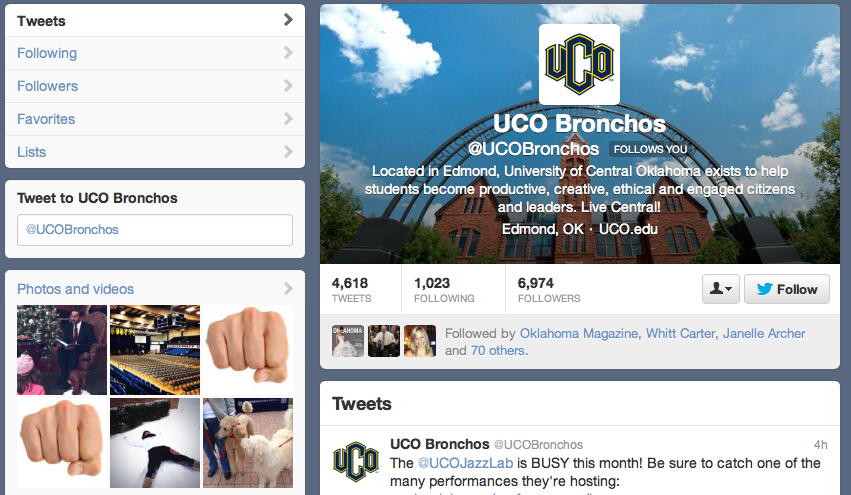
UCO's main twitter page. Others are for athletics, etc.
"We want to be the social media university," said Monica K. Helms in #clarkclass, twitter for journalists, today. As social media and web marketing director for UCO, she  and Adrienne Nobles, assistant vice-president in University Relations, brought the class a corporate view of twitter and social media, rounding out this sessions' series of speakers.
Their professionalism and advice about branding UCO and serving students resonated as they talked about problems and successes. It added a different and expanded perspective to the varied and changing uses of twitter and social media, in a changing university and student body, compared to earlier speakers. The main account, @UCO Bronchos, serves during weather and other emergencies as well in helping new students and others feel part of a "UCO family."
I and the students appreciated the humanity and practicality of these two serving UCO. And afterwards, several followed @UCO Bronchos.
So here are the debriefing comments and summary of their comments, mentioned by my  students, recorded by student @JenniferHesel.

  • Be adaptable; be ready to learn; communication is the same basic concept but social media offers new tools
  • Hash tagging UCO acceptance letters is such a smart idea
  • Tips for applying twitter to your job
  • Connecting with students, giving a personality to UCO and being helpful at the same time; nice to know there are people working at UCO that will have a conversation with you
  • Very different from other speakers from the standpoint that they offered ways to use twitter in a corporate environment  and how it should be used when representing your employer
  • “We put the H in Bronchos.”
  • It was nice to see who manages Twitter on campus; a face behind the Twitter account
  • For someone who works in housing/dining, was nice to see the other viewpoint about the management of our social media sites
  • It was interesting to see how they handle fake UCO related Twitter accounts and good to know they manage them in a responsible way
  • As a communicator you need to be adaptable
  • Learning is lifelong
  • It takes skills to successfully manage social media; UCO knows how to use and manage it properly
  • Reasons or purpose in having social media should be considered when beginning a UCO social media site
  • It’s not just about content; it’s about conversations
  • Like the rebranding idea of adding pictures from students to keep it fresh
  • UCO communicates with students using Twitter to stay connected
  • Like the silly posts; nice to know it’s not just a robot at the other end responding to tweets; that it is very human and personable
  • Keep your business your business!  It’s always out there for people to see when you post something
  • You can influence your followers in a positive or negative way
  • “It only takes one match to light a fire.”
  • The benefits of social media far outweigh the potential liability
  • Make social media a part of your integrated marketing plan
  • We can count on communication in general to evolve
  • “What you post has to be authentic.”
  • The way people feel about social media will dictate where it goes
That's all for this session, folks. @Okieprof, #clarkclass

Wednesday, May 21, 2014

UCO, twitter and tomorrow, in #clarkclass

Two UCO speakers tomorrow will close out this session of speakers for #clarkclass, Twitter for Journalists, people who work to make this place a "social media university." 
When I started this class, I had no idea
where it was going, and it continues to evolve, to change, with the times, with twitter, with the needs of my students.
What has astounded me most is how relevant twitter seems to them all, and what an abundance of great resources and people there are to help us all learn. 
Tomorrow, we'll hear about the "corporate" use of twitter, essential for an institution, from Assistant Vice-President in University Relations, Adrienne Nobles, and Social Media  and Web Marketing Director, Monica K. Helms. 
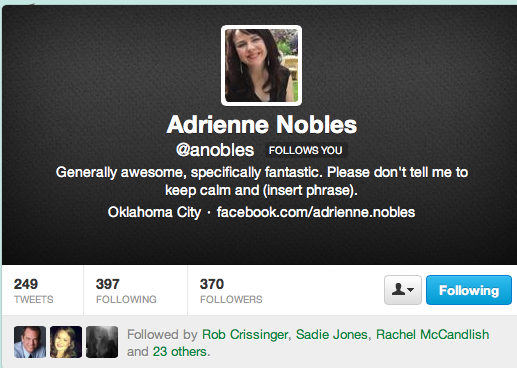
What impresses me most about these two "with it" women is that they're highly professional, and yet maintain their individuality on their twitter pages. Adrienne's "Generally awesome, specifically fantastic. Please don't tell me to keep calm." Monica's "Making awkward situations even more so since 1987...with an itchy twitter finger." Their advice to students and perspective on twitter's importance in all professions and fields is invaluable.

Wednesday, May 14, 2014

Twitter mania in #clarkclass--today's speaker

Mike Sherman, sports editor of The Oklahoman, returns to speak to #clarkclass, twitter for journalists, today. He brings enthusiasm, professionalism, a positive outlook on media, lots of sports experience and ideas, and honesty with a big smile and forthrightness. He's also a UCO grad.

If you're trying to follow #clarkclass, or want a taste of it, here are the links to today's reading/discussion assignments for the class, or you can just search #clarkclass on twitter.

1. What Journalists need to know:
https://twitter.com/Poynter/status/465987223913914369/photo/1

2. Social media and your career:
http://blogs.wsj.com/experts/2014/05/12/how-to-use-social-media-to-advance-your-career/?mod=e2tw

3. "Twibel"--libel: 
 http://www.poynter.org/latest-news/top-stories/235728/how-courtney-love-and-u-s-s-first-twitter-libel-trial-could-impact-journalists/

4. Twitter rules:
 https://support.twitter.com/groups/56-policies-violations/topics/236-twitter-rules-policies/articles/18311-the-twitter-rules#

5. What's trending
@trendinaliaOKC


Wednesday, March 26, 2014

"Watercolour," Brit artists and social media

British influence in  "colour," trial watercolor, 8 by 6, 140 # d'Arches
Today's painting above has an international story with it, thanks to "social media." Notice I spelled "colour" the British way, for a reason.
Social media has made the world much smaller and more fruitful as I've met and contacted new people and old.
Thus it is that recently, someone in the UK favorited one of my paintings earlier this month on twitter, and we've begun following each other.
We have much in common. He's Ian McKendrick from Cambridge, U.K., and he's a watercolour artist and student, in addition to being a social media guru for business...fitting in with what I teach in journalism these days. His web site Ian McKendrick for his watercolours is really sophisticated. I'm envious and have been prodded to develop my own site, separate from this blog. 
I've noticed that his favoriting of my paintings added much to my blog traffic, and I've also favorited his paintings. 
He showed a painting, he calls them "projects," from another Brit painter's book, and so I ordered three of the books. One of them arrived today, and inspired this experimental painting.
What I gained most from the book "Landscapes in Watercolour" was new combinations of "colours." Oh, here's the link to this painters page, and his name is Ray Campbell Smith.
I do notice that much of his work has much more atmosphere and moisture in the air than we have here in Oklahoma, and certainly in my beloved West, where the landscapes are more dramatic. In addition, I've been experimenting more and more with brilliant color, but still I think anyone who is painting in watercolour is always a student, always learning. Thus this painting today.
And here too is Ian's web page as a Social media guru. His twitter handle is @watercolourJrny.
I hope to meet him in person when we travel to the UK this summer, but in the mean time, we'll certainly be sharing more and more. Now if this were really "British style," the comma would be outside those quote marks and in the following. I love the spelling of "watercolor," but though a direct descendant of King Edward Longshanks , the tyrant in "Braveheart," (ironically now married to a Campbell), I'm firmly an American (not a Yankee though) journalist, and periods and commas always go outside quote marks--over here in the "colonies."
Isn't it great the stories behind paintings? So much to learn.

Tuesday, January 7, 2014

twittering at UCO-a social media university


@okieprof #clarkclass

Twitter for journalists class  is back in session, and our guest professionals today were Adrienne Nobles, assistant vice-president in University Relations, and Monica Helms, social media and web marketing director.
They spoke about UCO's use of "social media," offered advice and answered questions from my students.
Subjects included everything from law and ethics to common sense advice. Both with-it women are stars in UCO's modern approach to education. Adrienne is like me--more a viewer of twitter than a user, but seasoned with experience in media and public relations. Monica is an unending source of quotes.

They also have their own twitter accounts, and know that they always represent UCO, even when it's personal.
After they left, we conducted our debriefing. Each student offered at least one insight learned. As we've done with three previous speakers in earlier blog posts, and in the next three the rest of this week, here's a summary.  You can see more comments by searching @okieprof #clarkclass. Here's what was mentioned, dutifully recorded by my student Lacey Rhodes, @laceymrhodes.

  • “There is freedom of speech but not freedom from consequence.”
  • Don’t be afraid to tweet your passions.
  • “It only takes one match to burn down the house.”
  • Monica plans out her tweets, seasonally and around activities.
  • It’s not the things that are relevant it’s us that has to stay relevant to those things.
  • Sometimes we have to bite our tongue.
  • A healthy sense of paranoia is probably a good thing.
  • Commit yourself to life-long learning.
  • Know what your peers are doing. 
  • Be relatable and approachable.
  • Act on the idea that the “internet is forever”
  • Always pretend you are on the clock. You still represent your employer.
  • UCO needs to be the social media university.
  • Don’t be shy but yet approachable.
  • Make connections with people you don’t necessarily follow.
  • You always represent your employer.
  • Main goal: get others to share your content.
  • Build relationships in your community.
  • Be able to adapt to the different stories of the different people.
  • The bad weather was communicated through social media.
  • You should always be learning even when you are out of school.
  • Every once in a while you should do a google search of yourself. 


Thursday, December 19, 2013

Twittering star and former student

@clarkclass #clarkclass
Speaker to my Twitter for Journalists class today was Sheri Guyse, @MyJRNY, marketing director for Good Egg Dining, and so much more. We watched Good Egg's video, and referred to Sheri's Blog, Really Most Sincerely, ahead of time.
"This class  so transcends twitter, it's about life" 
The class got the ultimate compliment, in my book, from one student after Sheri left today. he said "This class so transcends twitter, it's about life." 
So what did she talk about? Her journey, personally and professionally. About the booming cultural life in Oklahoma City. About travel. About food. About music. About the avant garde way Good Egg uses twitter and social media to open new restaurants and in daily operation, advertising, PR and marketing.
In our debriefing after she left, several students mentioned how much she inspired them with her off the cuff remarks, honesty and advice about twitter and more. I am so fortunate to have so many great former students.
You can see some of the students tweets during her comments at @okieprof, search #clarkclass.
Here are some student comments during our debriefing, notes take by Lacey Rhodes.

    •    Be a good person, and keep the content clean.
    •    There is nothing at all that you cannot do.
    •    Keep your relationship statuses offline.
    •    “Fear is this weird thing that our brain does that serves absolutely no purpose.”
    •    Use twitter to tell a story
    •    Both speakers we’ve had said to be a good speaker and always keep learning.
    •    Be curious about things outside the box.
    •    Create a personal relationship with your customers or the people who follow you, follow them!
    •    Don’t wait around for the job to be posted but sometimes create your own!
    •    Don’t stay in the digital; there is life happening too.
    •    There is no such thing as a work-life balance because your work is your life. Have a passion for your work.
    •    She would only hire a friend or an intern that she knew on twitter. Align yourself with people that will help you strategically.
    •    It’s not all strategic but sometimes it happens accidentally.
    •    Take advantage of all the classes you can take while you are in school.
    •    Be well-rounded. It really helps you in this field. You can do journalism, advertising and all of it.
    •    Be inquisitive and ask for help when you need it.
    •    Don’t settle for being average.
    •    “Twitter is a drug of choice”
    •    “Live in the flow and then people will fall into your stream."
    •    She created her own position so she has full control of her job now.
    •    She encouraged us to do anything we want. Failure isn’t bad for you. It is a step towards success.
    •    If there is something you don’t like, then don’t do it. If you really hate your job then quit. Move on to something better.
    •    Fear is a weird trick our brain tries to play, we need to ignore fear because it is useless.
    •    Her attention span is dwindling because of social media.


My favorite quotes:
  • "Take the classes you want to take."
  • "Fear serves no purpose."
  • "The holy gospel of social media is that you have to always want to learn."
  • "Read fiction. The storytelling will help you."

Monday, August 19, 2013

The 24th UCO autumn of change

So much has changed. 
It's my 24th autumn at UCO.  Parking lots are crammed and students crowd the sidewalks, visiting and  heading to and from classes.
Most of these students weren't even alive when I started work here, and the freshmen were born in 1995.
Venturing across campus, listening to music blaring, letting the energy of hope and youth sink in, I'm amazed at the changes.
The students all have mobile phones, iPods and most have laptop computers, non-existent when I started. They nonchalantly carry backpacks and water bottles with them. There are many more now, about 17,000, and there are many more languages spoken on campus as international students have also increased.
They walk on neat sidewalks across a manicured campus where gravel parking lots once lapped up to buildings.  In 1990, there was little Internet, email was new and strange, and there were only a few computers on campus. 
Media has changed. The student newspaper, The Vista was in its prime, and broadcast was in another department. Today they've merged and are dominated by online news, using new inventions never imagined then--Facebook Twitter, Instagram and You Tube.
Since then Oklahoma survived a terrorist bombing and has been revitalized. America has been attacked and involved in three wars and air travel is excruciating.
My office today is in part of a building that didn't exist then, along with other new buildings dotting the campus. We're still a commuter campus, but there more resident students and a vital campus life, almost non-existent then. The average age of the students has dropped from upper twenties to lower twenties, as more and more fresh high school graduates arrive. 
Then I was old enough to be my students' father...now I could be their grandfather. I've worked under four university presidents, four deans, four governors and four U.S. Presidents. I've endured countless meetings, just as more than 3,000 students have endured me.
The first classes I taught were editing and feature writing. Today I teach classes in social media, blogging, international media and writing. My teaching has changed as I grow more tolerant and aware of what's important and not so. I served 19 years as a department chair, had successes and losses, and wish I'd given it up long before then.
    Teaching keeps you young, and aware that you're not--Clark
I've changed too, with less hair, more wrinkles and weight, though I still work with newspapers. I have written and traveled more. My children are up and grown.  I've survived some trials, tragedies and losses, and enjoyed adventures and happiness, losing friends and loved ones, and making new ones, including being blessed with many great students. And of course, eight grandchildren.
But some things haven't changed at UCO, including the energy of the young, especially at the start of the fall semester. Old North, the 1892 iconic building  is still vacant but being renovated, towering over the campus. And the coeds are always attractive.


Tuesday, August 6, 2013

All a-twitter about journalism and more

By @okieprof
(A version of this appeared in the Oklahoma Press Association Publisher last month as part of my monthly column, Clark's Critique.)
“You need a ‘Batman belt’ to be a journalist,” Dave Rhea of the Journal Record, the daily business newspaper,  told my students this year.
Even though the context was my new “Twitter for Journalists” class, he was specifically talking about journalists having a lot of different skills, not just about technology. They need to be versatile, able to get the story out in several ways.
I think that’s true of anyone out looking for a job and career these days.
He describes twitter as part of the “disruptive technology” that has changed almost all industries in the past few years, but none more so than journalism.
Geezers like myself may scoff at twitter and other social media in all areas, and almost everyone overlooks  that journalism has always been a child of technology.  I’ve had to try to educate myself on this new-fangled stuff, especially since working journalists like Dave and others, advised us academics that our students need to be adept at it.
In teaching the class—two weeks of six hours a day, with all sorts of majors in it, I’ve relied on bringing in professionals in all fields, and we have learned much.
I’ll admit, as someone near the end of a career, I don’t need or use twitter much  other than to promote by blog, but I’m convinced  anyone involved in journalism and communication needs to know about it. So what follows are some brief—in keeping with the briefness of twitter—pointers from my speakers.
·       Almost every major news story in the past few years has been broken on twitter.
·       Twitter has become almost a new wire service.
·       It’s especially valuable in local news, if you have a strong list of followers who can keep you updated.
·       It’s a fast way to get news, but you always need to verify
·       Rather than harm writing, it ought to help it, by making you value every word.
·       It’s more a conversation than Facebook. Facebook has a longer “shelf life.”
·       Twitter is the New Age paper boy.
·       Don’t write anything on twitter, or your blog, you wouldn’t want your grandmother to read.
·       There is nothing off the record with a room full of people, and twitter.
·        Media isn’t dying, just the old profit margins.
·       Having 140 characters is no excuse for being incomplete.
·       With twitter you have an entire network of sources to choose from.
·       Someone always knows someone who is the source I need.
·       Twitter works best in breaking news when mainstream media can’t yet assemble all the facts.
·       It can be a living, breathing tip sheet for facts, sources and story ideas.
·       Social media blurs the lines between personal and professional.
·       Twitter is not ruining journalism.
·       It’s still about content.
·       Twitter is like any other tool. Do something useful, and it’s useful.
In addition to Dave @jdavereha, my other guest speakers include Mike Sherman @MikeSherman, sports editor for The Oklahoman; freelancer and former community journalist Heide Brandes @HeideWrite; broadcast veteran and UCO colleague Desiree Hill @dezhill; Good Egg media guru Sheri Guyse @MyJrny; and HR maven Jessica  Merrill @blogging4jobs. Follow us all, if you wish. I’d be glad to reciprocate. Merrill has written a book that is invaluable, Tweet This—twitter for business.
Four more items.
 There are many tutorials on twitter on YouTube if you need advice. I also use Twitter for Dummies.
The Oklahoman’s sports headlines are an example of successful tweeting. Sherman has a huge list of fans who tweet him suggestions for headlines on games. The Oke takes them, edits and revises, but it is reader interaction and citizen journalism at its best.
In advertising and PR, twitter is essential . Guyse noted that the last several restaurants opened by Good Egg spent not one dollar in advertising for successful openings. It was all social media that brought in crowds.
All the speakers said they wouldn’t hire people who couldn’t use twitter professionally.