"When dawn spreads its paintbrush on the plain, spilling purple... ," Sons of the Pioneers theme for TV show "Wagon Train." Dawn on the mythic Santa Fe Trail, New Mexico, looking toward Raton from Cimarron. -- Clarkphoto. A curmudgeon artist's musings melding metaphors and journalism, for readers in more than 150 countries.
Showing posts with label Terrence Miller Clark. Show all posts

Wednesday, July 8, 2020

The colors of a season

"Western Candles," 5 x 7 watercolor, 140 lb Fabriano Artistico extra white cp
"Fall" was today's #WorldWatercolorMonth daily prompt, and the word immediately brings color to me.
To an Easterner and Midwesterner, it probably brings vision of the riot of multi-colored leaves of hardwoods changing as the days get shorter and cooler.
I love those, but as most Westerners, I'll bet the images that comes to mind are  either the lower elevation Cottonwoods, or the quaking high altitude Aspen, every shade of yellow and gold.
Both will "knock your eyes out" with gorgeous, luminous golds, especially against the contrasting, complementary intense blue Western skies.
So here's two paintings today.
Terrence Miller Clark, in the Aspens
Almost every Western artist has attempted painting the Aspen, including me--never to my satisfaction, and a photo of my Dad painting them in oils in Northern New Mexico long ago, hangs in front of me as I type this.
I wondered why we call it "fall," as a synonym for the more elegant word "autumn." Turns out that "autumn" was first used in English in the 1300s, but eventually "fall" came into use 300 years later as poets  used the phrase "the fall of the leaves."
It certainly applies. 
But today, on a whim, I tried again, using just sponges, with a minimum of brushwork. I think it's impossible to capture their real glory on paper, but this was something different, and I undoubtedly will try again.
And for the heck of it...a similar technique for those Eastern hardwoods.
"Hardwood Explosion," 5 x 7 watercolor, 140 lb Fabriano Artistico extra white cp

Tuesday, January 7, 2020

A story of when a dream becomes real

"Te Ata," 5 x 7 watercolor, my first portrait
"I don't do portraits. I'm not that good," I told a student last fall who asked if I'd paint one of  her and her dog.
For some reason in December, in my do-it-yourself art school reading, I thought I'd perhaps try to attempt one, more of a hope or dream.
You have to understand that my brother and I grew up in the home of one of the best portrait artists of all time, our father Terrence Miler Clark.
I've written about his remarkable talent  many times. Our memories of being sketched by him are numerous and we both have several of his portraits hanging in our homes. 
"Sit still," we were often told while posing again. Here are two of those stories and examples of his work:


I wish I had that talent, but don't. It's more in seeing and being able to transfer that onto paper. I've referred and commissioned a pencil portrait from a former student instead. Susan also has the ability in charcoal.
Also understand that entire books have been written about watercolor portraiture (Dad's were usually meticulous colored pencil portraits).
But then yesterday, a friend called and asked me to do a watercolor card of  a Chickasaw.   I hesitated, but said I'd try.
Then he sent me a photo of who he wanted, but in black and white, plus references for color for clothes, feather, jewelry. 
The pressure built because it was Te Ata, renowned Chickasaw actress and storyteller.
First step was trying to select colors especially for skin color, searching the Internet, and getting his approval.
Second was trying to draw the outline and main features of this woman, which took more than one try.
Several steps were thinking about  deciding colors, solving problems of light and shadow, and where to start.
He wanted a red tailed hawk feather and I knew that would be easiest. The most difficult would be the face and especially the eyes. That meant I'd do her eyes last, so the entire portrait could fail at the last. 
Yesterday, I painted the feather, her hair and costume. And stopped.
Today, after much procrastination, I began by erasing most of the drawing lines, or making them very faint. 
Then came the light flesh colors, leaving the eyes white. Then came the shadowing to give the face form. Then came the lips. Then the eyes, and a few final touch ups on shadows.
I learned a lot, and am thankful my friend likes it, and am thankful for the opportunity to push myself. Taking a risk becomes a story of a dream becoming real.
But it's hard work, though when doing this the rest of the world goes away. I found a quote from my Dad recently, that sums it up: "The harder I work at painting, the younger I feel."


Saturday, August 12, 2017

Southwestern sunset, watercolor

Southwestern Sunset, watercolor, 6" by 11.5", 140 lb. d'Arches 
Inspiration, like love, comes you seek it, when you work, most of all, I think, when you need.
Today's watercolor, the first of the month after July's daily challenge, comes on a rainy day, when I knew I needed to paint, for me. After a week of "vacation"--minimal writing, no blogging, no painting, but drinking in love and family and landscapes on a 2,500 mile road trip, it was time. 
Inspiration is internal. I find it many places, including the broad vistas of my beloved Southwest of rich colors and dry air, in travels, in love, and from my father.
I'd found this old pencil sketch of my Dad's, Terrence Miller Clark, done no telling how many years ago, of something he saw in his road trip travels. He saw beauty everywhere, and he could capture that beauty, in landscape, in portraits, with a talent that stuns me. I'm thankful I have a smidgen of his spirit and soul. 
This one's for you, Dad. Thanks. May we one day paint together again.
Pencil sketch, 3" by 9.5"--Terrence Miller Clark

Sunday, June 4, 2017

Great Plains Sunset-1--art school

Great Plains Sunset, 6 by 10, 300 # d'Arches--For Dad
I found a small watercolor of Dad's this past week, on a scrap of paper, done the last year of his life. I didn't get to paint with him enough.
His work inspired this first attempt today. The more I paint, the more I learn, from Terrence Miller Clark's art school.

Tuesday, December 27, 2016

"All aboard" for the journeys

All aboard, 5 by 7 card
Trains have captivated me since I was a little boy. This card, from a previous year for dear friends who are also train loves, captures my desire to go.
The composition isn't original, but based on my Dad's drawing and scratchboard that became our Christmas card almost 60 years ago. 
I was a little boy with Dad when we visited the turntable at Fort Worth long ago, when he did the original drawing (it wasn't winter), and still have it, along with the winter scene (scratchboard is when the artist covers a white board with black and "scratches" out the image--I can't imagine the talent and patience that takes).
I've written about it before on this blog. See the story from last year, also titled "Journeys", the same as today before I even looked back to find it. 
Apparently I'm not the only one who loves trains, because every time I put "All aboard" in a headline, my page hits go way up--notice the list of favorite posts in the sidebar.
The mystery of heading out, traveling, journeying must be the allure of trains.
Fort Worth turntable, 11 by 13  scratchboard, Terrence Miller Clark
Framed, on our wall

Saturday, June 18, 2016

He was not the best father, a father's lament

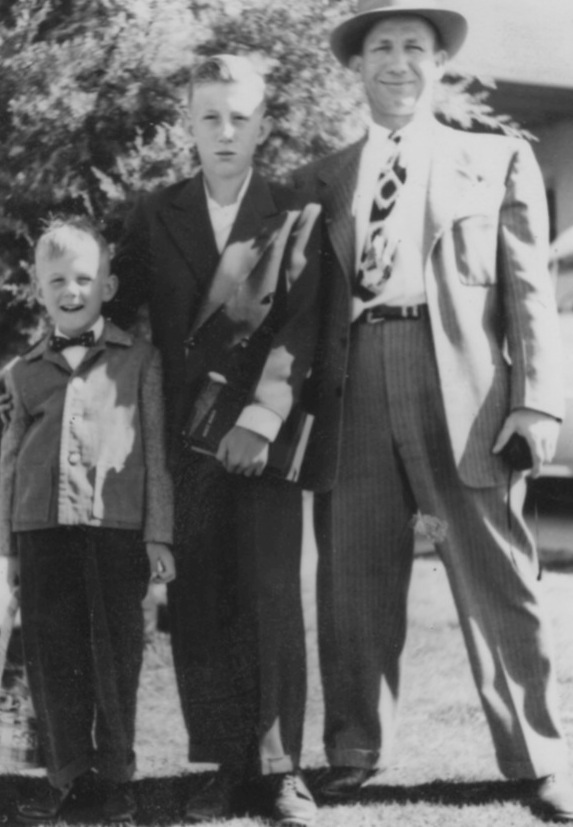
Dad, Jerry and I,  Manzano Mountains, 1950s
But he was the only one I had.
 Neither am I, but I have tried.
Terrence Miller Clark, 1914-1973.
I've written about him a lot, the talented artist with a wooden leg, coming up out of the dirt poor Oklahoma Depression and red clay town of Comanche, Oklahoma, the oldest of five boys, all of whom fled that town to become successes. 
He could draw before he could walk, I think, and I have so many questions I'd like answered. You never asked as a child, and if it weren't for stories from my now late Uncle Mike, I'd know a lot less.
I want to know more about hopping the freight train that cost him his leg in Tucumcari in 1933. I want to know more about his playing football. I want to know more about his art. I want to study art with him. I want to know what his favorite drink was. I want stories of his teen years and 20s. Alas.
He was incredibly talented as an artist, but he had many flaws...an awful temper, an overbearing selfishness, a wandering eye...and more.
Easter Sunday, Albuquerque
I spent a good portion of my life trying not to follow in those steps, but I too have many flaws and failures, but I've really tried to be a good father, providing for my children, being respectable, being loving. I think he had more excuses, or reasons, for his shortcomings than I do mine, but as I get older the genes and art have kicked in and I know I treasure his influence, his life. He had hard-won guts, even speaking out loudly in church in one Sunday sermon, telling a preacher, "You're wrong."
I see so many posts this weekend from wonderful people saluting their fathers, as the best fathers ever. I am touched, and envious, and guilty, I guess. 
Keep posting those photos, keep mentioning those memories. Keep telling your fathers how great they are, regardless of flaws. You are so fortunate. My wife, with parents in their '80's, says it's hard to believe my parents have been so long gone.
I am not the best father...but I am so thankful my children and grandchildren still love me. All these years later, I'm in his debt, even with his many flaws.
My brother Jerry has commented that I should attempt a family history. That stumps me in many ways, but as I looked back at the previous posts on our father on this blog, maybe I've started.
Consider these articles:

My dad had a wooden leg 
Fathers' Day in black and white 
Fathers' day musings 
Pages from beyond death 
Pages from the past 
Ghosts from the past 
A spooky view of the past 
When iris bloom 
Forbidden art from long ago 
Of time and mortality 
Sitting still, portraits in time 
100 years ago and more 


Saturday, August 15, 2015

80 years ago today, America mourned for two Okies

Terrence Miller Clark's masterpiece portrait of Will Rogers
Two of the most famous Oklahomans died today, 80 years ago, when Will Rogers and Wiley Post died in a plane crash at Point Barrow Alaska. 
America mourned, but for Okies the loss was even greater-- they were everyone's heroes, idolized during the tough Depression years. 
The photo Dad used to draw from
We grew up with Will all around us in the Clark household, with books, sketches and our father's masterpiece portrait. My Dad's pencil portrait of Will, which took him a painstaking 14 months to draw when Will was still fresh in that generation's memory, is his best portrait work, showing all the famous people he knew. Damaged over the years, and aging, it hangs in my brother's house in Lubbock. Fortunately we have surviving 12" by 16" rotogravure prints  (About one fourth the size of the original). Dad had them made in the 1950s to try to sell. That didn't work, but they keep showing up in long forgotten friends' and relatives' houses--given as gifts--or even on ebay. One hangs in my office, and we have a few left.
As far as I'm concerned Dad, a relatively unknown poor Okie boy, set the example that Charles Banks Wilson years later followed or whatever for a much less detailed but famous color portrait of Will. You can see for yourself.
The memorial near Wiley Post's grave
And by coincidence, Wiley Post's grave is only about five miles from here in Memorial Park Cemetery on Memorial Road and Kelly.
Here are Dad's portrait, Wiley's grave memorial, and the key to all the people in Dad's portrait.

Wednesday, January 14, 2015

Just a simple signature

Road to Taos, 8" x 10", oil
It's been more than 40 years since the signature of "TMClark" has been applied to an oil painting,
This was my first oil, and when I finally signed it, I had many different feelings.
"I hope Dad likes it." "I wish I could have studied art with him."  "There's so much to learn." "I'm just learning as I'm going, and have no idea what I'm doing." "In a couple of years, I'll consider this crude and be embarrassed by it."
Dad was the real artist. Art was as essential as breathing. He could draw almost before he could walk. For the record, Dad died in December, 1973. His finished and unfinished work hangs in our house and my studio room. He never got a degree, but was always learning. I'm fortunate to have many of his notebooks and books, with his graceful handwriting (something I didn't inherit) to study from.
I'm thus intimidated by oils, having tried  20 years ago, but never pursuing them. I took up watercolor years ago at the prodding of my first wife, Neysa Barnes Clark, because my Dad, Terrence Miller Clark, hadn't done much of it. His work with pencil portraits and oil landscapes dominated. His son, Terry Michael Clark sure won't try portraits, but he's become comfortable with watercolor.
Thanks to the prodding of my wife Susan, and others, I finally ordered oils, and sat down--no stood up, as I always do to paint--through the past week to paint. First order was to find something that spoke to me, not something that others wanted painted. I found a photograph taken when we were heading to Los Alamos a year ago, although digitally altered for contrast and color. 
So I went back to what I know...landscapes, composition, and a passion for New Mexico.
Lots of experimentation here that accomplished artists would laugh at I'm sure. Techniques that are sloppy. Amateur use of color. And so forth. But I finally got to something that is close to my vision, not a recreation of one of my Dad's compositions, or techniques. 
Do I like oils? Not sure. I love the smell of oil paints, but I'm comfortable with watercolor. Oils are harder work, even if they're more forgiving. I'm not comfortable, yet.
When I finally started to sign it, putting that "TMClark" on it brought back more memories and experiences than you can ever know. 
It's just a simple signature. But there's nothing simple about it.

Monday, October 20, 2014

Why I paint

Art...I've been around it all my life, and it seems I've only recently began painting. Glancing back through old black and white photos makes me realize that's not so. 
I remember getting in trouble in grade school in New Mexico for drawing in class rather than paying attention. But it's only natural, growing up in the home of my Dad Terrence Miller Clark, who was an uncanny portrait artist from Oklahoma who could draw anyone and anything, and a landscape painter. His work hung all over our house when we grew up, and my brother and I still have much of it hanging on our walls or in storage.
I still have his old metal paintbox, with some aged oil paints, out in the garage and Susan has been urging me to try oils rather than just watercolors. I suppose that is in the near future. I do so love the smell of oil paint.
But I know I chose watercolors a few years ago because the opportunity arose to take lessons, I needed therapy, and I wasn't in "competition" with my Dad's work.
Still, I'm sorry it took me so long to "come back" to art...getting away from the type-A career-oriented workaholic I was. 
I found this 3" by 4" photo, dated 1947, of me with watercolors at age three and four in Fort Worth, Texas, , painting. And then here's Susan's 4.5" by 6.5" sketch of that. They both hang on the wall in front of me when I paint. 
I guess that's why I paint.


Wednesday, March 28, 2012

Speaking of Geezers


 “Latch on to the old geezers and sop up all you can from them.”
That’s my advice to my journalism students, and anyone else for that matter.
I’ve been fortunate to count five special people who had huge influences on my life and career as a teacher and journalist. What they had in common was a passion for their work, an interest in hard-working younger people, huge amounts of experience in their fields, a desire to keep learning with an eye on the future and change, and no sense of being old.
Every field of work and living has people like these, and I know you can think of some: a seamstress, a cook, an auto mechanic, a mother, a cattleman, a store owner, a piano player, a school teacher. Just by being around them you’d learn about their craft. They would take you under their wings and guide you with wisdom and experience; but they had enough confidence in you to let you try and fail until you found your own wings.
Mentor’s a big buzz word in education right now, but long ago I figured out if I really wanted to learn my craft, I would find these people and “sit at their feet,” as they used to say. But with my mentors, sitting was the last thing you could do--they were busy.


"Latch on to the old geezers..." 
    
My last mentor, Harry Heath of OSU, the dean of Oklahoma journalism, forgot more about journalism than I know. He was the embodiment of the journalist-scholar, with extensive experience in media, and a scholarly attitude to boot. Always thirsty for knowledge, he never quit writing; retirement was not in his vocabulary. From him I learned to love Oklahoma journalism and journalists.
    Before him was my partner in publishing, Donald J. Morrison of the Waurika News-Democrat. He was committed to his town and family newspaper in a way best described as “from the old school.” From him I learned that small weekly newspapers can accomplish great things--like The Corps of Engineers’ Waurika Lake. He gave up a plush public relations job to come back to the small town and run the family paper. He didn’t make as much, but he could say, “I’m my own man.” 
    Callaway Buckley, executive editor of the Duncan (OK) Banner, could chew you out and 15 minutes later praise you, because he was a stickler for serious work. From Cal, a consummate newsman, I learned a passion for timely, accurate news coverage.
Henry Africa didn’t have a degree but was in charge of the University of Iowa Linotype school, a field obsolete even in the early 1960s. Henry knew the past and future--teaching me--a graduate student--more about the entire process of journalism than anyone. I learned not to be wedded to technology--that technology always changes, and content is most important. Do things the right way, and learn to adapt.
Terrence Miller Clark, father and artist. He taught me to see beauty, and to apply its principles in everything I work at. He also , by osmosis really--by being around art and always trying to draw something, prepared me for my current passion, watercolor painting.
They’re all dead, but live on in the lives of others. I’m fortunate to be a disciple of these men. It’s sort of sad to think that I’m getting too old to have any more mentors--the years just sort of slipped by. I keep thinking that some day I’ll be described as such by some students, and, after 20 years in the business and 25 in college teaching, I guess  I am  getting to be an old geezer myself. One  former student already saucily addresses me as, "Hey Geezer."
Despite the fancy talk about mentors these days, there isn’t much practical instruction out there for journalism students or journalists. A tragedy in many newsrooms with high turnover  and staff cutbacks and "early retirements " is that there are few long-term news people with enough crust to help out new reporters. The same is true in higher education, or any field.


"You need 'new blood,' but  'old blood' too."

In every organization  and endeavor , you need new blood, but you need old blood too. Everybody  desperately needs old geezers with rich memories to pass on the wisdom and experience not found in books or employee manuals.
As I look out over the students this semester, I’ll tell them, if they want to be a success, they need to latch onto the old geezers--the more wrinkles they have, the more stories they can tell, the more experience and wisdom they have--they’ve traveled enough miles to become interesting.
I hope they’ll take that advice from this old geezer.


Tuesday, October 5, 2010

Pages from the past

"Comanche vs. Grandfield--a Minute to Play"--8 by 10 by Terrence Miller Clark
Dad was the starting guard on the Comanche Indian football team, "Iron Guard Clark" they called him. You didn't get by him, and since you played both offense and defense in those days, and with little leather helmets and no face masks, you saw lots of hard action. Comanche had a solid football team, and so did its arch rivals Marlow and Grandfield. Today, Grandfield is a ghost of itself, the cotton gin gone, wide streets and stores vacant. Comanche is withering too, has been surpassed by Duncan, 10 miles north. The Sun Refinery is closed at Meridian, and it can no longer compete with more prosperous Marlow, 10 miles north of Duncan, on US 81, paralleling the Rock Island tracks and the old Chisholm Trail.

But not in the '20s and '30s. Dad caught the action. I wonder if he is Number 13? I wonder what  year? I hope my dad's last uncle, Mike, can tell me his number.

Dad played his last football game in the fall of 1931, and graduated in spring of 1932. I have his senior ring. That summer in the Depression, he and a friend Carl Price, rode box cars on the Rock Island line and other trains to Juarez, Mexico to celebrate.

Coming home, they "changed trains" in Tucumcari, N.M., waiting on a Rock Island freight back to Oklahoma. Early one morning, as they were getting ready to jump into an open box car, a railroad employee started talking to Dad. They talked too long, and the train sped up. Dad tried to jump on, slipped, fell under the steel wheels, and lost his right leg below the knee and his left pinkie finger as he pushed himself away.

Iron Guard Clark was no more. But he could still draw, and always did. But not inside the lines or by anyone's rules.

More violent art

Gangsters and trains, and even the Civil War caught my Dad's imagination. I was more enamored with the Civil war than he....this is the only one I know that he did. But imagine, going back to my first post, not being allowed to draw this! It is a record of a time, and an artist and of a family.


They look like Yankees. Mine would have been Confederates.

Oh how I wish I could sit down and talk with Dad about these. Is your father still alive?
Ask them about their lives. don't rely on old photos or drawings.

Forbidden, yellowing war art--part 2

"Seven bullets"--8" by 10" by Terrence Miller Clark, Comanche, Oklahoma, sometime in the 1920s or very early 1930s.

Art reflects the times. Growing up in red-dirt poor Comanche, Oklahoma, Terrence Miller Clark, born in 1914--when Oklahoma was only seven years old as a state. He was the first of five brothers, and could draw before he could walk. He usually got in trouble for his art, but his talent was obvious to everyone in town. Yes, I have some talent, but not the talent of my father. I labor over my work, and for Dad, it was just who he was.


All of these are on thin, yellowing paper, 8" by 10".

Forbidden art from long ago

Death--8" by 10" pencil sketch by Terrence Miller Clark, probably in early high school years at Comanche, Oklahoma
I recently found this collection of my Dad's artwork. But there's more here than a high school student's artist work, probably done in class when he should have been studying. His main topic was WWI., which was fresh in everyone's memory when he was growing up in the 1920s  and early 30s in red dirt Oklahoma.

I learned recently that my dad would not have been able to draw like this in current public schools.   Why?

We were recently having a kitchen sink installed, and I was talking to the 30-something fellow doing the work. I expect that he was conservative, perhaps an evangelical, but we were having a great conversation and he had definite, well-defined opinions on lots of stuff. He told me that he and his wife were home-schooling their children. They live in the Putnam City district. He said they sent their son to first grade, and then pulled him out, for a number of reasons. One reason was that the boy was not allowed to draw pictures, in art class, of any weapons. "Boys draw pictures of swords, knights, fighting," he said. "Nothing wrong with that."

I thought of these pictures of my Dad's. I related this story to a professor colleague of mine who also home-schools her children. She wasn't surprised. She said in Edmond, art classes forced the children to "color inside the lines."

My Dad never colored inside the lines. when I was in first grade, I never did either, and got graded down in later grades for wasting my time drawing pictures of U-boats, and dogfights between Mustangs and Me-109s from WWII. Too often, mine showed the Germans winning, and that didn't sit well in the 1950s.

My Dad and I would never have graduated. All my children got good educations in public schools, in Waurika and Stillwater. But creativity was allowed.
And it still should be. Not politically correct test-oriented rote learning. Oklahoma and America need creativity more than ever, and that means letting students explore, and try, and fail, and if they want to draw pictures of people fighting, let them.We don't need cookie cutter; we need individuals.

So these photos, and the ones following, all 8 x 10 on fragile, yellowing paper and Big-Chief tablet paper, are forbidden today.